Ai Implementation Framework In Manufacturing Process Enabling Smart Manufacturing

Rating:
90%
Ai Implementation Framework In Manufacturing Process Enabling Smart Manufacturing
Slide 1 of 6
Favourites Favourites

Try Before you Buy Download Free Sample Product

Audience Impress Your
Audience
Editable 100%
Editable
Time Save Hours
of Time
The Biggest Sale is ending soon in
0
0
:
0
0
:
0
0
AI-Ready
Upload this template to AI and ask it to make any changes to content or color
100% editable Powerpoint Template for AI-assisted presentations. Finish your work in less time. Download Prompt Kit
Works with
Microsoft PowerPoint
Microsoft 365
Claude for PowerPoint
ChatGPT
Google Slides
Microsoft Copilot
Rating:
90%
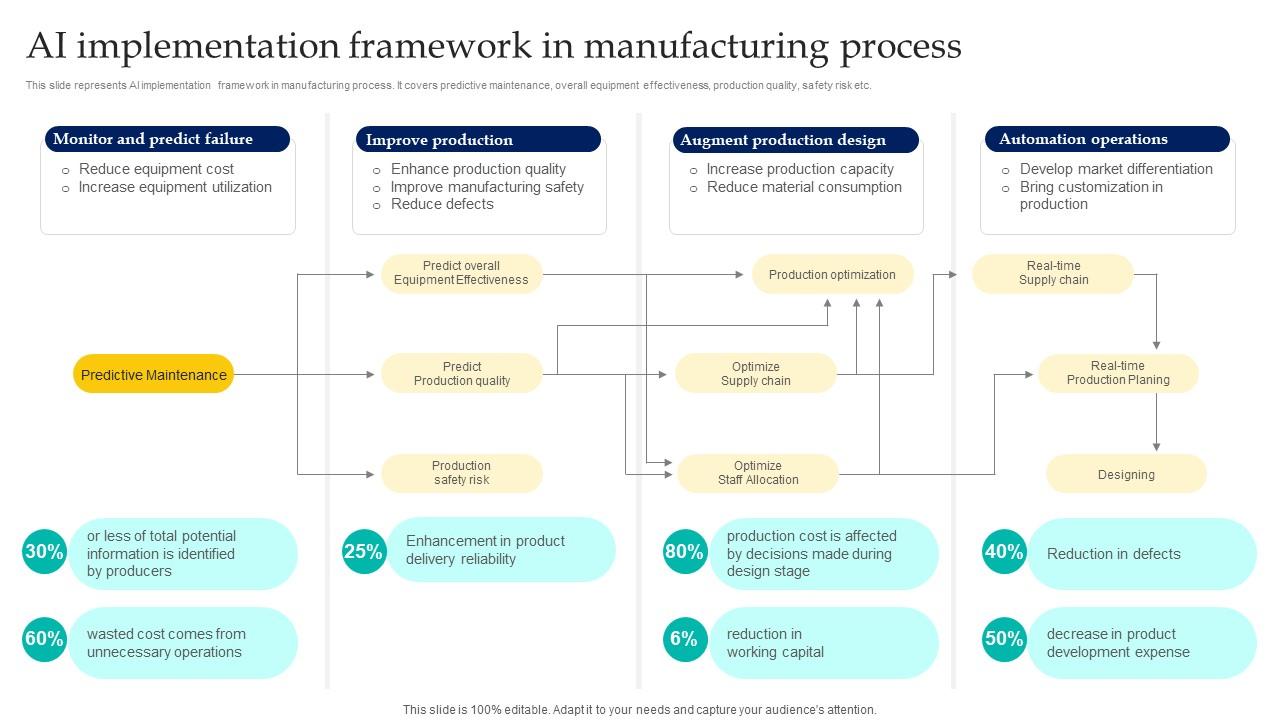
This slide represents AI implementation framework in manufacturing process. It covers predictive maintenance, overall equipment effectiveness, production quality, safety risk etc. Present the topic in a bit more detail with this Ai Implementation Framework In Manufacturing Process Enabling Smart Manufacturing. Use it as a tool for discussion and navigation on Improve Production, Augment Production Design, Automation Operations. This template is free to edit as deemed fit for your organization. Therefore download it now.

FAQs for Ai Implementation Framework In Manufacturing Process

Key components of an AI implementation framework in manufacturing include data infrastructure development, process automation systems, predictive maintenance protocols, quality control integration, and workforce training programs. These components work together by streamlining production workflows, minimizing equipment downtime, and enhancing operational efficiency, with many manufacturing organizations finding that strategic AI integration delivers significant cost reductions and competitive advantages.

Manufacturers can assess AI readiness by evaluating data infrastructure quality, workforce technical capabilities, existing automation systems, budget allocation for technology investments, and leadership commitment to digital transformation. Through comprehensive readiness audits, companies in automotive, electronics, and pharmaceutical sectors streamline implementation timelines, minimize integration risks, and accelerate ROI realization, ultimately delivering competitive manufacturing advantages.

Computer vision, predictive maintenance algorithms, robotic process automation, natural language processing, and machine learning analytics are most beneficial for manufacturing operations. These technologies streamline production by reducing downtime through predictive insights, enhancing quality control through automated inspection, and optimizing supply chains, with many manufacturers finding that strategic AI implementation delivers significant cost reductions and competitive advantages.

AI integration transforms supply chain management by enhancing demand forecasting, optimizing inventory levels, automating procurement decisions, and enabling real-time logistics tracking. Through machine learning algorithms and predictive analytics, manufacturers achieve reduced stockouts, minimized carrying costs, and improved supplier relationships, while automotive and electronics companies report 20-30% efficiency gains and significantly enhanced operational resilience.

Data quality serves as the foundation for successful AI implementation in manufacturing, directly impacting algorithm accuracy, predictive maintenance effectiveness, quality control precision, and operational decision-making reliability. Poor data quality can lead to flawed insights and costly production errors, while high-quality data enables manufacturers to achieve significant improvements in efficiency, reduce downtime, and enhance product quality, ultimately delivering competitive advantage in an increasingly automated manufacturing landscape.

Common challenges during AI implementation in manufacturing include data quality issues, legacy system integration, workforce resistance, insufficient technical expertise, and high initial investment costs. While these obstacles present complexity, many manufacturers find that strategic planning, phased rollouts, and comprehensive employee training enable successful transformations, ultimately delivering enhanced operational efficiency, predictive maintenance capabilities, and competitive advantage in an increasingly automated industrial landscape.

Predictive maintenance leveraging AI improves operational efficiency by analyzing equipment data patterns, predicting failures before they occur, and optimizing maintenance schedules to minimize downtime. Through machine learning algorithms, manufacturers in automotive, aerospace, and heavy machinery sectors reduce unplanned outages by 30-50%, ultimately delivering lower operational costs and enhanced productivity.

Manufacturers should measure AI success through operational efficiency metrics like reduced downtime and faster production cycles, quality improvements including defect reduction rates, cost savings from automated processes, and ROI calculations. These metrics enable companies across automotive, electronics, and pharmaceutical sectors to demonstrate tangible value, with many finding that combining productivity gains with quality enhancements delivers competitive advantage.

Manufacturers can ensure workforce readiness through comprehensive training programs, strategic change management initiatives, cross-functional collaboration opportunities, and gradual technology integration phases. By investing in upskilling current employees, creating AI literacy workshops, and fostering adaptive mindsets, organizations streamline transitions while maintaining productivity, with many finding that early workforce engagement ultimately delivers higher adoption rates and competitive advantage.

Ethical considerations include data privacy protection, algorithmic bias prevention, workforce displacement mitigation, transparency in decision-making processes, and ensuring fair labor practices throughout automation transitions. Manufacturing companies must balance operational efficiency gains with responsible implementation, particularly regarding employee retraining programs and maintaining human oversight in critical production decisions, ultimately delivering sustainable competitive advantage while preserving workforce dignity.

Small manufacturers can leverage AI through cloud-based platforms, pre-built solutions, and strategic partnerships with AI vendors offering scalable, cost-effective implementations. By starting with focused applications like predictive maintenance, quality control, or inventory optimization, these companies can achieve significant operational improvements while building internal capabilities, ultimately delivering competitive advantages typically reserved for larger enterprises.

Toyota's predictive maintenance system reduces equipment downtime by 30%, while Siemens uses AI-powered quality control to detect defects with 99.7% accuracy in production lines. General Electric's digital twin technology optimizes jet engine manufacturing, and BMW leverages computer vision for automated inspection processes, with these implementations delivering significant cost reductions, enhanced operational efficiency, and competitive advantages across global manufacturing operations.

AI enhances quality control by automating defect detection, enabling real-time monitoring, and providing predictive maintenance capabilities through computer vision and machine learning algorithms. Manufacturing companies in automotive, electronics, and pharmaceuticals find that AI-powered systems reduce inspection time by 70%, minimize human error, and catch quality issues before products reach customers, ultimately delivering significant cost savings and improved brand reputation.

Manufacturers can foster AI innovation culture through cross-functional collaboration, comprehensive training programs, pilot project initiatives, leadership commitment, and employee empowerment strategies. These approaches enhance operational efficiency by encouraging experimentation, reducing resistance to change, and building internal expertise, with many manufacturing organizations finding that combining technical training with innovation incentives ultimately delivers competitive advantage and accelerated digital transformation.

Collaboration between IT and operations enhances AI implementation by aligning technical capabilities with operational requirements, ensuring data quality and system integration, and facilitating user adoption across manufacturing processes. Through cross-functional teams, manufacturers streamline deployment timelines, reduce implementation risks, and maximize ROI, with many organizations finding that joint ownership ultimately delivers more effective AI solutions and sustainable operational improvements.

Ratings and Reviews

90% of 100
Review Form
Write a review
Most Relevant Reviews
  1. 80%

    by Charlie Jones

    “You have the structure in place that are easy to explore new opportunities.I will be recommending your services to other people.”
  2. 100%

    by Donald Peters

    Colors used are bright and distinctive.

2 Item(s)

per page: