Un diagramme d'escalier en cinq étapes pour les modèles PowerPoint de croissance d'entreprise

Rating:
80%
An five staged stair diagram for business growth powerpoint templets
Slide 1 of 5
Favourites Favourites

Try Before you Buy Download Free Sample Product

Audience Impress Your
Audience
Editable 100%
Editable
Time Save Hours
of Time
The Biggest Sale is ending soon in
0
0
:
0
0
:
0
0
Rating:
80%

Caractéristiques de ces diapositives de présentation PowerPoint :

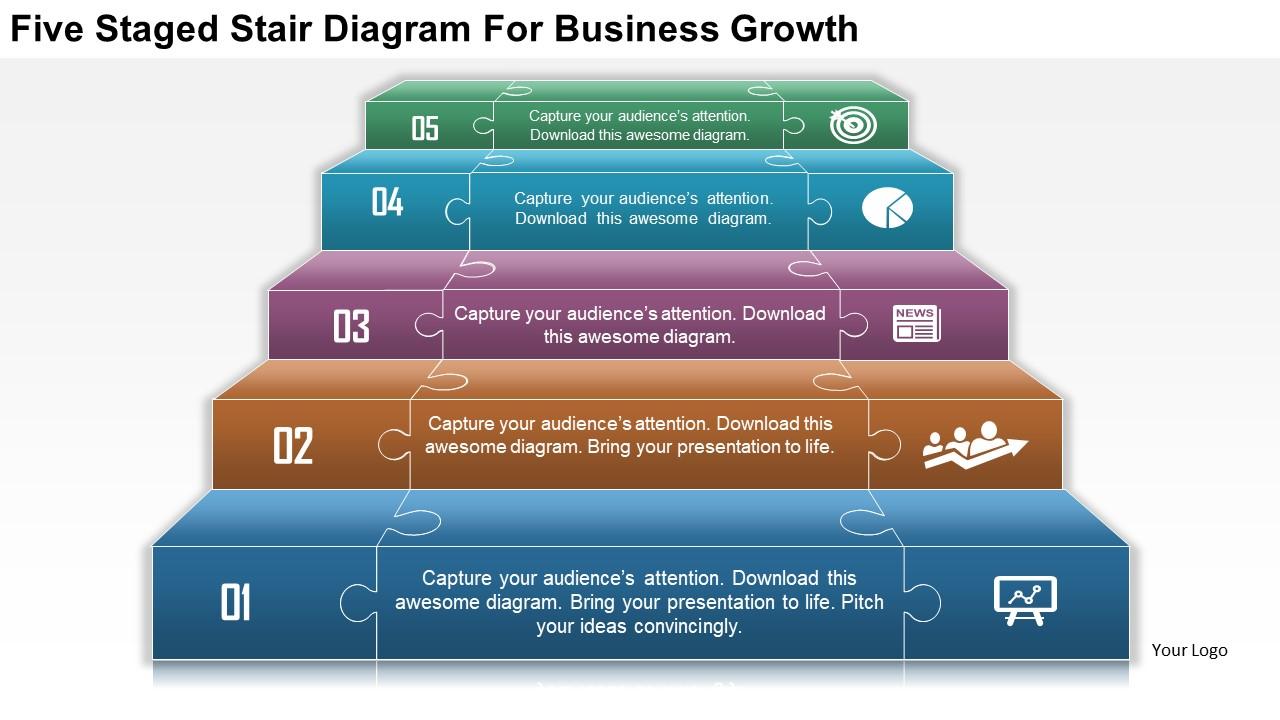
Nous sommes fiers de présenter notre diagramme d'escalier en cinq étapes pour les modèles PowerPoint de croissance d'entreprise. Ce modèle PowerPoint a été conçu avec un graphique de diagramme d'escalier en cinq étapes. Ce PPT contient le concept de croissance d'entreprise. Définissez les sujets liés à la croissance de l'entreprise dans toute présentation.

FAQs for An five staged stair diagram for business

Business growth staircase diagrams typically represent startup, survival, success, takeoff, and resource maturity stages, along with planning, development, market entry, expansion, and optimization phases. These sequential stages help organizations visualize their progression from initial concept through scaling operations, with many companies finding that clearly defined milestones enable better resource allocation and strategic decision-making for sustainable competitive advantage.

A staircase diagram maps startup growth through distinct phases like ideation, validation, scaling, and expansion, clearly showing progression from concept to market leadership. This visual framework enables entrepreneurs to identify current position, anticipate next challenges, and communicate milestones to investors, while demonstrating measurable advancement through funding rounds, revenue targets, and market penetration stages.

Staircase diagrams enhance business presentations by providing clear visual progression, simplifying complex growth processes, highlighting sequential achievements, and demonstrating logical step-by-step development. These visual tools streamline audience comprehension by transforming abstract business concepts into tangible pathways, with many organizations finding that structured visual storytelling significantly improves stakeholder engagement and strategic buy-in.

Businesses can identify their current stage by evaluating key performance indicators like revenue growth, market share, operational complexity, and resource requirements against each staircase level. This strategic assessment involves analyzing financial metrics, organizational structure, and competitive positioning, with many companies finding that honest evaluation of their capabilities, challenges, and growth trajectory reveals exactly where they stand and what's needed for advancement.

Key metrics include customer acquisition cost, lifetime value, revenue growth rate, market penetration, operational efficiency ratios, and scalability indicators at foundational levels, progressing to advanced metrics like market share, competitive positioning, and strategic partnerships. These measurements enable organizations to assess performance comprehensively across growth phases, with many companies finding that layered metric frameworks ultimately deliver clearer visibility into expansion opportunities and sustainable competitive advantage.

A staircase diagram helps businesses visualize strategic progression by breaking complex growth objectives into sequential, manageable phases with clear milestones and dependencies. This approach enables organizations to track advancement systematically, allocate resources strategically across development stages, and maintain momentum through structured implementation, with many companies finding that visual roadmaps significantly enhance team alignment and strategic execution.

Common mistakes include overcrowding steps with excessive details, creating unrealistic timelines, neglecting to define clear metrics, skipping stakeholder input phases, and failing to account for market variables. While these diagrams streamline strategic planning across organizations, successful implementation requires balanced specificity, achievable milestones, and regular review cycles, with many companies finding that iterative refinement delivers more accurate growth projections.

Stakeholders can use the staircase diagram to visualize sequential growth milestones, ensuring everyone understands the progression from current state to desired outcomes, with each step representing measurable objectives and resource requirements. This approach enables departments, investors, and leadership teams to synchronize their timelines and contributions, ultimately delivering coordinated execution and shared accountability across the organization's strategic growth journey.

Market research provides essential data-driven insights that define growth staircase progression, including customer needs analysis, competitive positioning, market sizing, demand forecasting, and risk assessment. Through comprehensive research methodologies, organizations systematically validate each growth phase before implementation, ensuring strategic decisions align with market realities, ultimately delivering reduced investment risks and accelerated scaling success.

A staircase diagram illustrates business scaling by showing progressive stages from startup through mature operations, with each step representing key milestones like revenue targets, team expansion, market penetration, and operational complexity. This visual framework helps entrepreneurs understand sequential growth phases, identify current positioning, and plan strategic transitions, with many scaling businesses finding that structured progression reduces risks while maximizing sustainable expansion opportunities.

Visual elements that enhance business growth staircase diagram clarity include color-coded progression stages, directional arrows, milestone markers, performance metrics labels, and consistent typography hierarchy. These design components streamline complex growth trajectories by distinguishing phases, emphasizing upward momentum, and highlighting key benchmarks, with many organizations finding that strategic visual consistency ultimately delivers improved stakeholder comprehension and faster strategic alignment.

Businesses can update their staircase diagrams by regularly reviewing milestones, adjusting timelines based on market conditions, incorporating new growth opportunities, and refining success metrics. Through quarterly assessments, companies in retail, technology, and financial services streamline their strategic planning, enhance operational efficiency, and maintain competitive advantage, ultimately delivering clearer roadmaps and faster decision-making processes.

Successful businesses exemplifying growth staircase steps include Tesla's startup innovation, Amazon's scaling through diversification, Apple's market leadership through ecosystem integration, and Microsoft's transformation into cloud services dominance. These companies demonstrate strategic progression by adapting business models, expanding market reach, leveraging technology advancement, and maintaining competitive advantage, ultimately delivering sustained growth across multiple industries and customer segments.

A staircase diagram facilitates team communication by visually breaking down complex growth goals into clear, sequential milestones that everyone can understand and track progress against. This structured approach enables teams to align on priorities, identify dependencies between growth phases, and celebrate incremental achievements, while ensuring transparent discussions about resource allocation, timeline expectations, and individual responsibilities throughout the growth journey.

**INPUT**: What tools or software are recommended for creating effective staircase diagrams for business growth? **OUTPUT**: Recommended tools include PowerPoint, Visio, Lucidchart, Canva, and specialized presentation platforms like SlideTeam, which offer pre-designed templates for strategic visualization. These platforms streamline diagram creation through intuitive interfaces, collaborative features, and professional templates, enabling organizations across consulting, finance, and retail sectors to communicate growth strategies effectively, ultimately delivering clearer stakeholder presentations and enhanced strategic alignment.

Ratings and Reviews

80% of 100
Review Form
Write a review
Most Relevant Reviews
  1. 80%

    by John Walker

    Thanks for all your great templates they have saved me lots of time and accelerate my presentations. Great product, keep them up!
  2. 80%

    by Thomas Garcia

    Very well designed and informative templates.

2 Item(s)

per page: