


Analyzing price optimization in company powerpoint presentation slides
Price optimization is the process of using consumer and industry data to determine the most appropriate price point for your product or service to increase revenue or profits. The optimum price point is when businesses will achieve their goals, whether those goals be improved profit margins, consumer growth, or a combination of the two. Here is a professionally designed template on Analyzing Price Optimization In Company that focuses the clients attention on current issues faced by the company, reasons of customer attrition, impact on customers, and company due to poor product pricing strategy. We have outlined the need for price optimization and challenges and solutions for setting prices. In this PowerPoint presentation, we have focused on different pricing strategies such as cost plus, penetration, skimming, competition based, value based, psychological, premium, and choosing the best pricing strategy model for the company. We have also covered the product pricing strategies in B2B and B2C business, inputs to determine prices, models for developing pricing strategies, optimizing pricing, the impact of implementing price optimization in business, and different dashboards. Book a free demo with our influential research and expert team. Get access to the template and download it now.






























-

- Google Slides is a new FREE Presentation software from Google.
- All our content is 100% compatible with Google Slides.
- Just download our designs, and upload them to Google Slides and they will work automatically.
- Amaze your audience with SlideTeam and Google Slides.
-

Want Changes to This PPT Slide? Check out our Presentation Design Services
-

- WideScreen Aspect ratio is becoming a very popular format. When you download this product, the downloaded ZIP will contain this product in both standard and widescreen format.
-

- Some older products that we have may only be in standard format, but they can easily be converted to widescreen.
- To do this, please open the SlideTeam product in Powerpoint, and go to
- Design ( On the top bar) -> Page Setup -> and select "On-screen Show (16:9)” in the drop down for "Slides Sized for".
- The slide or theme will change to widescreen, and all graphics will adjust automatically. You can similarly convert our content to any other desired screen aspect ratio.
Compatible With Google Slides

Get This In WideScreen
You must be logged in to download this presentation.


Do you want to remove this product from your favourites?
PowerPoint presentation slides
Deliver this complete deck to your team members and other collaborators. Encompassed with stylized slides presenting various concepts, this Analyzing Price Optimization In Company Powerpoint Presentation Slides is the best tool you can utilize. Personalize its content and graphics to make it unique and thought provoking. All the fifty eight slides are editable and modifiable, so feel free to adjust them to your business setting. The font, color, and other components also come in an editable format making this PPT design the best choice for your next presentation. So, download now.

People who downloaded this PowerPoint presentation also viewed the following :
Content of this Powerpoint Presentation
Slide 1: This slide displays the title i.e. 'Analyzing Price Optimization in Company' and your Company Name.
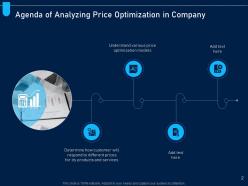
Slide 2: This slide presents the agenda for the project.
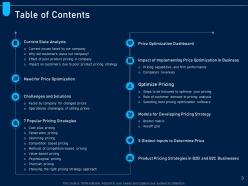
Slide 3: This slide presents the table of contents for the project.
Slide 4: This slide exhibits the title for current state analysis.
Slide 5: This slide covers current issues faced by the company such as inappropriate pricing strategy, failure to anticipate price demand curve, discounting & sale pricing, etc.
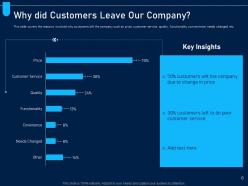
Slide 6: This slide covers the reasons involved why customers left the company such as price, customer service, quality, functionality, convenience, needs changed, etc.
Slide 7: This slide covers the effect of poor product pricing within the company such as revenues, customer churn, product cost, goodwill, productivity, profits, etc.
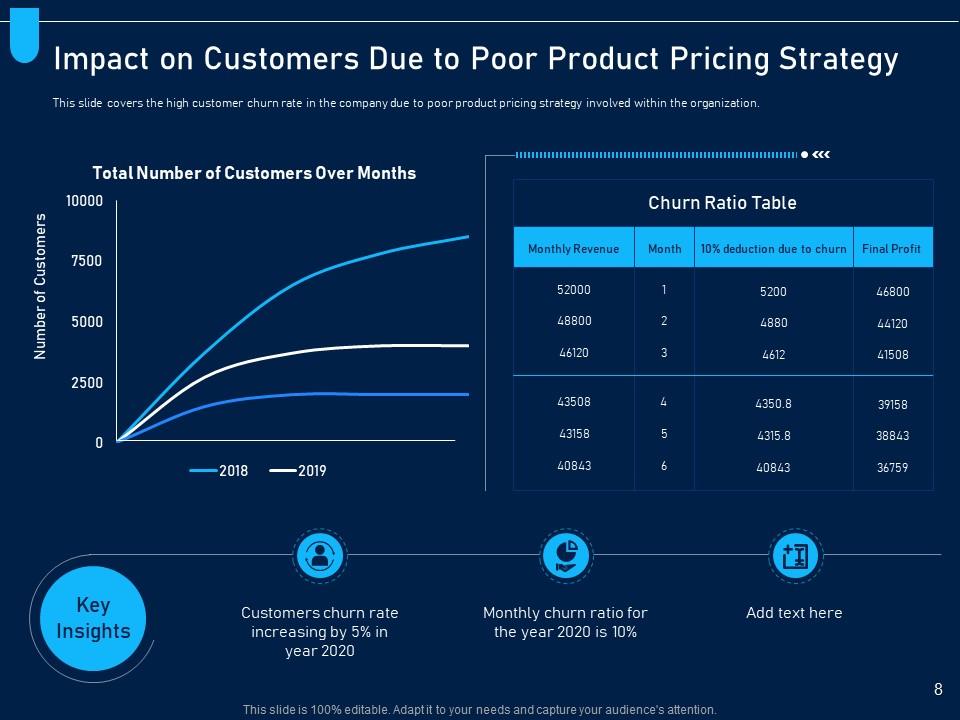
Slide 8: This slide covers the high customer churn rate in the company due to poor product pricing strategy involved within the organization.
Slide 9: This slide showcases the title for need for prize optimization.
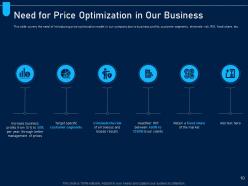
Slide 10: This slide covers the need of introducing price optimization model in our company due to business profits, customer segments, eliminate risk, ROI, fixed share, etc.
Slide 11: This slide displays the title for challenges & solutions.
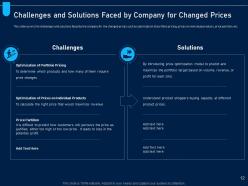
Slide 12: This slide covers the challenges and solutions faced by the company for the changed prices such as optimization of portfolio pricing, price partition, etc.
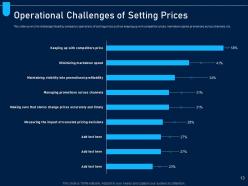
Slide 13: This slide covers the challenges faced by company’s operations of setting prices such as keeping up with competitor prices, markdown spend, etc.
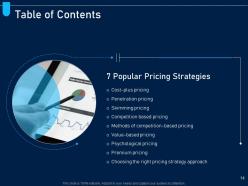
Slide 14: This slide presents the title for 7 popular pricing strategies.
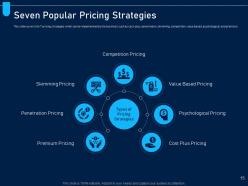
Slide 15: This slide covers the 7 pricing strategies which can be implemented by the business such as cost-plus, value based, psychological, and premium, etc.
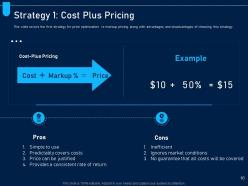
Slide 16: This slide covers the first strategy for price optimization i.e markup pricing along with advantages and disadvantages of choosing this strategy.
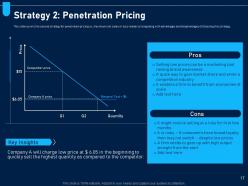
Slide 17: This slide covers second strategy for penetration pricing i.e., maximum unit sales or loss-leader pricing with advantages and disadvantages of choosing this strategy.
Slide 18: This slide covers the third strategy for skimming pricing along with advantages and disadvantages of choosing this strategy.
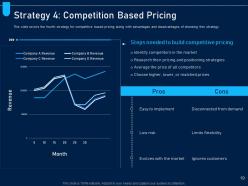
Slide 19: This slide covers the fourth strategy for competitive based pricing along with advantages and disadvantages of choosing this strategy.
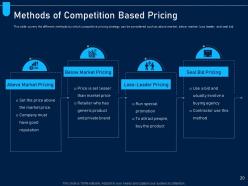
Slide 20: This slide covers the different methods by which competitive pricing strategy can be considered such as above market, below market, loss leader, and seal bid.
Slide 21: This slide covers the fifth strategy for value-based pricing along with advantages and disadvantages of choosing this strategy.
Slide 22: This slide covers the sixth strategy for psychological pricing along with advantages and disadvantages of choosing this strategy.
Slide 23: This slide covers seventh strategy for premium pricing also known as image pricing or prestige pricing along advantages and disadvantages of choosing this strategy.
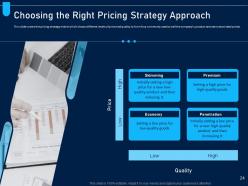
Slide 24: This slide covers the pricing strategy matrix which shows different levels of price and quality.
Slide 25: This slide displays the title for product pricing strategies in B2B & B2C businesses.
Slide 26: This slide covers the different types of pricing models which can be used in B2B and B2C businesses to grow company’s profits.
Slide 27: This slide presents the title for 5 distinct inputs to determine price.
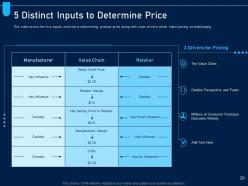
Slide 28: This slide covers the five inputs involved in determining product price along with main drivers which make pricing so challenging.
Slide 29: This slide exhibits the title for models for developing pricing strategy.
Slide 30: This slide covers the Boston consultancy group matrix which focuses on star, question mark, cash flow, and dog to evaluate market pricing strategy.
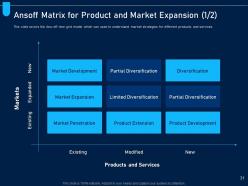
Slide 31: This slide covers the Ans-off nine grid model which can used to understand market strategies for different products and services.
Slide 32: This slide covers the Ans-off grid model which can used to understand market strategies for different products and services.
Slide 33: This slide displays the title for optimize pricing.
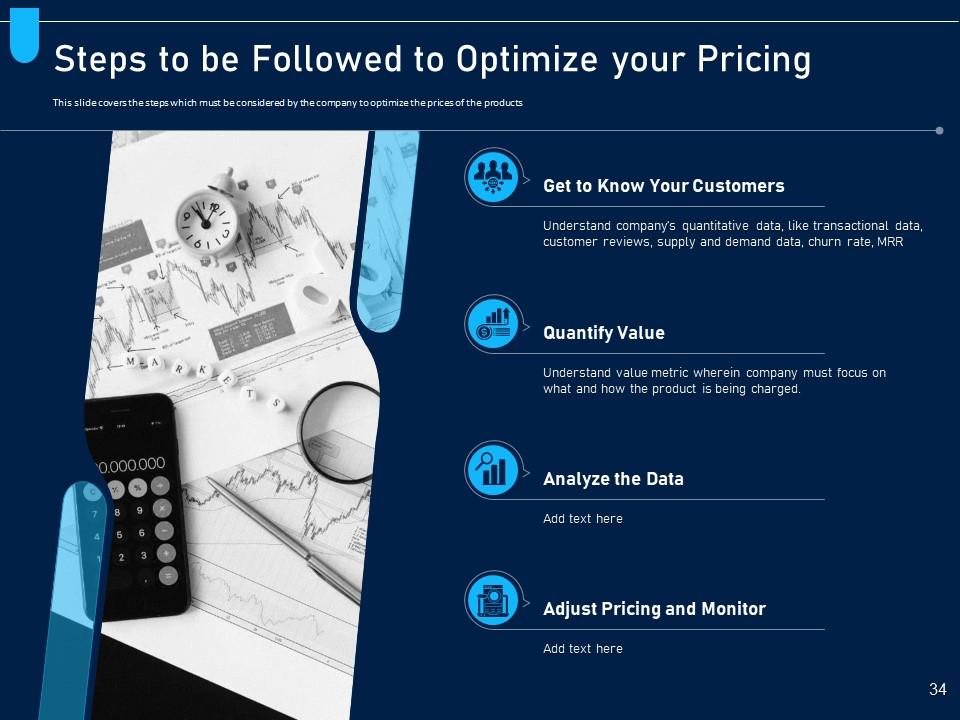
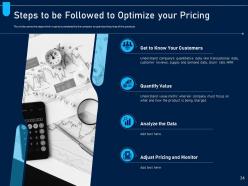
Slide 34: This slide covers the steps which must be considered by the company to optimize the prices of the products.
Slide 35: This slide covers the relationship between price and other factors such as customer demand, sales revenues, product costs, gross profits, and product positioning.
Slide 36: This slide covers the different price optimization software along with their features and prices and company will choose the best one for its use.
Slide 37: This slide presents the title for impact of implementing prize optimization in business.
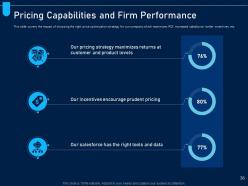
Slide 38: This slide covers the impact of choosing the right price optimization strategy for our company which maximizes ROI, increased salesforce, better incentives, etc.
Slide 39: This slide covers the impact of choosing the right price optimization strategy for our company which increases company’s sales and profits.
Slide 40: This slide displays the title for prize optimization dashboard.
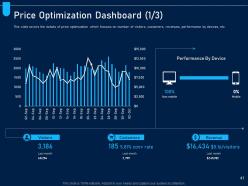
Slide 41: This slide covers the details of price optimization which focuses on number of visitors, customers, revenues, performance by devices, etc.
Slide 42: This slide covers the details of price optimization which focuses on price changes, leader, distribution, and benchmark.
Slide 43: This slide covers the details of price optimization which focuses on price changes, leader, distribution, and benchmark.
Slide 44: This is the icons slide for the project.
Slide 45: This slide depicts the title for additional slides.
Slide 46: This slide presents the hours spent by company to evaluate pricing strategy.
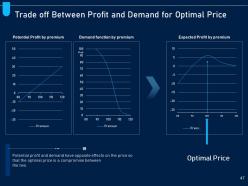
Slide 47: This slide showcases the trade off between profit and demand for optimal price.
Slide 48: This slide presents the graphical presentation of business conversion due to improved pricing strategy.
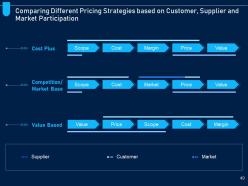
Slide 49: This slide exhibits the comparison between pricing strategies based on customer, supplier and market penetration.
Slide 50: This slide displays the chart for strategical pricing for competitive and customer intelligence.
Slide 51: This slide showcases the vision, mission and goals of the company.
Slide 52: This slide mentions details of team members responsible for the project.
Slide 53: This slide presents about the company, target audience and its client's values.
Slide 54: This slide displays the posts for past feedbacks and experiences of the clients.
Slide 55: This slide exhibits the puzzle related to the company.
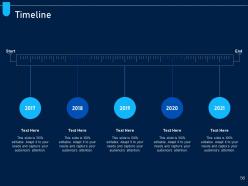
Slide 56: This slide shows the yearly timeline of your company.
Slide 57: This slide presents the goals of your company.
Slide 58: This is the thank you slide and mentions contacts details of the company including phone no., office address, etc.
Analyzing price optimization in company powerpoint presentation slides with all 58 slides:
Use our Analyzing Price Optimization In Company Powerpoint Presentation Slides to effectively help you save your valuable time. They are readymade to fit into any presentation structure.
-
Good research work and creative work done on every template.
-
Content of slide is easy to understand and edit.
-
Excellent design and quick turnaround.
-
Very unique, user-friendly presentation interface.
-
Innovative and attractive designs.
-
Appreciate the research and its presentable format.
-
Professional and unique presentations.
