


Application Security Implementation Plan Powerpoint Presentation Slides




Try Before you Buy Download Free Sample Product
 Impress Your
 Audience
 100%
100% Editable
 Save Hours
 of Time


Explore our Application Security Implementation Plan PowerPoint Presentation, which explains how to implement application security in an organization. It also includes critical challenges, performance analysis, and a project summary of application security. Additionally, this Securing Applications through Encryption PPT demonstrates the various application security approaches, including authorization, authentication, encryption, access control, logging, security testing, etc. This Authentication Template also includes the team structure for implementing application security in IT and the team responsibility assignment matrix for application security. Furthermore, the Implementing Authentication in Application Security Presentation caters to scenarios after implementing application security in organizational networks based on several parameters such as unauthorized access, data breaches, and compliance. Lastly, our Access Control Deck outlines best practices, a checklist, a training budget, a timeline, a roadmap, and the impact of application security. Download our 100 percent editable and customizable template, also compatible with Google Slides.
People who downloaded this PowerPoint presentation also viewed the following :
Content of this Powerpoint Presentation
Slide 1: The slide introduces Application Security Implementation Plan. State Your Company Name and begin.
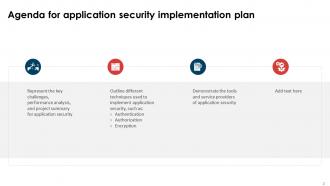
Slide 2: This is an Agenda slide. State your agendas here.
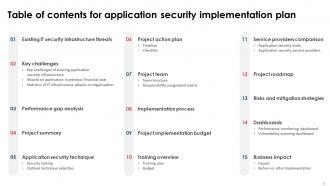
Slide 3: The slide displays Table of contents for the presentation.
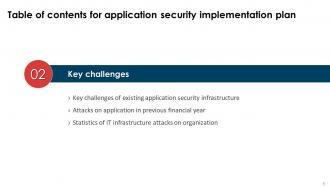
Slide 4: The slide continues Table of contents.
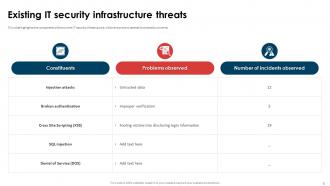
Slide 5: This slide highlights the components of the current IT security infrastructure, which are prone to several functionality concerns.
Slide 6: The slide renders Title of contents further.
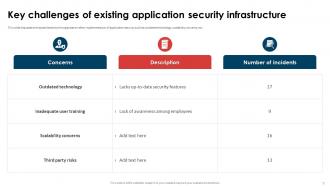
Slide 7: This slide discusses the issues faced by the organization after implementation of application security.
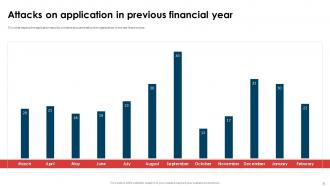
Slide 8: This slide depicts the application security incidents encountered by the organization in the last financial year.
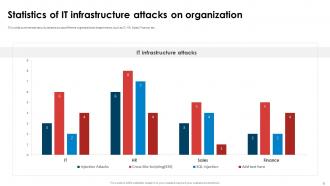
Slide 9: This slide summarizes security attacks across different organizational departments, such as IT, HR, Sales, Finance, etc.
Slide 10: The slide depicts Title of contents which is to be discussed further.
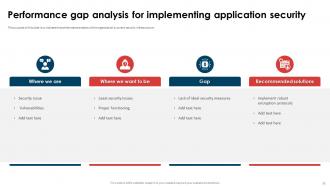
Slide 11: The slide indicates the performance analysis of the organization’s current security infrastructure.
Slide 12: The slide represents Title of contents further.
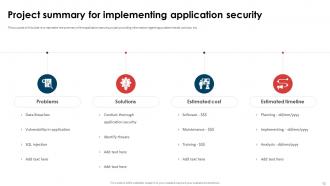
Slide 13: The slide demonstrates the summary of the application security project providing information regarding problems faced, solution, etc.
Slide 14: The slide displays Title of contents further.
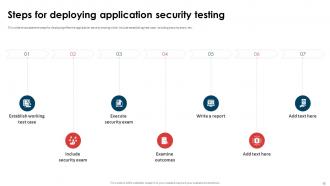
Slide 15: This slide showcases the steps for deploying effective application security testing which include establishing test case, including security exam, etc.
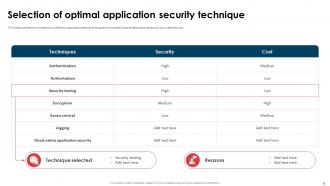
Slide 16: This slide outlines the comparison of different application testing techniques on the basis of parameters such as security provided and cost.
Slide 17: The slide renders Title of contents which is to be discussed further.
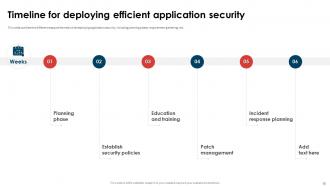
Slide 18: This slide describes the different steps performed while deploying application security, including planning phase, requirement gathering, etc.
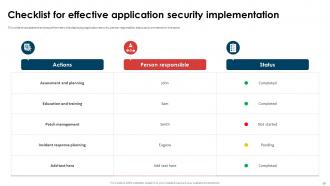
Slide 19: This slide showcases the actions performed while deploying application security, person responsible, status and comments for the same.
Slide 20: The slide renders Title of contents which is to be discussed further.
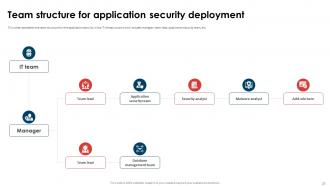
Slide 21: This slide represents the team structure for the application security in the IT infrastructure.
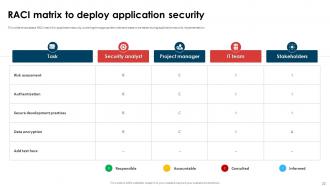
Slide 22: This slide shows a RACI matrix for application security, outlining the appropriate roles and steps to be taken during application security implementation.
Slide 23: The slide again presents Title of contents.
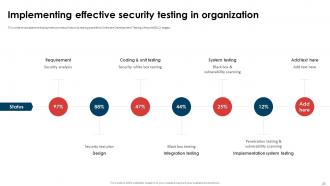
Slide 24: This slide showcases the deployment process of security testing parallel to Software Development Testing Lifecycle(SDLC) stages.
Slide 25: The slide displays Title of contents which is to be discussed further.
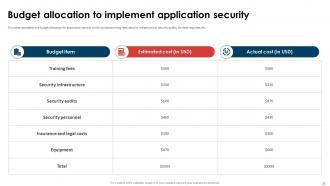
Slide 26: This slide represents the budget allocation for application security which includes training fees, security infrastructure, etc.
Slide 27: The slide displays Title of contents further.
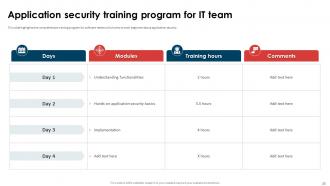
Slide 28: This slide highlights the comprehensive training program for software testers which aims to train beginners about application security.
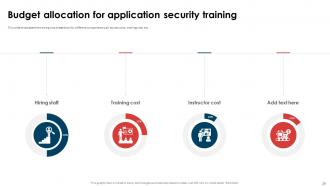
Slide 29: This slide showcases the training cost breakdown for different components such as instructor, training cost, etc.
Slide 30: The slide renders Title of contents further.
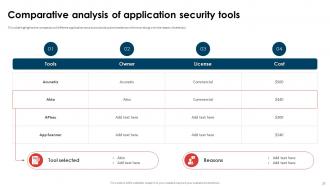
Slide 31: This slide highlights the comparison of different application security tools and optimal selection of the tool along with the reason of selection.
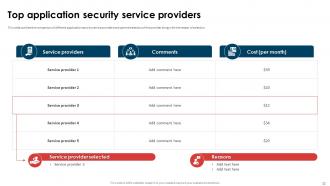
Slide 32: This slide outlines the comparison of different application security service providers and optimal selection of the provider.
Slide 33: The slide represents Title of contents.
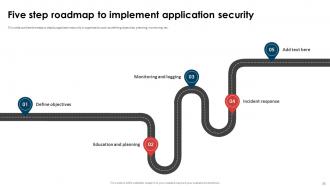
Slide 34: This slide outlines the steps to deploy application security in organization such as defining objectives, planning, monitoring, etc.
Slide 35: The slide displays Title of contents which is to be discussed further.
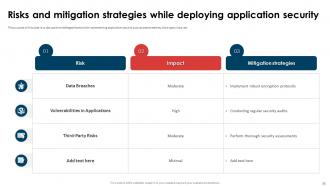
Slide 36: The slide discusses the challenges faced while implementing application security such as data breaches, third-party risks, etc.
Slide 37: The slide again renders Title of contents.
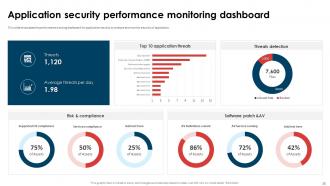
Slide 38: This slide showcases the performance tracking dashboard for application security to analyze and monitor security of application.
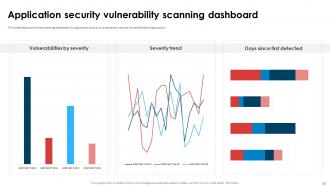
Slide 39: This slide shows the threat scanning dashboard for application security to analyze and monitor vulnerabilities of application.
Slide 40: The slide depicts Title of contents further.
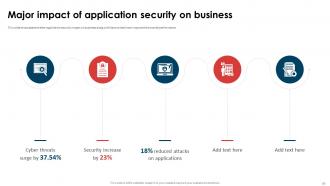
Slide 41: This slide highlights the after application security impact on business along with factors that have improved the overall performance.
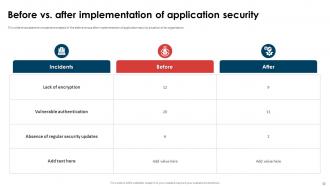
Slide 42: This slide showcases the comparative analysis of the before versus after implementation of application security situation of an organization.
Slide 43: This slide shows all the icons included in the presentation.
Slide 44: This slide is titled as Additional Slides for moving forward.
Slide 45: This slide showcases the steps for deploying effective authentication which include defining requirements, selecting authentication method, etc.
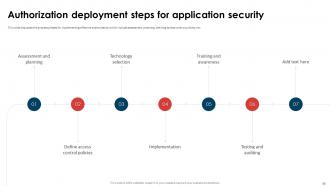
Slide 46: This slide discusses the process phases for implementing effective authorization which include assessment, planning, defining access control policies, etc.
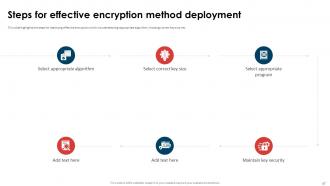
Slide 47: This slide highlights the steps for deploying effective encryption which include selecting appropriate algorithm, choosing correct key size, etc.
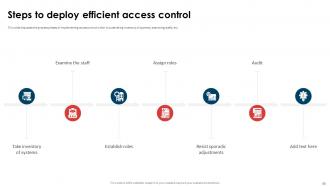
Slide 48: This slide renders the process phases of implementing access control which include taking inventory of systems, examining staffs, etc.
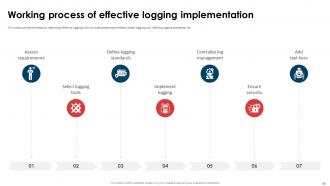
Slide 49: This slide outlines the steps for deploying effective logging which include assess requirements, select logging tool, defining logging standards, etc.
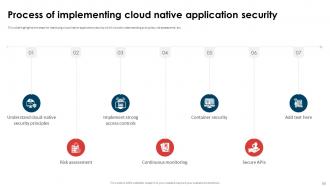
Slide 50: This slide highlights the steps for deploying cloud-native application security which include understanding principles, risk assessment, etc.
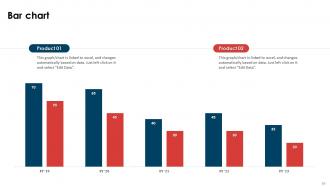
Slide 51: This slide presents Bar chart with two products comparison.
Slide 52: This is a Timeline slide. Show data related to time intervals here.
Slide 53: This slide depicts Venn diagram with text boxes.
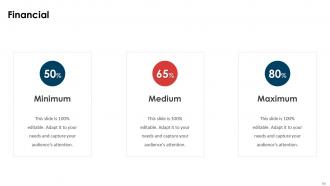
Slide 54: This is a Financial slide. Show your finance related stuff here.
Slide 55: This slide contains Puzzle with related icons and text.
Slide 56: This is Our Goal slide. State your firm's goals here.
Slide 57: This is an Idea Generation slide to state a new idea or highlight information, specifications etc.
Slide 58: This slide provides 30 60 90 Days Plan with text boxes.
Slide 59: This slide shows Post It Notes. Post your important notes here.
Slide 60: This is a Thank You slide with address, contact numbers and email address.
Application Security Implementation Plan Powerpoint Presentation Slides with all 68 slides:
Use our Application Security Implementation Plan Powerpoint Presentation Slides to effectively help you save your valuable time. They are readymade to fit into any presentation structure.











FAQs for Application Security Implementation Plan
So you want five main things: threat modeling (figure out what you're actually protecting against), solid coding standards plus training for your devs, automated security testing baked into your CI/CD pipeline, regular security reviews and pen testing, and a good incident response plan. Honestly, most people screw up the testing piece - can't just slap security on at the end, right? Also make sure someone actually owns this stuff across teams. Oh, and start with threat modeling first since it'll help you figure out where to blow your budget. That foundation makes everything else way easier.
Start with a security audit - gotta see what you're working with first. Run some vulnerability scans on your apps and comb through your code for the usual suspects (SQL injection, XSS, that fun stuff). Check if basic stuff like authentication and encryption are actually there. Your dev process matters too - are you testing security during builds or just crossing your fingers? Document everything you find. The good, the ugly, all of it. Honestly, this part's kind of tedious but it'll show you what needs immediate attention versus what can sit on the backburner.
Think of threat modeling like scoping out what could actually go wrong before you build your defenses. Map out where attackers might hit your app, then figure out which threats would hurt the most. Honestly, most teams just throw security controls everywhere without thinking - total waste of money. Short bursts work better than marathons for this stuff. You'll want to focus your budget on the risks that could actually wreck you, not minor annoyances. Oh, and don't set it and forget it - revisit every few months since new attack vectors pop up constantly.
Start with OWASP - their Top 10 list and ASAMM model are pretty much what everyone uses as the baseline. NIST's Cybersecurity Framework works well for the broader organizational stuff, especially if you're dealing with any government compliance requirements. ISO 27001 is decent but honestly kind of a slog to get through. I'd map your current security setup against OWASP's ASAMM first to spot the obvious gaps. Their testing guide and secure coding practices are really practical for daily use too.
For automation, start with SAST and DAST tools - static analysis catches bugs in your code, dynamic testing hits live apps. SonarQube or Checkmarx are solid for SAST, though honestly any decent vendor works if you're consistent about it. OWASP ZAP handles dynamic scanning pretty well, or Burp Suite if you've got budget. Oh, and don't sleep on dependency scanners like Snyk - they'll flag sketchy third-party libraries. The real trick is hooking everything into your CI/CD so it runs automatically. Way better than scrambling to test security stuff later.
Build security right into your dev pipeline from the start - don't tack it on later, trust me. Automated security testing in CI/CD is a must, plus containerized tools that scale with your apps. Risk-based security decisions beat blanket policies every time (learned this the hard way). Your architecture should play nice with APIs and microservices so you can pivot when new threats pop up. Oh, and get security champions embedded in each team who can make calls without waiting around for approvals - that's been a game changer for us.
Dude, start with threat modeling when you're designing stuff - way easier than fixing security holes later. Get SAST, DAST, and dependency scanning running in your CI/CD pipeline. Code reviews need to cover security too, not just functionality. Honestly, training your devs upfront is clutch - I've seen too many teams scramble because they skipped this step. Set up automated gates so bad code can't reach production. Regular pen testing is a must. Oh, and make security everyone's job, not just something you dump on the security team. They'll thank you for it.
Honestly, the biggest thing is getting everyone to actually care about security instead of treating it like the security team's headache. Do those lunch-and-learn sessions where you show real vulnerabilities - like, actually demo a SQL injection because seeing it happen is way more effective than some boring policy document. Build security talks right into your sprint planning and code reviews so it just becomes normal. Oh, and definitely celebrate when someone spots an issue or has a good suggestion. People respond way better to praise than getting blamed for stuff. Maybe just throw in one 30-minute security chat at your next team meeting and see how it goes?
Track both the quick wins and long-term stuff. Vulnerability metrics are your bread and butter - mean time to fix issues, critical vulns caught in testing vs production, security testing coverage. Business impact matters too: incidents, security-related downtime, audit results. Here's what most people miss though - process metrics like dev training completion and security review frequency actually tell you way more about whether your culture's really shifting. Oh, and make your dashboard dead simple. Nobody's gonna check some overly complex thing every month, trust me.
You really need a solid incident response plan - it's what separates the pros from everyone else scrambling around when shit hits the fan. Even with great security, something will eventually break through. Quick response and good coordination? That's what keeps a small issue from becoming a massive breach. Your plan should cover who to call when (clear escalation paths), how to communicate during chaos, and - this part's crucial - doing post-mortems after each incident. Learn from every screw-up. Trust me, the first time you actually need it, you'll be grateful it exists.
Honestly, the biggest pain points are usually money and people being stubborn about change. Developers will fight you on new security stuff because it slows down their deployments - and yeah, I totally get their frustration there. Skills gaps are brutal too since most teams don't have anyone who really knows both the technical and app security sides. Oh, and legacy systems? Total nightmare. Trying to add security to old code is expensive and risky as hell. Getting budget approval sucks when execs can't see immediate payoff. My advice? Pick your most critical apps first and focus there.
First thing - hit up the CVE database and run tools like Snyk or OWASP Dependency Check on everything. Check when the library was last updated too. Active maintainers are your friend here, especially ones who actually fix security bugs fast. I'm probably too paranoid about this stuff, but whatever. Also look at what permissions you're giving these dependencies - some of them are nosier than they need to be. Throw automated scanning into your build pipeline so you're not manually hunting for new vulns every week. Oh, and keep a list of all your dependencies somewhere. Trust me on that one.
Dude, continuous monitoring is seriously worth it. Instead of finding out about security issues weeks later, you'll catch threats as they happen. Set up basic logging and alerts first - don't overthink it initially. When suspicious stuff pops up, you get pinged immediately. Same goes for when new code creates vulnerabilities. Way better than the whole "deploy and hope nothing breaks" thing we used to do. Your team learns from incidents way faster this way. Plus you can actually adjust your security on the spot instead of waiting around. Add fancier tools later once you've got the basics down.
Honestly, hands-on workshops are where it's at - have them actually break stuff first. Nothing clicks like watching someone SQL inject your sample app in real time. Build security checks right into code reviews so it's just part of the flow. Set up internal docs with examples from your actual stack (way more useful than generic tutorials). Maybe throw in some CTF challenges to keep things interesting? The trick is making it feel relevant to what they're building every day. Oh, and skip the abstract security theory lectures - developers tune out hard when it's not practical.
Look, compliance isn't something you can just tack on later - it literally drives your whole security strategy. First thing is figuring out which standards apply to you (SOC 2, PCI DSS, GDPR, whatever). Then map out where you're failing to meet those requirements right now. I'd honestly treat compliance as your starting point, not your finish line. You can always build more security on top. Don't forget you'll need constant audits and tons of documentation - like, seriously, document everything. Oh and make sure your deadlines actually line up with what regulators expect.
-
“Ample and amazing variety of templates available, really helpful for making professional PPT for day to day workings.”
-
The presentations are very helpful. I am always able to get appropriate templates for the different topics related to my profession.