Audit Checklist To Evaluate Ai Marketing Agency How To Use Chatgpt AI SS V
Try Before you Buy Download Free Sample Product
Audience
Editable
of Time
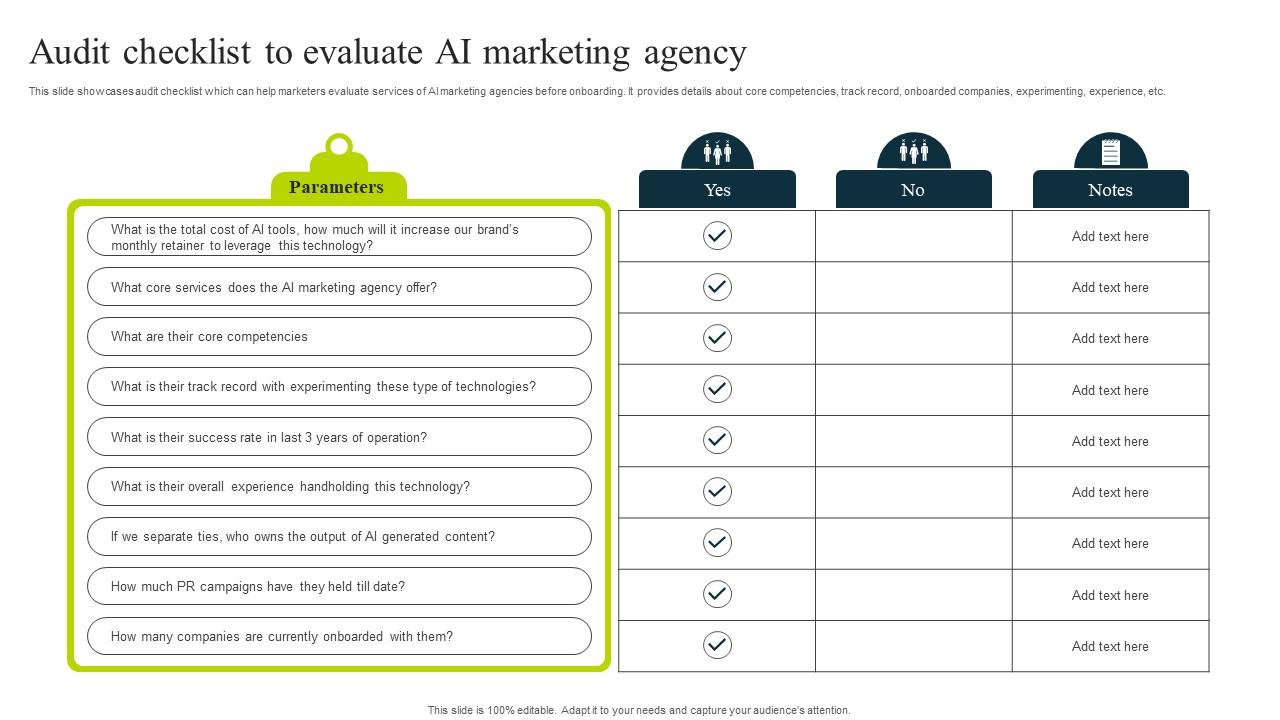
This slide showcases audit checklist which can help marketers evaluate services of AI marketing agencies before onboarding. It provides details about core competencies, track record, onboarded companies, experimenting, experience, etc.
People who downloaded this PowerPoint presentation also viewed the following :
Audit Checklist To Evaluate Ai Marketing Agency How To Use Chatgpt AI SS V with all 9 slides:
Use our Audit Checklist To Evaluate Ai Marketing Agency How To Use Chatgpt AI SS V to effectively help you save your valuable time. They are readymade to fit into any presentation structure.
FAQs for Audit Checklist To Evaluate Ai Marketing Agency How To Use Chatgpt
AI marketing agencies should track conversion rates, customer acquisition costs, return on ad spend, engagement metrics, and attribution accuracy across channels. These KPIs enable agencies to demonstrate tangible value through optimized budget allocation, improved targeting precision, and enhanced campaign performance, with many finding that comprehensive tracking ultimately delivers better client retention and competitive advantage in an increasingly data-driven marketing landscape.
Agencies ensure compliance by implementing robust data governance frameworks, conducting regular privacy impact assessments, anonymizing personal data before AI processing, establishing clear consent mechanisms, and maintaining comprehensive audit trails. Through strategic partnerships with legal experts and privacy-by-design approaches, marketing agencies streamline regulatory adherence while maximizing AI capabilities, ultimately delivering enhanced customer insights and campaign effectiveness without compromising data protection standards.
Evaluating AI model accuracy requires systematic data validation, performance metric analysis, A/B testing against control groups, bias detection assessments, and regular model retraining cycles. Marketing agencies should implement continuous monitoring frameworks that track conversion rates, customer engagement metrics, and ROI outcomes, while conducting quarterly audits to ensure models adapt to changing consumer behaviors and market conditions, ultimately delivering measurable campaign performance improvements.
Agencies can implement robust client onboarding by establishing standardized intake processes, conducting thorough AI tool assessments, creating personalized implementation roadmaps, and setting clear performance benchmarks from day one. This strategic approach enables seamless integration of AI technologies like predictive analytics and automated campaign optimization, while ensuring clients understand capabilities and expectations, ultimately delivering faster campaign launches and measurable ROI improvements.
Best practices for maintaining transparency in AI-driven marketing analytics reports include providing clear data source documentation, explaining algorithm decision-making processes, offering plain-language summaries of complex metrics, and maintaining audit trails for all automated recommendations. These approaches enhance client trust by demystifying AI outputs, enabling stakeholders to understand campaign performance drivers, and ensuring compliance with data governance requirements, with many agencies finding that transparent reporting ultimately strengthens client relationships and competitive positioning.
Marketing agencies can measure AI ROI through key performance indicators like campaign conversion rates, customer acquisition costs, lead generation efficiency, and client retention metrics, while comparing pre- and post-AI implementation results. Through advanced analytics platforms, agencies track cost savings from automation, revenue increases from personalized targeting, and operational efficiency gains, ultimately demonstrating tangible value to clients and stakeholders.
Data quality criteria for AI marketing systems include accuracy, completeness, consistency, timeliness, and relevance across all customer touchpoints and campaign metrics. These standards ensure reliable insights by validating data sources, eliminating duplicates, and maintaining fresh customer profiles, with many agencies finding that rigorous data auditing significantly enhances campaign performance and ROI.
AI-driven customer segmentation leverages machine learning algorithms, predictive analytics, real-time data processing, and behavioral pattern recognition to create dynamic, granular customer groups, while traditional methods rely on static demographic categories and historical survey data. Through advanced algorithms, marketing agencies deliver hyper-personalized campaigns, predict customer lifetime value, and automatically adjust segments based on evolving behaviors, ultimately enabling more precise targeting and significantly higher conversion rates than conventional segmentation approaches.
Common pitfalls include inadequate data quality assessment, insufficient staff training on AI tools, unrealistic ROI expectations, poor integration with existing systems, and lack of proper governance frameworks. Many agencies rush implementation without establishing clear metrics or change management processes, ultimately finding that successful AI integration requires strategic planning, comprehensive staff development, and gradual scaling rather than wholesale transformation.
Agencies can ensure continuous improvement by implementing feedback loops that collect campaign performance data, conducting regular model retraining with fresh datasets, and establishing A/B testing protocols for algorithm optimization. Through systematic performance monitoring and data analysis, marketing agencies streamline their AI capabilities while enhancing targeting accuracy, ultimately delivering better client outcomes and maintaining competitive advantage in an increasingly data-driven landscape.
AI customer targeting ethical considerations include data privacy compliance, algorithmic bias prevention, transparency in automated decision-making, consent management, and fair representation across demographic groups. These frameworks help marketing agencies build trust while delivering personalized experiences, with many organizations finding that ethical AI practices ultimately enhance customer relationships, reduce regulatory risks, and create sustainable competitive advantages in increasingly privacy-conscious markets.
Agencies should approach AI training through comprehensive onboarding programs, hands-on workshops with specific tools, continuous learning initiatives, and cross-functional collaboration sessions that combine technical skills with strategic thinking. This structured approach enables staff to leverage AI for campaign optimization, data analysis, and client reporting while maintaining creative oversight, ultimately delivering enhanced productivity, improved client outcomes, and competitive advantage in an increasingly automated marketing landscape.
A/B testing enables AI marketing agencies to systematically compare campaign variations, optimize algorithms, and validate performance assumptions through controlled experimentation and data-driven insights. By testing different creative elements, audience segments, and messaging approaches, agencies can refine their AI models, improve targeting accuracy, and deliver measurably better ROI for clients while continuously enhancing campaign effectiveness.
Agencies can utilize AI to enhance content creation through automated writing tools, intelligent content optimization, personalized messaging systems, predictive analytics for trending topics, and dynamic content curation platforms. These technologies streamline workflows by generating initial drafts faster, optimizing content for specific audiences, and curating relevant materials across channels, ultimately delivering more targeted campaigns while reducing production costs and time-to-market for marketing initiatives.
**INPUT**: What strategies can be employed to foster collaboration between AI developers and marketing teams in an agency? **OUTPUT**: Effective collaboration strategies include cross-functional workshops, shared project dashboards, regular sprint reviews, joint goal-setting sessions, and integrated communication platforms. Through these approaches, agencies streamline campaign development, enhance data-driven insights, and accelerate time-to-market, with many finding that collaborative frameworks ultimately deliver more innovative solutions and stronger client outcomes.
-
Visually stunning presentation, love the content.
-
Excellent design and quick turnaround.