


B2B Startup Go To Market Strategy Powerpoint Presentation Slides GTM CD




Try Before you Buy Download Free Sample Product
 Impress Your
 Audience
 100%
100% Editable
 Save Hours
 of Time


This emerging B2B SaaS startup is specifically designed for hardworking and professional teams looking for customer service automation. Our professionally designed B2B startup Marketing Strategy helps launch and ensures that it is well-equipped to thrive in the dynamic AIaaS market. This startup cleantech PPT begins with an overview of the AI as a service market. Then it highlights problems and solutions, showing how the startup will resolve certain market obstacles such as handling times, customer journeys, etc. Furthermore, this B2B marketing PowerPoint presentation shows an overview of the business, including the introduction, services offered, value proposition, and target audience. Moreover, it conducts competitor analysis of companies offering similar experiences. Additionally, PPT slides include various strategies, including pricing, branding, positioning, content marketing, customer onboarding, and customer retention. Lastly, it outlines a timeline for the B2B startup market entry along with elements like performance metrics, conversational AI startup costs and investment, financial forecasts, legal considerations, and risk analysis. Download the B2B content marketing deck right away.
People who downloaded this PowerPoint presentation also viewed the following :
Content of this Powerpoint Presentation
Slide 1: This slide showcase title B2B Startup Go To MARKET STRATEGY. State Your Company Name
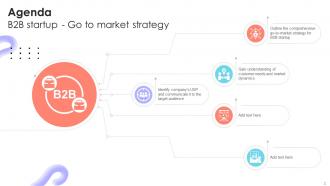
Slide 2: This slide showcase title Agenda B2B startup - Go to market strategy.
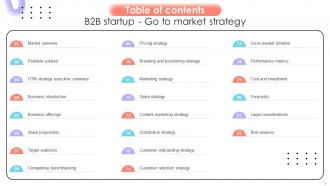
Slide 3: This slide exhibit Table of Content.
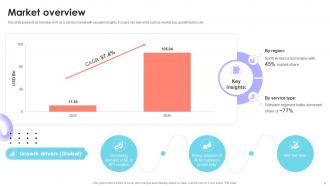
Slide 4: This slide presents an overview of AI as a service market with valuable insights. It covers key elements such as market size, growth factors, etc.
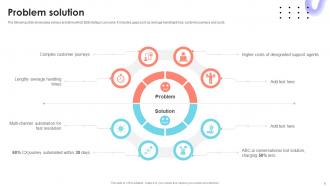
Slide 5: This slide showcases various problems which B2B startups can solve. It includes gaps such as average handling times, customer journeys and costs.
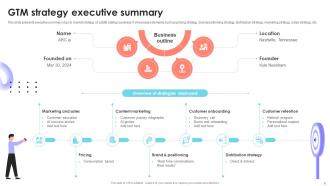
Slide 6: This slide presents executive summary of go to market strategy of a B2B startup business.
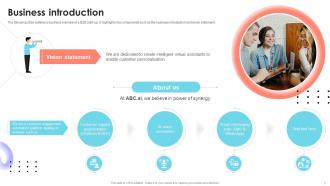
Slide 7: This slide outlines a business overview of a B2B start-up. It highlights key components such as the business introduction and vision statement.
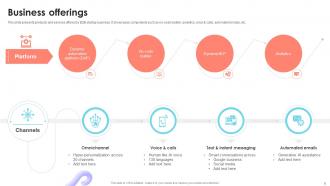
Slide 8: This slide presents products and services offered by B2B startup business.
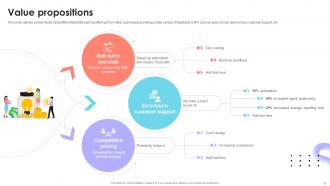
Slide 9: This slide outlines various factors that differentiate B2B start-up offerings from other businesses providing similar service.
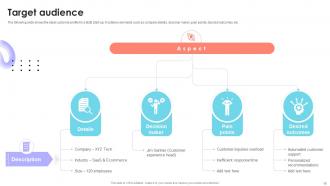
Slide 10: This slide shows the ideal customer profile for a B2B start-up. It outlines elements such as company details, decision maker, pain points, desired outcomes, etc.
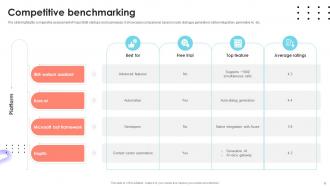
Slide 11: The slide highlights comparative assessment of major B2B startups and businesses.
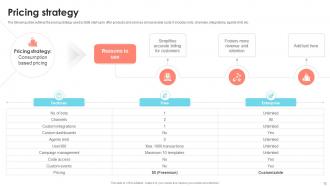
Slide 12: This slide outlines the pricing strategy used by B2B start-up to offer products and services at reasonable costs.
Slide 13: This slide showcases the branding strategy to position B2B startup among target audience.
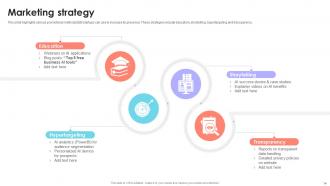
Slide 14: This slide highlights various promotional methods B2B startups can use to increase its presence.
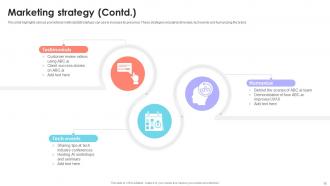
Slide 15: This slide highlights various promotional methods B2B startups can use to increase its presence.
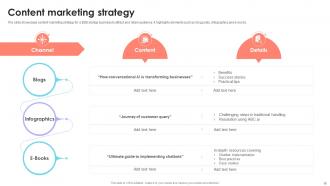
Slide 16: The slide showcases content marketing strategy for a B2B startup business to attract and retain audience.
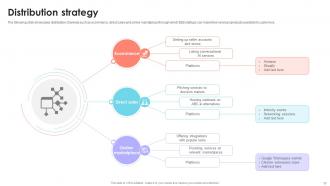
Slide 17: This slide showcases distribution channels through which B2B startups can make their services/products available to customers.
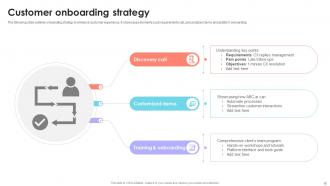
Slide 18: This slide outlines onboarding strategy to enhance customer experience.
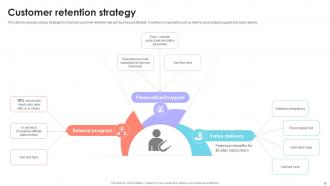
Slide 19: The slide showcases various strategies to maximize customer retention rate and business profitability.
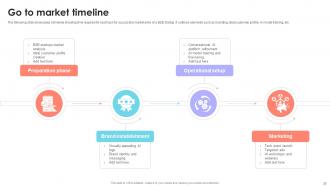
Slide 20: This slide showcases a timeline showing time required for each task for successful market entry of a B2B startup.
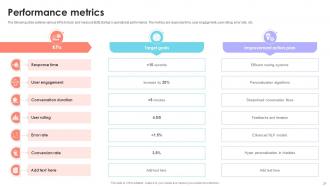
Slide 21: The following slide outlines various KPIs to track and measure B2B startup’s operational performance.
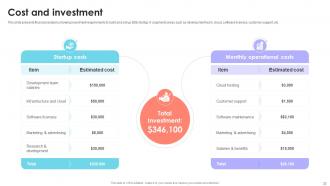
Slide 22: This slide presents financial analysis showing investment requirements to build and set up B2B startup.
Slide 23: The slide outlines future projections showing the estimated growth of the B2B business for five years after launch.
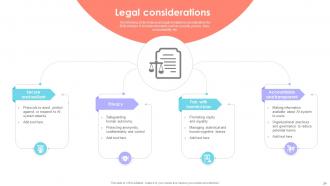
Slide 24: The following slide showcases legal compliance considerations for B2B startups.
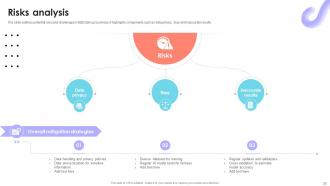
Slide 25: The slide outlines potential risks and challenges in B2B start-up business. It highlights components such as data privacy, bias and inaccurate results.
Slide 26: This slide showcase Icons slide for B2B startup - Go to market strategy
Slide 27: This slide is titled as Additional Slides for moving forward.
Slide 28: This is an Idea Generation slide to state a new idea or highlight information, specifications etc.
Slide 29: This slide depicts Venn diagram with text boxes.
Slide 30: This slide shows Post It Notes for reminders and deadlines. Post your important notes here.
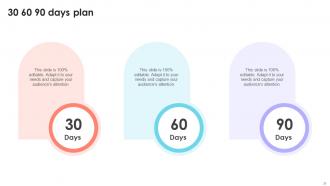
Slide 31: This slide provides 30 60 90 Days Plan with text boxes.
Slide 32: This is a Thank You slide with address, contact numbers and email address.
B2B Startup Go To Market Strategy Powerpoint Presentation Slides GTM CD with all 40 slides:
Use our B2B Startup Go To Market Strategy Powerpoint Presentation Slides GTM CD to effectively help you save your valuable time. They are readymade to fit into any presentation structure.












FAQs for B2B Startup Go To Market Strategy Powerpoint Presentation
Key components of an effective B2B go-to-market strategy include target market segmentation, value proposition development, pricing strategy, sales channel optimization, and competitive positioning analysis. These elements work together by aligning product messaging with customer needs, streamlining sales processes, and enabling strategic market entry, with many organizations finding that integrated approaches ultimately deliver faster revenue growth and sustainable competitive advantage.
Businesses can accurately identify and segment their B2B target audience through comprehensive market research, customer data analysis, industry mapping, behavioral pattern assessment, and firmographic profiling. This strategic combination enables organizations to create precise buyer personas, tailor messaging effectively, and allocate resources efficiently, with many companies finding that targeted segmentation significantly enhances conversion rates and accelerates sales cycles.
Competitive analysis plays a crucial role in B2B go-to-market strategy by identifying market gaps, informing pricing strategies, and revealing differentiation opportunities. Through comprehensive competitor research, organizations can position their solutions more effectively, refine their value propositions, and develop targeted messaging that resonates with prospects, ultimately enabling faster market penetration and sustainable competitive advantage.
B2B companies can leverage digital marketing to enhance go-to-market efforts through content marketing, social media engagement, search engine optimization, marketing automation, and targeted advertising campaigns. These strategies streamline lead generation and nurture prospects across multiple touchpoints, with many organizations finding that integrated digital approaches accelerate sales cycles, improve conversion rates, and deliver measurable ROI while building stronger customer relationships.
Key metrics include customer acquisition cost (CAC), sales cycle length, conversion rates, monthly recurring revenue (MRR), and customer lifetime value (CLV). These indicators enable organizations to optimize resource allocation, identify bottlenecks, and accelerate growth, with many B2B companies finding that tracking pipeline velocity and customer retention rates ultimately delivers competitive advantage and sustainable revenue scaling.
Sales alignment is absolutely critical to B2B go-to-market success, ensuring consistent messaging, coordinated customer touchpoints, and unified revenue objectives across marketing, sales, and customer success teams. Organizations with strong sales alignment achieve 32% higher revenue growth and 38% higher win rates, with companies like Salesforce and HubSpot demonstrating how strategic alignment streamlines lead handoffs, accelerates deal cycles, and ultimately delivers superior customer experiences and competitive advantage.
Content marketing supports B2B go-to-market strategies through thought leadership articles, case studies, whitepapers, webinars, and targeted social media campaigns. These approaches build credibility and trust while educating prospects throughout the buyer's journey, with many organizations finding that strategic content ultimately accelerates sales cycles, enhances lead quality, and establishes competitive differentiation in increasingly crowded markets.
B2B companies face challenges including longer sales cycles, complex decision-making processes, intense competition, unclear value propositions, and difficulty reaching target audiences effectively. These obstacles often result in delayed market entry, increased customer acquisition costs, and reduced competitive positioning, with many organizations finding that strategic market research, targeted messaging, and comprehensive launch planning significantly enhance their success rates and market penetration.
Partnerships and alliances integrate into B2B go-to-market strategies through channel partnerships, technology integrations, co-marketing agreements, referral programs, and strategic joint ventures. These collaborative approaches enable companies to leverage partner networks, access new customer segments, and share market development costs, with many organizations finding that strategic alliances accelerate market penetration while reducing customer acquisition expenses.
B2B go-to-market development leverages CRM platforms, marketing automation tools, sales enablement software, analytics dashboards, and account-based marketing technologies. These solutions streamline lead generation, customer segmentation, and pipeline management, with many organizations finding that integrated technology stacks accelerate market entry, enhance sales efficiency, and deliver measurable competitive advantage across industries.
Customer feedback refines B2B go-to-market strategies by identifying market gaps, validating product-market fit, optimizing messaging, and revealing new use cases across different buyer personas. Through structured feedback loops, organizations enhance targeting precision, streamline sales processes, and adjust pricing models, with many B2B companies finding that customer insights ultimately accelerate market penetration and competitive positioning.
B2B brands can differentiate through specialized industry expertise, unique value propositions, strategic partnerships, innovative service delivery models, and thought leadership content. These approaches enable companies to establish market authority while building deeper customer relationships, with many organizations finding that combining sector-specific solutions with exceptional customer experiences ultimately delivers sustainable competitive advantage.
B2B pricing strategies should be determined through comprehensive market analysis, competitor benchmarking, customer value assessment, cost structure evaluation, and strategic positioning within your go-to-market framework. This data-driven approach enables organizations to optimize revenue potential while remaining competitive, with many companies finding that value-based pricing models ultimately deliver stronger margins and enhanced customer relationships.
Customer education serves as a strategic accelerator in B2B go-to-market strategies by reducing sales cycles, building trust, and positioning companies as thought leaders in their respective markets. Through webinars, whitepapers, and training programs, organizations like software providers and manufacturing companies enhance buyer confidence, streamline decision-making processes, and ultimately deliver higher conversion rates and stronger customer relationships.
B2B businesses ensure seamless customer journeys through integrated CRM systems, automated lead nurturing workflows, aligned sales and marketing teams, and consistent messaging across touchpoints. By implementing lead scoring, personalized content delivery, and streamlined handoff processes, organizations like software companies and professional services firms reduce friction, accelerate conversion cycles, and ultimately deliver higher close rates while enhancing customer experiences.
-
Great product with highly impressive and engaging designs.
-
“There is so much choice. At first, it seems like there isn't but you have to just keep looking, there are endless amounts to explore.”