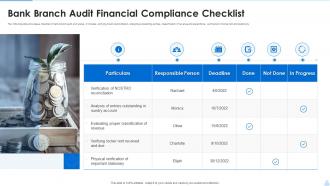
Bank Branch Audit Financial Compliance Checklist
Try Before you Buy Download Free Sample Product
Audience
Editable
of Time
The following slide showcases checklist of bank branch audit and status. it includes verifying nostro reconciliation, analyzing outstanding entries, classification of revenue and expenditure, verification of locker rent and stationary.
People who downloaded this PowerPoint presentation also viewed the following :
Bank Branch Audit Financial Compliance Checklist with all 6 slides:
Use our Bank Branch Audit Financial Compliance Checklist to effectively help you save your valuable time. They are readymade to fit into any presentation structure.
FAQs for Bank Branch Audit
Bank branch audit objectives include ensuring regulatory compliance, assessing operational efficiency, evaluating risk management practices, verifying financial accuracy, and reviewing customer service standards. These comprehensive assessments enable financial institutions to identify vulnerabilities, streamline processes, and enhance internal controls, while ensuring adherence to banking regulations, ultimately delivering improved operational performance and regulatory confidence.
Internal audit functions ensure compliance by conducting systematic risk assessments, reviewing operational procedures, and performing regular testing of controls against regulatory standards. Through comprehensive compliance monitoring, auditors evaluate anti-money laundering protocols, customer due diligence processes, and lending practices, while documenting findings and tracking remediation efforts, ultimately delivering enhanced regulatory adherence and minimizing potential penalties for financial institutions.
Bank branch operations present risks including cash handling errors, fraudulent transactions, regulatory compliance violations, cybersecurity breaches, and inadequate internal controls. These vulnerabilities can expose financial institutions to significant losses, regulatory penalties, and reputational damage, with many banks finding that comprehensive audit frameworks help identify weaknesses early, ultimately delivering enhanced operational security and regulatory confidence.
Technology enhances bank branch audit efficiency by automating data collection, enabling real-time monitoring, and providing advanced analytics for risk assessment. Through AI-powered systems and digital audit trails, banks streamline compliance verification, reduce manual errors, and accelerate reporting processes, with many financial institutions finding that automated auditing delivers faster turnaround times and more comprehensive oversight.
Common indicators include excessive wait times, frequent system downtimes, high error rates in transactions, poor staff utilization, and inconsistent service delivery across different banking functions. These inefficiencies often manifest through customer complaints, increased operational costs, and reduced transaction processing speeds, with many financial institutions finding that addressing these indicators through systematic auditing ultimately delivers improved customer satisfaction and enhanced competitive positioning.
Auditors assess internal controls through transaction testing, segregation of duties reviews, authorization protocol verification, and compliance monitoring systems evaluation. These comprehensive assessments examine cash handling procedures, loan approval processes, and regulatory adherence across operations, with many financial institutions finding that regular control testing significantly reduces operational risk while enhancing customer trust and regulatory compliance.
Customer feedback provides critical insights into service quality, operational efficiency, and compliance gaps that internal audits might miss. Banks increasingly integrate customer surveys, complaint analysis, and satisfaction metrics into their audit frameworks, with many financial institutions finding that customer perspectives reveal process bottlenecks, staff performance issues, and regulatory concerns, ultimately enhancing branch operations and competitive positioning.
Auditors should evaluate bank branch financial reporting by examining transaction accuracy, regulatory compliance, internal controls effectiveness, reconciliation processes, and documentation standards. Through systematic review of ledger entries, cash management procedures, and customer account records, auditors can identify discrepancies, ensure regulatory adherence, and strengthen operational controls, ultimately delivering enhanced financial transparency and reduced compliance risk.
Bank branch audits commonly employ risk-based auditing, transaction sampling, compliance testing, surprise inspections, and control environment assessments. These methodologies work together by identifying high-risk areas, validating transaction accuracy, and ensuring regulatory adherence, with many financial institutions finding that this comprehensive approach ultimately delivers enhanced operational transparency and regulatory confidence.
Bank branch audits enhance customer service by identifying operational inefficiencies, compliance gaps, staff training needs, and technology limitations that directly impact customer experiences. Through systematic evaluation of processes like loan approvals, account opening procedures, and transaction handling, banks can streamline workflows, reduce wait times, and ensure consistent service delivery, ultimately improving customer satisfaction and retention across all branches.
Auditors identify fraud risks through transaction pattern analysis, segregation of duties reviews, cash handling procedures evaluation, customer account monitoring, and staff behavior assessments. These methodologies enable detection of unauthorized transactions, embezzlement schemes, and procedural violations, while implementing enhanced controls, regular reconciliations, and surveillance systems ultimately delivers stronger fraud prevention and regulatory compliance.
Critical areas include customer due diligence procedures, transaction monitoring systems, suspicious activity reporting protocols, record-keeping practices, and staff training documentation. These compliance frameworks work together by ensuring proper customer identification, detecting unusual transaction patterns, and maintaining comprehensive audit trails, with many financial institutions finding that systematic monitoring across these areas significantly reduces regulatory risk while streamlining operational efficiency.
Auditors measure bank branch staff performance through transaction accuracy reviews, customer service assessments, compliance with regulatory procedures, sales target evaluations, and adherence to internal controls. These comprehensive evaluations examine error rates, processing times, and policy implementation, with many financial institutions finding that systematic performance measurement enhances operational efficiency, reduces risk exposure, and ultimately delivers improved customer experiences and regulatory compliance.
Past bank branch audit failures reveal critical lessons including inadequate risk assessment frameworks, insufficient staff training, poor documentation practices, and lack of real-time monitoring systems. These failures highlight that banks must implement comprehensive audit trails, regular compliance updates, and integrated technology solutions, with many financial institutions finding that proactive audit strategies significantly reduce regulatory penalties while enhancing operational transparency and customer trust.
Collaboration between auditors and bank branch management enhances audit efficiency through transparent communication, shared documentation access, and proactive issue identification. This strategic partnership enables faster data collection, real-time clarification of procedures, and immediate resolution of compliance gaps, with many financial institutions finding that collaborative audits reduce timeframes while improving accuracy and regulatory adherence.
-
Much better than the original! Thanks for the quick turnaround.
-
“Thank you to the SlideTeam. Your presentations look really skillful and have made my life so much easier.”