


Basic Principles Of Kaizen Training Ppt





Try Before you Buy Download Free Sample Product
 Impress Your
 Audience
 100%
100% Editable
 Save Hours
 of Time


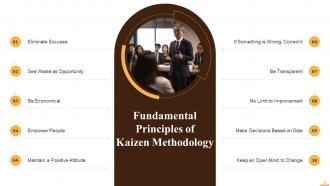
This set of slides in depth covers the fundamental principles of Kaizen. These are eliminate excuses, if something is wrong, correct it, see waste as opportunity, be transparent, set no limits for improvement, make decisions based on data, and keep the mind open to change.
People who downloaded this PowerPoint presentation also viewed the following :
Content of this Powerpoint Presentation
Slide 2
This slide showcases the fundamental principles of Kaizen. These are eliminate excuses; if something is wrong, correct it; see waste as opportunity; be transparent; be economical; set no limits for improvement; empower people; make decisions based on data; maintain a positive attitude, and keep mind open to change.
Instructor’s Notes:
Fundamental principles of Kaizen methodology are:
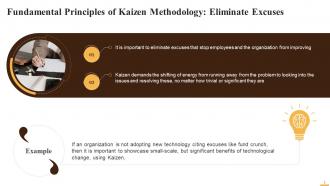
Eliminate Excuses:
- It is important to eliminate excuses that stop employees and the organization from improving
- Kaizen demands the shifting of energy from running away from the problem to looking into the issues and resolving these, no matter how trivial or significant they are
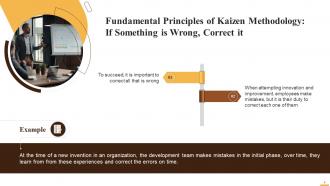
If Something is Wrong, Correct it:
- To succeed, it is important to correct all that is wrong
- In their attempts at innovation and improvement, employees make mistakes, but it is their duty to correct each one of these
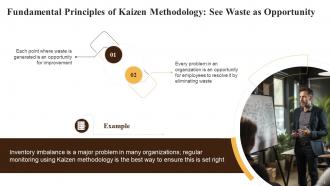
See Waste as Opportunity:
- Each wastage is an opportunity for making improvement
- Every problem in an organization is an opportunity for employees to resolve it with elimination of waste
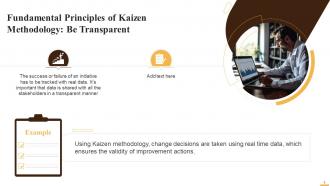
Be Transparent:
- Success or failure of an initiative has to be tracked with real data. It is important that data is shared with all the stakeholders in a transparent manner
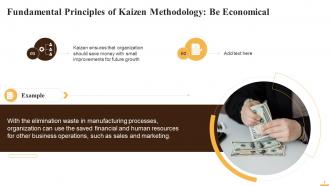
Be Economical:
- It is important to save money with small improvements for future goals and progress
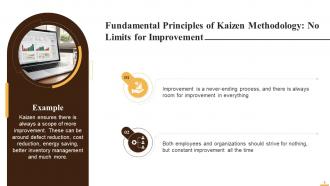
No Limit to Improvement:
- Improvement is a never-ending process, and there is always room for improvement in everything
- Both employees and organizations should strive for nothing but constant improvement till the end
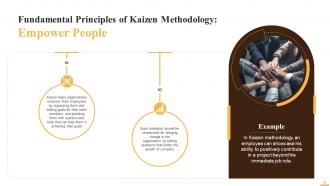
Empower People:
- Kaizen helps organizations empower their employees by organizing them and setting goals for their team members, and providing them with systems and tools that help in achievement of goals
- Each individual should be responsible for bringing change in the organization and work to solve problems that hinder the growth of the company
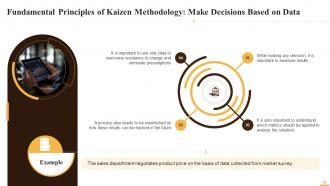
Make Decisions Based on Data:
- While making any decision, it is important to track and measure results
- Understand which metrics should be applied to analyze the situation
- Working on how these results be tracked is also super-important
- It is important to use only data to overcome resistance to change and eliminate presumptions
Maintain a Positive Attitude:
- A positive mindset can help employees welcome new opportunities for improvement
- It helps to identify the opportunities that could help both the employees and the organization grow
Keep an Open Mind to Change:
- It is important to ask questions to experience constant improvement
Always be open to change and discard fixed ideas
Slide 3
This slide showcases the Kaizen principle of eliminating excuse. It also explain that it is important to eliminate excuses that stop employees and the organization from getting on the road to improvement.
Slide 4
This slide showcases the Kaizen methodology that If something is wrong, correct it. It also explains that when attempting innovation and improvement, employees make mistakes, but it is their duty to correct each one of these.
Slide 5
This slide showcases the Kaizen methodology of seeing waste as an opportunity. It also explain that every problem in an organization is an opportunity for the employees to resolve with the elimination of waste.
Slide 6
This slide showcases the Kaizen methodology of ensuring transparency. It also explains that the success or failure of an initiative has to be tracked with real data.
Slide 7
This slide showcases the Kaizen methodology of be economical. It also explains that saving money with small improvements helps organizations achieve their future goals and progress faster.
Slide 8
This slide showcases the Kaizen methodology of no limits for improvement. It also explain that improvement is a never-ending process and both employees and organization should strive for nothing, but constant improvement.
Slide 9
This slide showcases the Kaizen methodology of empower people. It also explain that Kaizen helps organization empower their employees by organizing them and setting goals for their team members, and provide them with systems and tools that could help them in achieving their goals.
Slide 10
This slide showcases the Kaizen methodology of making decisions based on data. It also explain that it is important to use only data to overcome resistance to change and eliminate presumptions.
Slide 11
This slide showcases the Kaizen methodology of maintain a positive attitude. It also explain that a positive mindset can help employees welcome new opportunities and could help the organization grow.
Slide 12
This slide showcases the Kaizen methodology of having an open mind to change. It also explain that it is important to ask questions to experience continuous improvement.
Basic Principles Of Kaizen Training Ppt with all 31 slides:
Use our Basic Principles Of Kaizen Training Ppt to effectively help you save your valuable time. They are readymade to fit into any presentation structure.













FAQs for Basic Principles Of
So kaizen is basically about tiny improvements that add up over time. Pick one small annoying thing in your routine - like how messy your desktop is or that email you copy-paste every week. Fix that first. Don't blame people when stuff goes wrong. Instead, ask "why" five times to actually figure out what's causing the problem. Honestly, once you start seeing these little wins, it becomes kind of addictive? The trick isn't waiting for some massive life overhaul. Just commit to improving one tiny thing each week. Those micro-changes seriously compound.
So Kaizen is all about tiny daily improvements that everyone can do - like "how do I make this process 1% better today?" Six Sigma is the opposite. It brings in these specialists (they literally have black belts, which sounds kind of ridiculous) to tackle huge problems using tons of data and statistics. Your whole team can jump into Kaizen without special training. But Six Sigma? That requires serious resources and methodology training. Honestly, if you want quick wins and don't want to intimidate people, I'd start with Kaizen. Way more approachable for most teams.
Oh man, Kaizen is actually perfect for this! Basically everyone gets to pitch in on improvements instead of just the boss deciding everything. Your team starts brainstorming small tweaks together - builds way more trust that way. People get pumped because they're helping shape how things work, not just taking orders. Those little wins (even dumb stuff like fixing the messy shared drive) really do add up and get everyone hyped. The best part? You're constantly talking through ideas instead of waiting for those boring monthly meetings. Start small - maybe 15 minutes weekly where anyone can suggest one tiny change. Trust me, the energy shift is real.
Honestly, without strong leadership backing it up, Kaizen just dies a slow death. Your bosses need to actually walk the walk - celebrating those small improvements and genuinely listening when people suggest changes. I've worked places where managers talked a big game but would shut down any idea that made them look incompetent (which was most of them, let's be real). People won't speak up about problems if they're gonna get blamed for it. The whole thing only works when leadership sees it as changing company culture, not some checkbox exercise they can forget about next quarter.
Track the obvious stuff first - productivity, costs, defect rates, cycle times. That's your concrete proof things are actually working. But honestly? The culture piece matters just as much, maybe more. Employee engagement scores, how many people are throwing out suggestions, implementation rates - all that soft stuff tells the real story. Don't go overboard though. Pick like 3-4 metrics that actually matter to your goals and stick with those. I've seen teams drown in spreadsheets trying to measure everything. Monthly check-ins work well to spot trends and tweak your approach.
Honestly, the biggest pain will be people just not wanting to change - even good changes feel scary. Middle managers get weird about it too since they think employees making improvements threatens their job or something. Leadership gets impatient because Kaizen is super slow, like watching paint dry. Training everyone properly is a nightmare, and different departments will do things completely differently even with the same instructions. My suggestion? Find a few people who are actually excited about it first. When they get some wins, make a big deal about it. That momentum thing really works.
Oh totally! Kaizen definitely works outside manufacturing. Healthcare teams use it for patient check-ins, tech companies apply it to cut down deployment times. Restaurants even use it for kitchen workflows - which honestly makes so much sense when you think about it. The whole thing is just asking "what small annoying thing can we fix today?" Finance, software, pretty much any industry benefits. I'd say pick one thing that bugs you regularly in your workflow. Then just get your team together and brainstorm tiny tweaks. You'll be surprised how those little changes add up over time.
For process improvement? Value stream mapping is gold - it shows you exactly where things are getting stuck. Then there's 5S for keeping workspaces organized and the 5 Whys method for digging into root causes. PDCA cycles help structure everything systematically. But honestly, don't overthink it - I've seen amazing results with just whiteboards and sticky notes. Gemba walks are huge too since you need to actually watch what's happening on the floor, not guess from your office. My advice? Pick one tool that fits your specific problem first. Trying to use everything at once just creates chaos.
Honestly, you can't skip training if you want Kaizen to actually work. People need to get the basics - like spotting waste and using the Plan-Do-Check-Act cycle. I've watched companies try to wing it and... yeah, that goes nowhere fast. The training doesn't need to be some elaborate program, but give them real practice with the tools. One-time workshops are pretty useless though. You'll want ongoing coaching instead. Oh, and start with team leaders first - they can help roll it out to everyone else. Trust me, without proper training your improvement efforts just die out.
Toyota's the obvious pick here - they basically created modern Kaizen and went from making garbage cars in the 60s to owning the market. 3M's another solid example, using it for innovation and cutting waste. Boeing did it too for faster aircraft assembly. Virginia Mason Medical Center (random but cool) applied the same principles to patient care and error reduction. Oh, and if you're actually gonna try this stuff, definitely dig into Toyota's Production System first. There's a ton of documented processes you can steal and adapt for whatever you're doing.
Look, you've gotta make this stuff feel rewarding, not like more crap on their plate. Celebrate wins publicly - even the small ones matter. Actually give people time to work on their ideas because nobody's brainstorming on their lunch break, you know? Here's the thing though - train your managers to ask "how do we improve this?" instead of "who screwed up?" That language switch makes a huge difference. And seriously, implement the good suggestions. I can't stress this enough. Nothing kills motivation faster than watching ideas vanish into thin air.
Honestly, the worst thing is "Kaizen fatigue" - your team just gets burned out from nonstop improvement meetings. People start avoiding those sessions like the plague. Don't chase every shiny idea that comes up. Give folks actual breathing room between changes or they'll hate you for it. Also, you might get so focused on tiny tweaks that you miss the big broken stuff that actually needs fixing. My advice? Pick your battles wisely. Celebrate the wins when they happen. Make sure leadership isn't just paying lip service to the whole thing. Oh, and definitely start with people who are actually excited about it rather than forcing everyone.
So basically you want every small improvement to actually connect to your big goals, right? I break down my long-term stuff into tiny pieces my team can handle week by week. Like, don't just do random improvements for the sake of it - that's just busywork and honestly a waste of time. Map out how each quick win gets you closer to the main thing you're after. Check in regularly too because it's super easy to get caught up doing improvements that feel productive but aren't really moving you forward. Think building blocks - each one has to support what comes next.
Honestly, kaizen is perfect for this because it gets everyone constantly looking for waste to cut - energy, materials, whatever. Small tweaks really do add up across your whole operation. What I love about it is people start thinking about environmental stuff as part of their regular job, not some corporate initiative from upstairs. Most of the time, reducing waste saves you money too, so you're killing two birds with one stone. Maybe start simple? Have your team track one waste metric for a month and see what ideas they come up with.
Customer feedback is your best friend for Kaizen - honestly, it's like having someone point out you've got spinach in your teeth. Your customers see the final result of everything you do, so they'll catch problems you're blind to from the inside. Can't just wing it and hope you're fixing the right stuff. Set up regular ways to hear from them - surveys work, but even asking "what's bugging you?" during normal conversations helps. Then actually use what they tell you in your improvement process. The trick is making feedback collection automatic, not just scrambling when complaints roll in.
-
“The presentation template I got from you was a very useful one.My presentation went very well and the comments were positive.Thank you for the support. Kudos to the team!”
-
Eye-catching PPT designs, outstanding team, and best customer service. I’m a super satisfied customer here!