Benefits Of Automated Insurance Underwriting
Try Before you Buy Download Free Sample Product
Audience
Editable
of Time
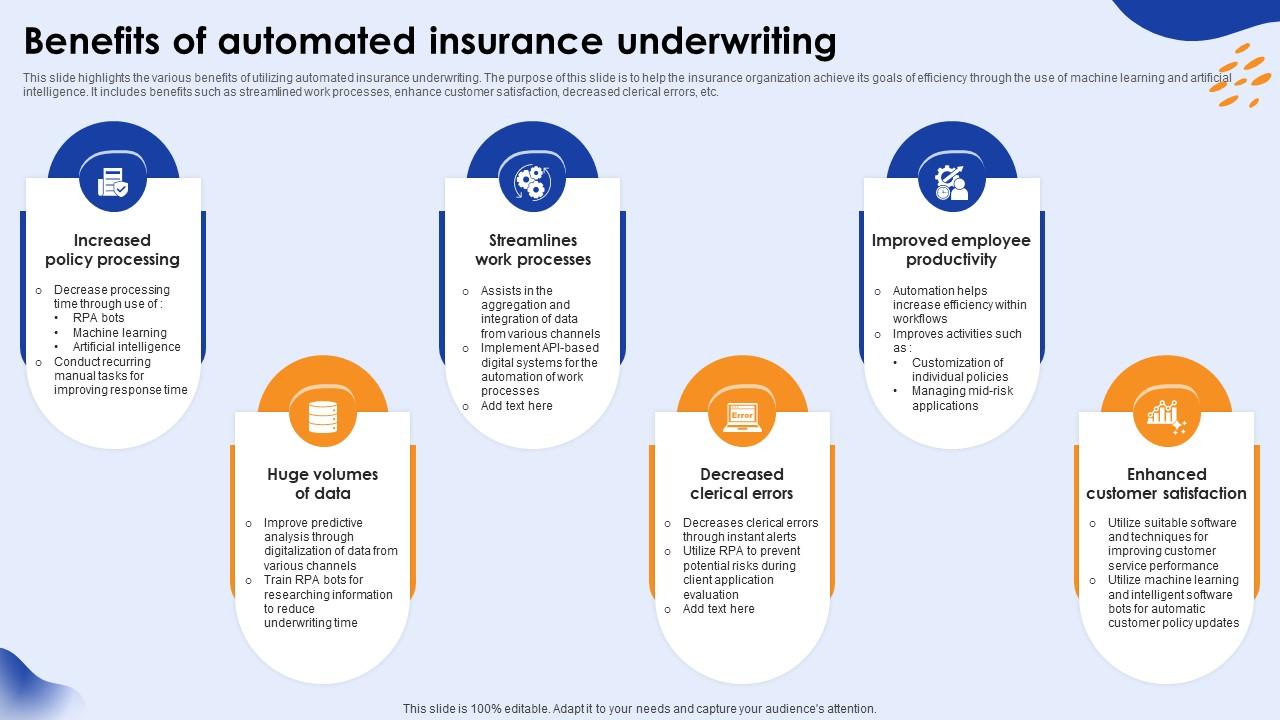
This slide highlights the various benefits of utilizing automated insurance underwriting. The purpose of this slide is to help the insurance organization achieve its goals of efficiency through the use of machine learning and artificial intelligence. It includes benefits such as streamlined work processes, enhance customer satisfaction, decreased clerical errors, etc.
People who downloaded this PowerPoint presentation also viewed the following :
Benefits Of Automated Insurance Underwriting with all 9 slides:
Use our Benefits Of Automated Insurance Underwriting to effectively help you save your valuable time. They are readymade to fit into any presentation structure.
FAQs for Benefits Of
Automated underwriting delivers faster claim processing, enhanced risk assessment accuracy, reduced operational costs, improved consistency in decision-making, and increased customer satisfaction through streamlined applications. These systems enable insurers to process applications in minutes rather than days while minimizing human error, with many companies finding that automation reduces underwriting costs by up to 30% while delivering superior customer experiences.
Automated underwriting dramatically accelerates policy issuance by eliminating manual review processes, instantly analyzing risk data through algorithms, and providing real-time decisions within minutes rather than days or weeks. Through machine learning and predictive analytics, insurers can process applications continuously, reduce administrative bottlenecks, and deliver immediate policy approvals, with many companies finding that automated systems enable same-day coverage while significantly reducing operational costs.
Automation enhances risk assessment accuracy by processing vast datasets consistently, eliminating human bias, and applying sophisticated algorithms that identify subtle risk patterns often missed by traditional methods. Through machine learning and predictive analytics, insurers can analyze historical claims data, real-time market conditions, and customer behavior patterns simultaneously, ultimately delivering more precise risk pricing and reducing underwriting errors by significant margins.
Machine learning analyzes vast datasets to assess risk profiles, predict claim probabilities, and automate underwriting decisions with greater accuracy than traditional methods. These algorithms continuously learn from new data patterns, enabling insurers to streamline application processing, reduce manual reviews, and deliver faster policy approvals while maintaining precise risk assessment standards.
Automated underwriting systems reduce operational costs by minimizing manual processing, accelerating application reviews, and eliminating redundant administrative tasks. These technologies streamline risk assessment through AI-driven data analysis and automated decision-making, with many insurance companies finding that they achieve 40-60% cost reductions while delivering faster policy approvals and enhanced customer experiences.
Key technologies driving automated underwriting include artificial intelligence, machine learning algorithms, predictive analytics, robotic process automation, and advanced data integration platforms. These technologies streamline risk assessment by analyzing vast datasets instantly, automating policy decisions, and reducing manual intervention, with many insurers finding that automated systems deliver faster approvals, improved accuracy, and enhanced customer experiences.
Automated underwriting significantly enhances customer experience by delivering faster policy approvals, reducing wait times from weeks to hours, and providing transparent, consistent decision-making processes. Through AI-powered systems, insurers streamline application processing, minimize paperwork requirements, and offer real-time updates, while enabling 24/7 service availability, ultimately creating more responsive customer interactions and higher satisfaction rates.
Insurers face challenges including legacy system integration complexities, staff retraining requirements, regulatory compliance adjustments, and initial technology investment costs when transitioning to automated underwriting. While these present implementation hurdles, many insurance companies find that strategic phasing of automation, combined with comprehensive change management programs, ultimately delivers faster policy approvals and enhanced competitive positioning.
Automated underwriting enhances compliance by standardizing risk assessment processes, maintaining comprehensive audit trails, ensuring consistent policy application, and automatically flagging regulatory violations in real-time. These systems enable insurance companies to reduce human error, accelerate regulatory reporting, and adapt quickly to changing compliance requirements, with many insurers finding that automated workflows ultimately deliver greater transparency and minimize regulatory penalties.
Automated underwriting transforms human underwriters from routine data processors into strategic risk advisors and complex case specialists, enabling them to focus on nuanced decision-making, customer relationships, and exceptional scenarios. While automation handles standard applications through algorithmic assessment, human underwriters increasingly concentrate on high-value policies, regulatory compliance, and relationship management, ultimately delivering enhanced service quality and operational efficiency across insurance organizations.
Automated underwriting systems utilize credit reports, medical records, claims history, financial statements, and third-party databases including social media analytics and IoT data. These diverse data sources enable insurers to streamline risk assessment, reduce processing times from weeks to minutes, and enhance accuracy, with many financial services companies finding that comprehensive data integration ultimately delivers more competitive pricing and improved customer experiences.
Automated underwriting facilitates faster claims processing by streamlining risk assessment algorithms, enabling real-time policy verification, and integrating seamlessly with claims management systems. These technologies accelerate decision-making through predictive analytics and automated documentation review, with many insurance providers finding that processing times decrease by 60-80%, ultimately delivering enhanced customer satisfaction and operational efficiency.
**INPUT**: What ethical considerations should be addressed when implementing automated underwriting technologies? **OUTPUT**: Ethical considerations include algorithmic bias prevention, data privacy protection, transparency in decision-making processes, fair access to coverage, and human oversight mechanisms. Insurance companies must balance automated efficiency with regulatory compliance and customer trust, ensuring their systems promote equitable outcomes while maintaining competitive advantages through faster, more accurate risk assessments. **Word count: 52 words**
Insurers ensure data privacy and security through robust encryption protocols, multi-factor authentication systems, regular security audits, compliance with regulatory frameworks like GDPR, and implementing zero-trust network architectures. These comprehensive measures enable financial institutions to protect sensitive customer information while maintaining operational efficiency, with many insurance companies finding that strategic security investments ultimately deliver enhanced customer trust and competitive advantage.
Future trends shaping automated underwriting include real-time risk assessment, predictive analytics integration, blockchain verification, IoT data incorporation, and AI-powered fraud detection capabilities. These technologies streamline decision-making by processing diverse data sources, enhancing accuracy through continuous learning algorithms, and reducing processing times, with many insurers finding that automated systems ultimately deliver faster policy approvals and improved competitive positioning.
-
I have been using SlideTeam for the past six months. Very happy and satisfied!
-
Editable templates with innovative design and color combination.