

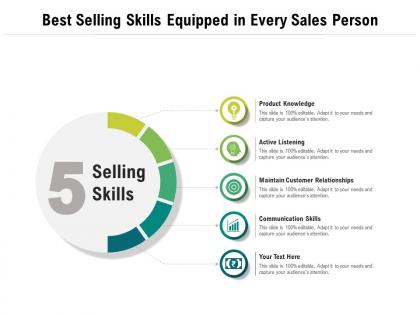
Best selling skills equipped in every sales person




Try Before you Buy Download Free Sample Product
 Impress Your
 Audience
 100%
100% Editable
 Save Hours
 of Time


Our Best Selling Skills Equipped In Every Sales Person are topically designed to provide an attractive backdrop to any subject. Use them to look like a presentation pro.
People who downloaded this PowerPoint presentation also viewed the following :
Best selling skills equipped in every sales person with all 2 slides:
Use our Best Selling Skills Equipped In Every Sales Person to effectively help you save your valuable time. They are readymade to fit into any presentation structure.
FAQs for Best selling skills equipped in
The top three selling skills every salesperson should master include active listening, relationship building, and consultative questioning techniques. These foundational skills enable sales professionals to understand customer pain points, establish trust through meaningful connections, and identify specific solutions that address client needs, with many organizations finding that salespeople who excel in these areas consistently deliver higher conversion rates and stronger customer retention.
Active listening improves sales performance by enabling you to understand customer pain points, identify specific needs, and build stronger rapport through genuine engagement. This approach allows sales professionals to tailor solutions more precisely, address objections proactively, and create trust-based relationships, ultimately leading to higher conversion rates and increased customer satisfaction.
Emotional intelligence enables salespeople to read customer emotions, adapt communication styles, build genuine rapport, and navigate objections with empathy and understanding. Through enhanced listening skills and social awareness, sales professionals can identify unspoken concerns, tailor their approach to individual personality types, and create trust-based relationships, ultimately delivering higher conversion rates and stronger customer loyalty.
Handle objections by actively listening to understand the underlying concern, acknowledging the prospect's perspective, and responding with relevant evidence or solutions that address their specific worry. Successful salespeople reframe objections as opportunities for deeper dialogue, using techniques like the "feel-felt-found" method or providing case studies from similar clients, ultimately building trust and moving prospects closer to purchase decisions.
Rapport-building techniques include active listening, mirroring communication styles, finding common ground, asking thoughtful questions, and demonstrating genuine interest in client needs. These approaches enhance trust by establishing personal connections, showing empathy, and creating comfortable environments, with many sales professionals finding that strong rapport significantly accelerates decision-making and increases conversion rates.
Product knowledge significantly enhances a salesperson's credibility, confidence, and ability to address customer concerns, objections, and technical questions effectively. Through comprehensive understanding of features, benefits, and competitive advantages, sales professionals can tailor presentations, provide relevant solutions, and build trust with prospects, ultimately delivering shorter sales cycles, higher conversion rates, and stronger customer relationships.
Effective deal-closing strategies include building genuine rapport, addressing objections proactively, creating urgency through limited-time offers, using assumptive closing techniques, and following up consistently with personalized communications. These approaches streamline the sales process by establishing trust, minimizing hesitation, and maintaining momentum throughout negotiations, with many organizations finding that combining multiple strategies ultimately delivers higher conversion rates and stronger client relationships.
Storytelling transforms selling by creating emotional connections, building trust, and making complex solutions memorable through relatable narratives. Sales professionals leverage customer success stories, problem-resolution scenarios, and outcome-focused case studies to demonstrate value, with many finding that prospects engage more deeply with stories than statistics, ultimately accelerating decision-making and closing rates.
Consultative selling delivers deeper customer relationships, higher close rates, increased deal values, reduced price objections, and enhanced customer retention compared to traditional methods. By focusing on understanding client needs, providing tailored solutions, and building trust through expertise, sales professionals create sustainable competitive advantages while customers receive more strategic value and long-term partnership benefits.
Adapting selling techniques involves identifying customer personality types through communication styles, decision-making patterns, and behavioral cues, then tailoring your approach accordingly. Analytical customers prefer detailed data and specifications, while relationship-focused buyers respond to testimonials and trust-building, with many sales professionals finding that this personalized approach significantly increases conversion rates and customer satisfaction.
Best practices for following up with leads include personalized thank-you messages, addressing specific concerns raised during the pitch, sharing relevant case studies, scheduling concrete next steps, and maintaining consistent communication timelines. These approaches enhance relationship building by demonstrating genuine interest, providing additional value, and keeping momentum alive, with many sales professionals finding that strategic follow-up sequences significantly improve conversion rates and accelerate deal closure.
Social media enhances selling skills by enabling relationship building, thought leadership establishment, and direct customer engagement across platforms like LinkedIn, Twitter, and Instagram. Through consistent content sharing, active community participation, and strategic networking, sales professionals can demonstrate expertise, build trust with prospects, and create valuable touchpoints that streamline the sales process, ultimately delivering stronger customer relationships and increased conversion rates.
B2B selling emphasizes relationship building, consultative approaches, longer sales cycles, and committee-based decision making, while B2C focuses on emotional triggers, individual purchasing decisions, and shorter transaction timelines. These different approaches require distinct skill sets, with B2B sellers developing expertise in stakeholder management and complex solution presentation, while B2C professionals excel at personal connection and immediate value demonstration.
Body language is crucial in sales, accounting for up to 55% of communication impact through posture, eye contact, facial expressions, and gestures that build trust and rapport. Sales professionals should focus on maintaining open posture, consistent eye contact, and mirroring client body language, with many finding that confident, authentic nonverbal communication significantly enhances credibility and accelerates deal closure.
Persistence in selling helps overcome initial rejections, build long-term client relationships, and demonstrate genuine commitment to solving customer problems. This consistent follow-through approach enables sales professionals to stay top-of-mind with prospects, navigate complex decision-making cycles, and ultimately close deals that competitors abandon, with many finding that strategic persistence delivers significantly higher conversion rates.
-
Commendable slides with attractive designs. Extremely pleased with the fact that they are easy to modify. Great work!
-
Designs have enough space to add content.
-
The content is very helpful from business point of view.
-
Great quality slides in rapid time.
-
Thanks for all your great templates they have saved me lots of time and accelerate my presentations. Great product, keep them up!