Bitcoin Pool In Powerpoint And Google Slides Cpb

Rating:
80%
Bitcoin Pool In Powerpoint And Google Slides Cpb
Slide 1 of 6

or

Favourites Favourites

Try Before you Buy Download Free Sample Product

Audience Impress Your
Audience
Editable 100%
Editable
Time Save Hours
of Time
The Biggest Sale is ending soon in
0
0
:
0
0
:
0
0
Rating:
80%
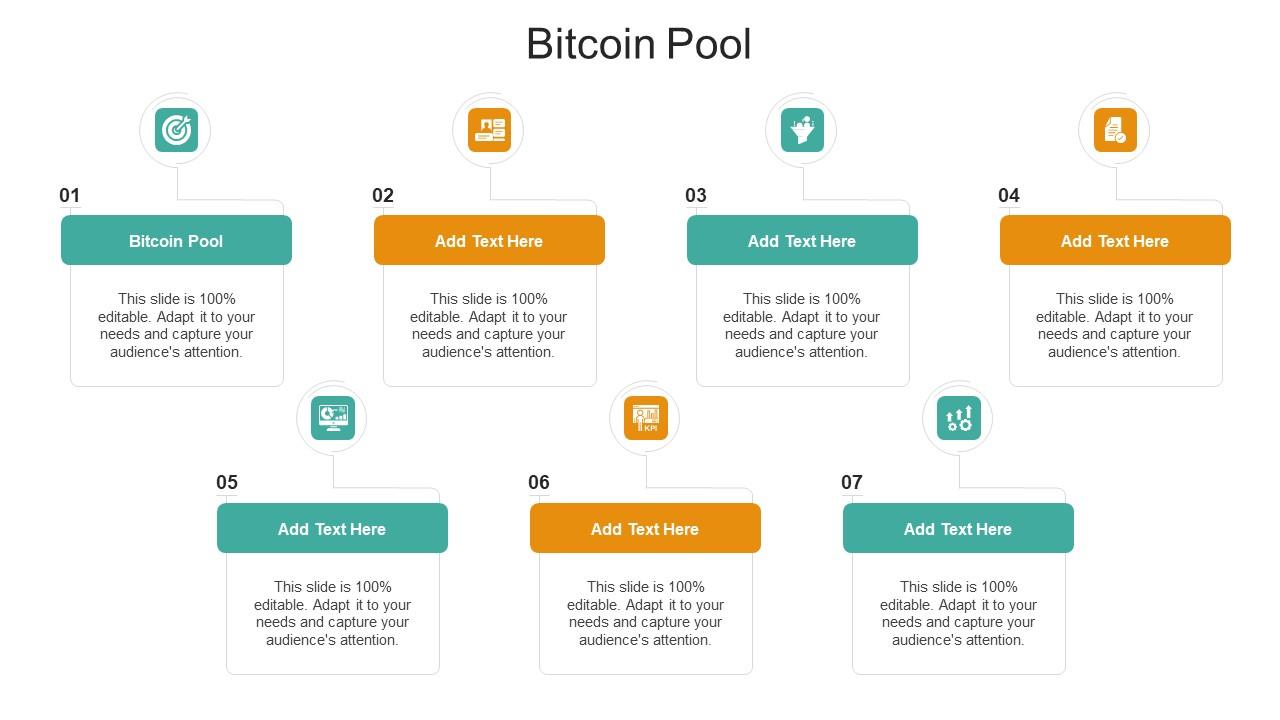
Presenting Bitcoin Pool In Powerpoint And Google Slides Cpb slide which is completely adaptable. The graphics in this PowerPoint slide showcase seven stages that will help you succinctly convey the information. In addition, you can alternate the color, font size, font type, and shapes of this PPT layout according to your content. This PPT presentation can be accessed with Google Slides and is available in both standard screen and widescreen aspect ratios. It is also a useful set to elucidate topics like Bitcoin Pool. This well structured design can be downloaded in different formats like PDF, JPG, and PNG. So, without any delay, click on the download button now.

People who downloaded this PowerPoint presentation also viewed the following :

FAQs for Bitcoin Pool In Powerpoint And

A Bitcoin mining pool is a collaborative network where individual miners combine their computational resources to solve complex cryptographic puzzles and earn block rewards collectively. Pool operators distribute mining tasks across participants, aggregate their hash power, and share rewards proportionally based on contribution, enabling smaller miners to receive consistent payouts while reducing individual variance and operational costs.

Mining pools distribute rewards among participants through proportional allocation systems based on each miner's contributed computational power and verified work shares. Most pools use methods like Pay-Per-Share, Proportional, or Pay-Per-Last-N-Shares systems, automatically calculating distributions through smart contracts and blockchain verification, with miners typically receiving payouts once minimum thresholds are met, ultimately enabling smaller operations to earn consistent returns while competing alongside larger mining enterprises.

When choosing a Bitcoin mining pool, consider pool fees, payout methods, minimum withdrawal thresholds, server locations, pool size, and reputation for reliability and transparency. These factors directly impact your mining profitability, with many miners finding that larger pools offer more consistent payouts while smaller pools provide higher individual rewards, ultimately enabling you to optimize earnings based on your specific mining setup and risk tolerance.

Mining pools offer consistent payouts, reduced variance, lower technical barriers, and shared resources, while solo mining provides complete control and potentially higher rewards. While pools charge fees and dilute individual profits, they enable smaller miners to compete effectively in an increasingly competitive landscape, with many finding that predictable income streams ultimately deliver better financial stability than the high-risk, high-reward nature of solo mining.

Pool fees directly reduce miners' earnings by taking a percentage of rewards, typically ranging from 1-3%, but they enable access to consistent payouts, professional infrastructure, and reduced variance that solo mining cannot provide. Many miners find that pool participation with modest fees delivers better long-term profitability than solo mining, especially for smaller operations, ultimately providing predictable income streams and operational stability in an increasingly competitive mining landscape.

Bitcoin pools use load balancing algorithms, stratum mining protocols, advanced hash rate distribution systems, real-time difficulty adjustment mechanisms, and automated server switching technologies. These technologies streamline operations by minimizing downtime, maximizing computational efficiency, and optimizing reward distribution, with many mining operations finding that strategic pool selection delivers significantly higher profitability and consistent returns.

Larger mining pools aggregate computational resources from more miners, significantly increasing their collective hash power and creating a higher probability of successfully mining blocks due to their enhanced processing capacity. While smaller pools offer potentially higher individual rewards per block, major pools like Antpool and F2Pool demonstrate that size enables more consistent block discovery, ultimately delivering steadier income streams and reduced variance for participating miners.

Bitcoin mining pools use several payout methods including Pay-Per-Share (PPS), Proportional, Pay-Per-Last-N-Shares (PPLNS), Full Pay-Per-Share (FPPS), and shared maximum pay per share. These methods balance risk distribution and reward allocation differently, with many miners finding that PPS offers predictable income while PPLNS maximizes long-term profitability, ultimately enabling strategic revenue optimization.

Miners can ensure security by choosing reputable pools with transparent fee structures, strong technical infrastructure, and proven track records of reliable payouts. They should use secure wallet addresses, enable two-factor authentication, monitor their hashrate contributions regularly, and diversify across multiple pools to minimize risks, while researching pool operators' reputations and payout histories before committing resources.

Stratum protocols enable efficient communication between miners and Bitcoin pools by reducing bandwidth usage, minimizing latency, and supporting variable difficulty adjustments for different mining hardware capabilities. These protocols streamline pool operations by delivering real-time work assignments, processing share submissions seamlessly, and coordinating thousands of miners simultaneously, ultimately enhancing mining efficiency and pool profitability.

Bitcoin pool evolution has dramatically transformed mining from individual operations to collaborative ecosystems, enabling smaller miners to compete while concentrating hash power among major pools. This shift has enhanced mining efficiency, reduced individual variance, and democratized participation, though it raises centralization concerns, with many miners finding that pooled resources deliver more consistent rewards and operational sustainability.

**INPUT**: What are the regulatory considerations surrounding Bitcoin mining pools? **OUTPUT**: Regulatory considerations include compliance with financial services laws, anti-money laundering requirements, tax reporting obligations, energy consumption regulations, and securities classifications in various jurisdictions. These frameworks vary significantly across countries, with mining pools navigating complex requirements while ensuring operational transparency, proper participant verification, and regulatory reporting, ultimately delivering compliant operations and sustainable competitive advantage in increasingly regulated markets. **Word count: 60 words**

Bitcoin pools handle network difficulty adjustments by automatically recalibrating their mining algorithms and redistributing computational tasks among pool members when Bitcoin's network adjusts difficulty every 2,016 blocks. These pools continuously monitor hash rates, optimize resource allocation across miners, and adjust payout calculations to maintain profitability, with many mining operations finding that pooled resources provide more stable returns during difficulty fluctuations.

Common misconceptions about Bitcoin mining pools include believing they centralize Bitcoin control, that operators can steal funds, that larger pools guarantee better profits, and that joining requires technical expertise or expensive equipment. While pools do concentrate hash power, they operate transparently with provable reward distribution, and individual miners retain control over their earnings, with many smaller operations finding pools actually democratize access to consistent mining rewards.

Miners can assess Bitcoin mining pool reliability through uptime statistics, payout history, fee structures, hash rate distribution, and community feedback across forums and social media platforms. Through transparent reporting systems, established pools like Antpool and F2Pool demonstrate consistent performance records, timely payouts, and strong technical infrastructure, ultimately enabling miners to maximize profitability while minimizing operational risks.

Ratings and Reviews

80% of 100
Review Form
Write a review
Most Relevant Reviews
  1. 80%

    by Denis Rose

    My presentations were a bit amateur before I found SlideTeam’s designs. I’ve been able to find slides for nearly every topic I’ve had to present. Thanks, Slideteam!
  2. 80%

    by Columbus Vasquez

    Easily Editable.

2 Item(s)

per page: