


Brand Extension Strategy Implementation For Gaining Competitive Advantage Branding CD





Try Before you Buy Download Free Sample Product
 Impress Your
 Audience
 100%
100% Editable
 Save Hours
 of Time


An extension strategy is a tactic used to boost market share for a certain good or service, keeping it out of decline and in the mature stage of the marketing product lifecycle. This PowerPoint Brand Extension Strategy Implementation for Gaining Competitive Advantage presentation offers access to a guide that can help businesses in extending their product lines, product lifecycle, brand name extension, fighting market competition, etc. Furthermore, the complete deck includes slides that can help businesses in getting a competitive advantage from brand extension through increasing customer loyalty, brand visibility, etc. Additionally, it offers impact assessment in terms of financial and market aspects for extension strategy campaigns of a company including annual income statement, performance by division, etc. Lastly, the PPT deck includes certain real word scenarios from corporations such as Godiva, Nestle Maggi, McDonalds, etc. in which detailed significance and working of brand extension are explained. Download it now.
People who downloaded this PowerPoint presentation also viewed the following :
Content of this Powerpoint Presentation
Slide 1: This slide displays the title Brand Extension Strategy Implementation for Gaining Competitive Advantage.
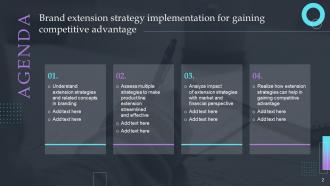
Slide 2: This slide displays the title AGENDA.
Slide 3: This slide exhibit table of content.
Slide 4: This slide exhibit table of content- Extension Strategy Introduction.
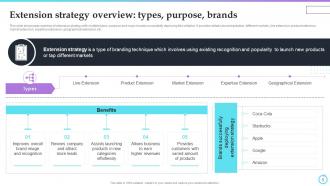
Slide 5: This slide showcases overview of extension strategy with multiple types, purpose and major brands successfully deploying this initiative.
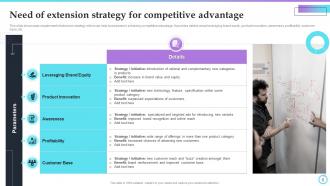
Slide 6: This slide showcases requirement of extension strategy which can help businesses in achieving competitive advantage.
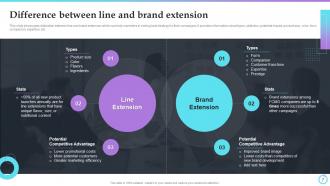
Slide 7: This slide showcases distinction between line and brand extension which can help marketers in sorting best strategy for their campaigns.
Slide 8: The following slide shows brand extension matrix with major techniques which are helpful for marketers to choose expansion campaign.
Slide 9: This slide exhibit table of content- Extension Strategy Overview.
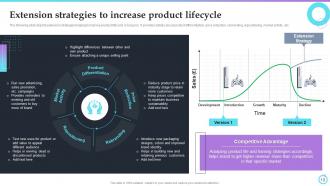
Slide 10: The following slide depicts extension strategies helping to improve product lifecycle in long run.
Slide 11: This slide shows key strategies which can help companies in extending their brand name.
Slide 12: This slide exhibit table of content- Product Line Extension.
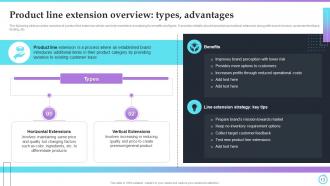
Slide 13: The following slide provides overview of product line extension which can help marketers in realizing its benefits and types.
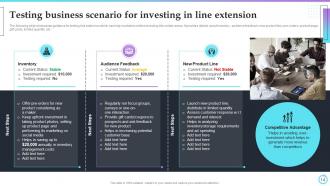
Slide 14: The following slide showcases guidance for testing line extension which can help marketers before investing into certain areas.
Slide 15: The following slide showcases assessment checklist which can help marketers to ensure effective deployment of line extension strategy.
Slide 16: The following slide showcases key techniques for initiating product line extension strategy for existing brands.
Slide 17: This slide showcases product line extension plan significant for marketers in launching new branding campaigns.
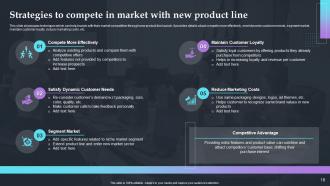
Slide 18: This slide showcases techniques which can help brands with their market competition through new product line launch.
Slide 19: This slide showcases best practices for brand managers before launching of new product line.
Slide 20: This slide exhibit table of content- Competitive Advantage Through Product Line Extension.
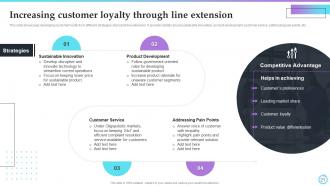
Slide 21: This slide showcases developing customer loyalty from different strategies of product line extension.
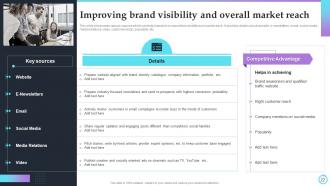
Slide 22: This slide showcases various sources which can help brands to increase their visibility and market reach.
Slide 23: This slide showcases various strategies and their impact on brand’s overall marketing efficiency.
Slide 24: This slide exhibit table of content- Measuring Performance of Brand Extension Strategy.
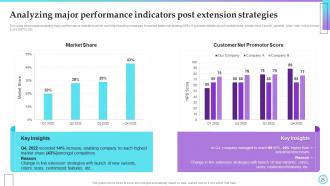
Slide 25: This slide showcases analyzing major performance indicators which can help branding managers to assess extension strategy KPIs.
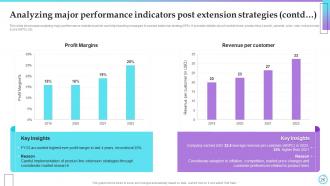
Slide 26: This slide showcases analyzing major performance indicators which can help branding managers to assess extension strategy KPIs.
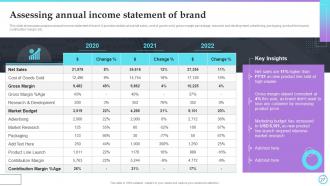
Slide 27: This slide showcases analyses annual income statement of brand.
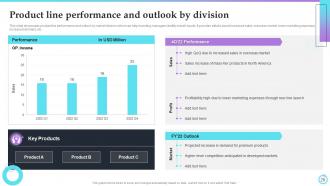
Slide 28: This slide showcases product line performance and outlook by market division which can help branding managers identify overall inputs.
Slide 29: This slide showcases affect of key extension strategies on major key performance indicators (KPI) and market insights.
Slide 30: This slide exhibit table of content- Use Cases and Examples.
Slide 31: This slide showcases case study of Godiva’s brand extension into premium chocolateries market.
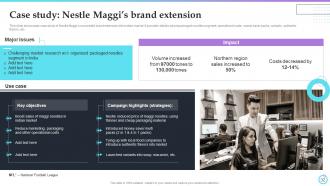
Slide 32: This slide showcases case study of Nestle Maggi’s successful brand extension into Indian market.
Slide 33: This slide showcases case study of McDonalds McCafé's successful brand extension into worldwide market.
Slide 34: This is the icons slide.
Slide 35: This slide presents title for additional slides.
Slide 36: This slide presents your company's vision, mission and goals.
Slide 37: This slide presents About us.
Slide 38: This slide depicts posts for past experiences of clients.
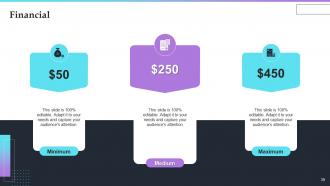
Slide 39: This slide depicts Financial.
Slide 40: This slide shows details of team members like name, designation, etc.
Slide 41: This slide shows Our target.
Slide 42: This slide shows SWOT analysis.
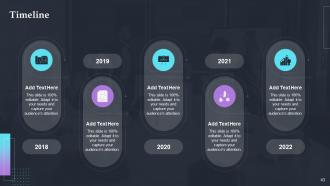
Slide 43: This slide exhibits yearly timeline of company.
Slide 44: This slide displays Venn.
Slide 45: This is thank you slide & contains contact details of company like office address, phone no., etc.
Brand Extension Strategy Implementation For Gaining Competitive Advantage Branding CD with all 50 slides:
Use our Brand Extension Strategy Implementation For Gaining Competitive Advantage Branding CD to effectively help you save your valuable time. They are readymade to fit into any presentation structure.




























FAQs for Brand Extension Strategy Implementation For Gaining Competitive
Brand extension strategies deliver significant competitive advantages through leveraging existing brand equity, reducing marketing costs, accelerating market entry, increasing customer lifetime value, and diversifying revenue streams. These approaches enable companies to streamline product launches while minimizing risk, with many retail and technology organizations finding that strategic extensions enhance market presence and ultimately deliver stronger customer relationships across multiple product categories.
Consumer perception significantly influences brand extension success by determining acceptance, credibility, and purchasing decisions based on existing brand associations and perceived fit. When consumers view the extension as naturally aligned with the parent brand's core values and expertise, companies experience higher adoption rates, reduced marketing costs, and stronger market penetration, with many retail and technology brands finding that positive consumer sentiment directly correlates with extension profitability.
Companies should consider market demand, brand fit with the new category, competitive landscape, required resources and capabilities, and potential risks to the parent brand's reputation. These factors help organizations evaluate whether their brand equity translates effectively, with many finding that closely related categories like automotive companies extending into luxury accessories deliver stronger customer acceptance and sustained competitive advantage.
Companies can effectively evaluate brand extension risks through comprehensive market research, brand equity assessment, competitive analysis, and financial modeling to measure potential cannibalization and consumer perception shifts. Through systematic testing, focus groups, and pilot launches, organizations can identify potential misalignment between core brand values and new categories, while assessing resource requirements and market readiness, ultimately minimizing strategic missteps.
Market research plays a crucial role in brand extension strategy by identifying consumer perceptions, market gaps, competitive landscapes, and target audience preferences. Through comprehensive analysis, companies can evaluate brand equity transferability, assess extension feasibility, and minimize risks, with many retail and technology brands finding that data-driven insights ultimately deliver higher success rates and stronger market positioning.
Established brands maintain identity through consistent visual elements, core messaging, and brand values while adapting communication strategies to new product contexts. Successful extensions like Apple moving from computers to phones and Disney expanding from animation to theme parks demonstrate how strategic alignment with fundamental brand promises, combined with careful market positioning, enables seamless diversification while strengthening overall brand equity.
Successful brand extensions include Apple's evolution from computers to smartphones and wearables, Virgin's expansion across airlines to telecommunications and health, Disney's growth from animation into theme parks and streaming services, and Amazon's transformation from books to cloud computing and retail. These strategic expansions leverage core brand equity while entering complementary markets, ultimately delivering diversified revenue streams and enhanced customer lifetime value.
Strong brand equity significantly enhances extended product line acceptance by leveraging established consumer trust, perceived quality, and emotional connections to reduce perceived risk and accelerate market adoption. Companies like Apple successfully extending from computers to phones and watches, or Amazon expanding from books to cloud services, demonstrate how positive brand associations transfer seamlessly, ultimately delivering faster consumer acceptance and competitive market positioning.
Brand extensions enhance customer loyalty by offering existing customers expanded product choices within their trusted brand ecosystem, reducing purchase risk and strengthening emotional connections. Through strategic extensions, companies like Apple and Amazon create comprehensive customer experiences across multiple categories, increasing purchase frequency, cross-selling opportunities, and lifetime value while making brand switching more difficult for competitors.
Common pitfalls include overextending into unrelated categories, diluting core brand identity, inadequate market research, and insufficient resource allocation for new ventures. Many companies underestimate consumer acceptance challenges and competitive responses, with retail and technology firms finding that rushed extensions without strategic alignment often cannibalize existing products, ultimately weakening brand equity and market position.
Brand synergy significantly enhances extension effectiveness by creating coherent connections between the parent brand and new offerings, ensuring consistent messaging, shared values, and complementary positioning across markets. When brands achieve strong synergy, customers experience seamless transitions between products, ultimately delivering increased trust, reduced marketing costs, and accelerated market penetration, with many companies finding that aligned extensions outperform standalone launches.
Brand extension success metrics include sales performance, market share growth, brand equity impact, customer acquisition rates, and profitability margins. These measurements enable organizations by tracking revenue generation, monitoring brand perception changes, and assessing customer acceptance across different sectors, with many companies finding that combining financial indicators with brand health metrics ultimately delivers comprehensive insights into extension viability and long-term strategic value.
Digital marketing supports brand extensions through targeted social media campaigns, SEO-optimized content marketing, influencer partnerships, email marketing to existing customers, and data-driven advertising across multiple platforms. These strategies enable brands to leverage existing customer relationships while reaching new audiences, with companies like Apple and Nike successfully using integrated digital approaches to introduce product extensions, ultimately driving faster market penetration and enhanced brand recognition.
Global brand extension cultural considerations include language nuances, religious sensitivities, local customs, color symbolism, and regional consumer preferences. These factors significantly impact product positioning, marketing messages, and brand perception, with many multinational companies finding that thorough cultural research and localized adaptation strategies ultimately deliver stronger market penetration and enhanced customer acceptance across diverse international markets.
Future trends influencing brand extension strategies include sustainability demands, digital-first consumer behaviors, AI-driven personalization, cross-industry collaborations, and direct-to-consumer models. These developments enable brands to streamline market entry, enhance customer experiences, and deliver targeted extensions across multiple touchpoints, with many organizations finding that data-driven insights ultimately accelerate successful expansion into adjacent markets.
-
The slides come with appealing color schemes and relevant content that helped me deliver a stunning presentation without any hassle!
-
Very unique, user-friendly presentation interface.