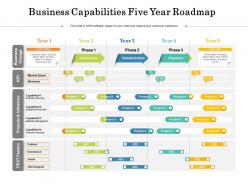
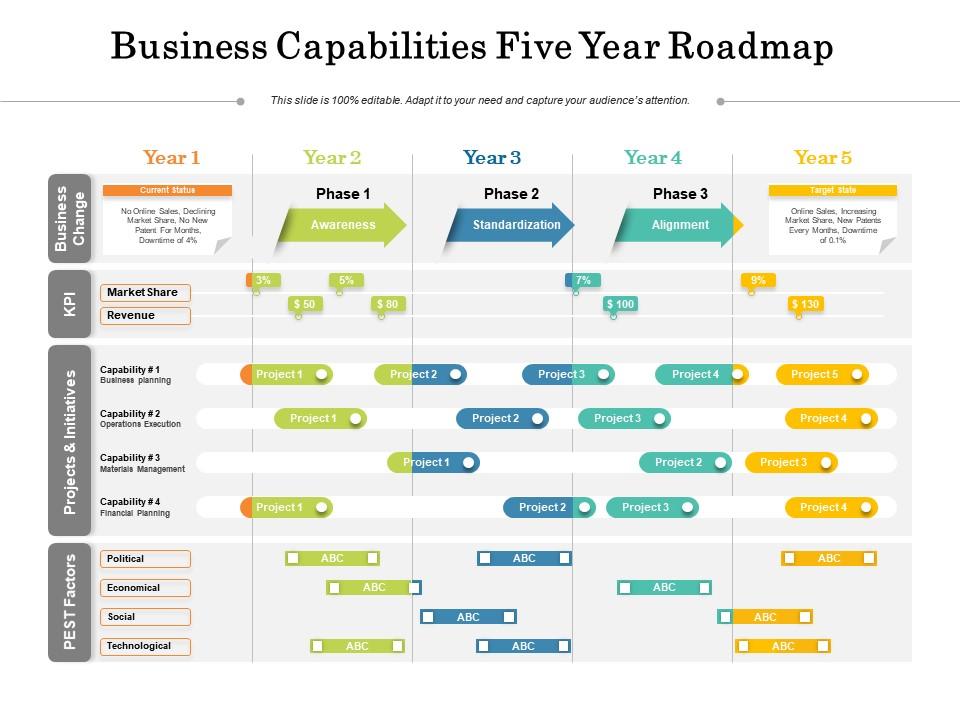
Hoja de ruta de cinco años de capacidades comerciales
Try Before you Buy Download Free Sample Product
Audience
Editable
of Time
Visualice su plan de trabajo y comunique sus ideas de manera impactante con nuestra hoja de ruta de cinco años de capacidades comerciales prediseñada. Muestre la descripción detallada del proyecto, los entregables clave y los hitos que se deben lograr con la ayuda de nuestro diseño de PowerPoint totalmente personalizable. Puede enfatizar fácilmente los objetivos del proyecto y discutir todas las actividades involucradas de una manera fácil de comprender utilizando nuestro tema PPT diseñado profesionalmente. Este diseño de hoja de ruta de PowerPoint es una herramienta de planificación estratégica perfecta que puede ayudar a mantener el proyecto en marcha. Con nuestro atractivo tema de PowerPoint, puede articular el flujo de trabajo, realizar un seguimiento del progreso del trabajo y tener una visión clara de la meta a alcanzar. Descargue esta versátil hoja de ruta de cinco años de capacidades comerciales y ahorre horas de trabajo. Este tema de PPT está disponible en relaciones de aspecto de 4,3 y 16,9. Esta plantilla de PowerPoint se puede personalizar para que pueda modificar el tamaño de fuente, el tipo de fuente, el color y las formas según sus requisitos. Esta presentación PPT es compatible con Google Slides, por lo que es fácilmente accesible. Puede descargar y guardar este diseño de PowerPoint en diferentes formatos como PDF, PNG y JPG.
Características de estas diapositivas de presentación de PowerPoint:
Presentación de diapositivas de PowerPoint sobre la hoja de ruta de cinco años sobre las capacidades empresariales. Este tema de PPT está disponible en relaciones de aspecto de 4,3 y 16,9. Esta plantilla de PowerPoint se puede personalizar para que pueda modificar el tamaño de fuente, el tipo de fuente, el color y las formas según sus requisitos. Esta presentación PPT es compatible con Google Slides, por lo que es fácilmente accesible. Puede descargar y guardar este diseño de PowerPoint en diferentes formatos como PDF, PNG y JPG.
People who downloaded this PowerPoint presentation also viewed the following :
Hoja de ruta de cinco años de capacidades comerciales con las 2 diapositivas:
Ofrezca a su audiencia una experiencia satisfactoria. Encontrarán que nuestra hoja de ruta de cinco años de capacidades empresariales es muy positiva.
FAQs for Business capabilities
So there's basically three pieces to this whole thing. Start by figuring out what capabilities you actually have right now and how they're doing - like an honest assessment, you know? Then map out where you want to be in a couple years (this part's actually pretty exciting once you get into it). The tricky bit is planning all the projects that'll get you from point A to point B. Don't go crazy trying to fix everything at once though - I've seen that backfire so many times. Pick the stuff that'll give you the biggest bang for your buck and is actually doable.
So you basically map out what capabilities you need to hit your strategic goals. First, figure out the gaps between where you are now and where you want to be. Then prioritize based on impact and urgency - though honestly, everything always feels urgent (classic mistake). Each capability should tie directly to a specific outcome you're trying to achieve. Don't forget timelines and dependencies or you'll be scrambling later. I'd treat it more like your execution game plan than some fancy wish list. The whole thing falls apart if you can't connect the dots between capabilities and actual results.
Honestly, I'd go with capability-based planning first - it's the most straightforward. Map what you've got against what you actually need for business results. Value stream mapping is where things get interesting though, shows you exactly how capabilities tie to real customer value. TOGAF's solid if you need structure, but don't get bogged down in all their documentation (trust me on that one). Start simple with a capability heat map - visual stuff works way better than spreadsheets. Layer your priorities on top after. Pick one approach as your main thing, then just steal the good bits from the others.
So first thing - map out what you can do against your big goals and score them on impact vs how much work they'll take. The 2x2 matrix thing actually works here, though I know it sounds corporate-y. Quick wins are obvious choices. But here's where it gets messy: some capabilities unlock others later, so you can't just pick the easy stuff. Also factor in what you're already good at and what resources you actually have. The boring foundational work usually matters more than the flashy projects, honestly. Get your key people to help weight everything together - makes the whole thing way less painful when everyone helped decide.
You absolutely need stakeholder input - otherwise you're just guessing at what matters. Different people spot different problems: sales sees customer pain points, IT sees the technical mess that's slowing everything down. Both are usually right, which makes it tricky. The real challenge is balancing all those competing voices without just giving the squeakiest wheel what they want. I'd do some structured workshops upfront to gather input, then keep checking in as you build it out. Trust me, a roadmap that looks perfect but nobody actually follows is basically worthless. You want something people will actually use and get behind.
Honestly, quarterly is the minimum but stuff changes so fast now that you might need to update it more often. Monthly check-ins work great - just quick ones to see if anything's shifted. Annual reviews? Way too slow, you'll miss major market changes or tech shifts. I've watched companies get burned because they thought their roadmap was permanent. Set those calendar reminders or you'll totally forget (I always do). The formal quarterly review is solid, but those lightweight monthly touches are where you catch problems early. Better to adjust course a few times than sail straight into a storm, you know?
Honestly, start simple with whatever your team will actually use - I've seen people create killer capability maps in PowerPoint of all things. Lucidchart and Visio are great middle-ground options if you want something cleaner. For the heavy-duty stuff, tools like MEGA or LeanIX are built specifically for this, but they're overkill unless you're dealing with enterprise-level complexity. Miro's pretty solid too, especially if your team likes collaborative tools. Don't overthink the tool choice though - just pick one and start mapping your current state first. You can always migrate later.
So a capabilities roadmap is just mapping what skills your org has now vs what you'll need down the road. The gaps jump out at you pretty fast - way better than shooting in the dark, honestly. List out the must-have capabilities for the next few years first. Then take a hard look at what you actually have today. Maybe you're missing technical chops, leadership depth, or specific domain expertise for upcoming stuff. It's kind of like auditing your team's skillset? But more strategic. You'll spot the holes where you're either short-staffed or just don't have the right people.
Look at both leading and lagging indicators - that's key. Capability maturity scores show how well each one's performing vs your target. Business impact stuff matters too: revenue growth, cost cuts, customer satisfaction tied to those capabilities. Time-to-market improvements are massive if you're competing hard. Honestly, adoption rates might be the most telling metric - doesn't matter how perfect your capability looks on paper if people aren't actually using it, right? I'd do quarterly check-ins to see how you're tracking against these numbers and tweak the roadmap as needed.
Think of a capabilities roadmap as your spending GPS. It shows you exactly where to put money and people first - the stuff that'll actually move the needle for your business goals. No more throwing cash at whatever department screams loudest (though honestly, sometimes you still will). The smart move? Build your annual budget around developing these key capabilities, not just keeping the lights on. You don't want to be that company building fancy AI dashboards when your basic data systems are held together with duct tape. Sequence matters here.
Oh man, don't try mapping out every tiny detail right away - you'll lose your mind. Start high-level first. The other big mistake? Skipping stakeholder input entirely, then wondering why nobody uses what you built. I've seen this happen way too often. Also avoid creating some beautiful static document that just sits there collecting dust. Your roadmap has to change as priorities shift. You can't plan future capabilities without knowing what you actually have now either. Get the right people involved early and honestly, just accept that you'll be updating this thing constantly.
Okay so here's the thing - your roadmap has to solve whatever's making the CEO lose sleep at night. Revenue, costs, beating competitors, you know the drill. I've watched so many of these things crash and burn because they seemed like random IT projects instead of actual business solutions. Find out what the top 3 priorities are first. Then map your capabilities to those specific problems with real timelines and metrics they can track. Oh and definitely get someone in the C-suite on your side early - let them help tell the story. Keep showing them wins along the way so they have something concrete to brag about.
Honestly, think of it like a GPS for your digital transformation. You map out which business capabilities need tech upgrades and when to do them. Super helpful for prioritizing where to spend money instead of just buying random tech that doesn't actually help your business. Stakeholders love it too because they can see exactly how new technology supports what the company actually does. You'll spot problems before they hit you, and - this might sound obvious but - you should definitely start by figuring out what capabilities you have now. Then identify what's missing digitally.
From what I've seen, tech and finance companies get the most out of capabilities roadmaps. They're always dealing with crazy complex changes and really need that direction. Healthcare and manufacturing aren't far behind - all those regulations and super long rollouts, you know? Pretty much any industry that's getting turned upside down will benefit, but those four really can't just make it up as they go. Oh, and if you've got multiple business units or big tech upgrades planned for the next few years, definitely prioritize this.
Market trends will mess with your roadmap constantly - there's no avoiding it. New tech pops up, customers start wanting different things, competitors shake up the game. Honestly, I've watched so many teams stick to their original plan while the world changed around them. Pretty painful to see. You've got to scan what's happening every few months and ask yourself "wait, does this shift what we actually need to be good at?" Building in some wiggle room helps too. That way you're not scrambling when external stuff forces your hand instead of just following internal priorities.
No Reviews