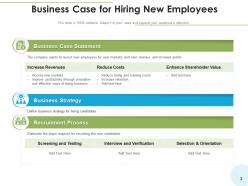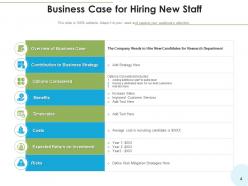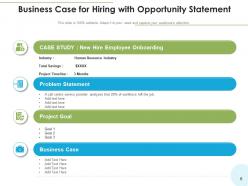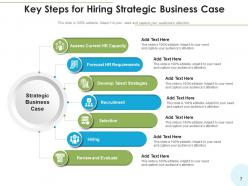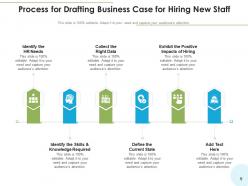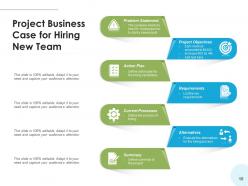
Business Case for Hiring Opportunity Statement Process Investment Requirements

Rating:
88%
Business Case For Hiring Opportunity Statement Process Investment Requirements
Slide 1 of 11
Favourites Favourites

Try Before you Buy Download Free Sample Product

Audience Impress Your
Audience
Editable 100%
Editable
Time Save Hours
of Time
The Biggest Sale is ending soon in
0
0
:
0
0
:
0
0
Rating:
88%

Merkmale dieser PowerPoint-Präsentationsfolien:

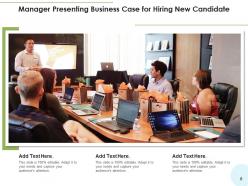
Stellen Sie eine glaubwürdige und überzeugende Präsentation ab, indem Sie diesen Business Case for Hiring Opportunity Statement Process Investment Requirements bereitstellen. Intensivieren Sie Ihre Botschaft mit den richtigen Grafiken, Bildern, Symbolen usw., die in diesem kompletten Deck präsentiert werden. Diese PPT-Vorlage ist ein großartiger Ausgangspunkt, um Ihre Nachrichten zu übermitteln und eine gute Zusammenarbeit aufzubauen. Die elf Folien, die dieser PowerPoint-Diashow hinzugefügt wurden, helfen Ihnen, das Thema gründlich zu erklären. Sie können damit verschiedene Arten von Informationen in Form von Statistiken, Zahlen, Datendiagrammen und vielem mehr studieren und präsentieren. Diese PPT-Diashow ist für die Verwendung in Standard- und Breitbild-Seitenverhältnissen verfügbar. Sie können es also nach Belieben verwenden. Darüber hinaus kann es in den Formaten PNG, JPG und PDF heruntergeladen werden, die alle vollständig bearbeitet und geändert werden können. Das tiefgreifendste Merkmal dieses PPT-Designs ist, dass es vollständig mit Google Slides kompatibel ist, wodurch es für jede Branche und jeden Geschäftsbereich geeignet ist.

FAQs for Business Case For Hiring Opportunity Statement

An effective hiring process includes job analysis and posting, candidate sourcing and screening, structured interviews, skills assessments, reference checks, and onboarding planning. These strategic steps streamline recruitment by attracting qualified talent, minimizing hiring bias, and reducing turnover costs, with many organizations finding that structured approaches ultimately deliver faster placements and better cultural fit.

Organizations can evaluate hiring ROI by measuring time-to-fill reduction, cost-per-hire decreases, employee retention rates, and productivity metrics of new hires. Through tracking these indicators alongside revenue generated by new employees, companies streamline recruitment investments while enhancing talent quality, with many finding that strategic hiring processes deliver measurable competitive advantages and long-term operational efficiency.

Technology and automation streamline hiring through AI-powered resume screening, automated interview scheduling, chatbots for candidate communication, predictive analytics for role matching, and digital assessment platforms. These tools significantly reduce time-to-hire, minimize administrative burden, and enhance candidate experiences, with many organizations finding that strategic automation delivers faster placements while enabling recruiters to focus on relationship-building and strategic decision-making.

Employer branding significantly impacts talent attraction by showcasing company culture, values, career growth opportunities, and employee experiences across digital platforms and professional networks. Strong employer brands reduce recruitment costs, accelerate hiring timelines, and attract higher-quality candidates, with many organizations finding that authentic branding delivers competitive advantage in increasingly tight talent markets.

Key hiring metrics include time-to-fill, cost-per-hire, quality of hire scores, candidate experience ratings, and retention rates within the first year. These measurements enable organizations to streamline recruitment operations, reduce operational costs, and enhance talent acquisition outcomes, with many companies finding that comprehensive tracking ultimately delivers faster hiring cycles and improved employee satisfaction.

Diverse hiring practices enhance company performance by fostering innovation, improving decision-making, and expanding market reach through varied perspectives and experiences. Organizations with diverse teams consistently demonstrate higher profitability, better problem-solving capabilities, and stronger customer connections, while also attracting top talent in an increasingly competitive landscape, ultimately delivering sustainable competitive advantage.

Training types include unconscious bias awareness, behavioral interviewing techniques, candidate assessment methodologies, legal compliance updates, and structured decision-making frameworks. These programs enhance hiring managers' abilities by improving candidate evaluation accuracy, reducing discriminatory practices, and streamlining selection processes, with many organizations finding that comprehensive training ultimately delivers better hiring outcomes and stronger team performance.

Candidate experience can be optimized through clear communication, streamlined application processes, timely feedback, and transparent timelines throughout recruitment stages. Organizations increasingly leverage automated updates, personalized interactions, and structured interview processes to enhance engagement, with companies like tech firms and financial services finding that positive candidate experiences strengthen employer branding and attract top talent.

A poorly executed hiring process creates significant risks including high turnover costs, decreased team productivity, cultural misalignment, legal compliance issues, and damaged employer reputation. These challenges ultimately result in substantial financial losses, reduced operational efficiency, and difficulty attracting top talent, with many organizations finding that strategic hiring investments deliver measurable competitive advantages.

Industry-specific hiring practices vary significantly, with healthcare requiring extensive credential verification and background checks, technology sectors emphasizing coding assessments and cultural fit interviews, and financial services focusing on regulatory compliance and risk assessment capabilities. These tailored approaches streamline candidate evaluation by aligning recruitment processes with sector-specific competencies, regulatory requirements, and operational demands, ultimately delivering higher-quality hires and reduced turnover rates.

Strategies include automated candidate screening, structured interview processes, pre-employment assessments, streamlined decision-making workflows, and strategic talent pipeline development. These approaches enhance efficiency by eliminating bottlenecks, standardizing evaluations, and maintaining candidate engagement, with many organizations finding that combining technology with clear hiring criteria ultimately delivers faster placements while preserving quality standards.

Predictive analytics improves hiring decisions by analyzing historical data patterns, candidate assessments, performance correlations, and retention indicators to identify top talent prospects. Through machine learning algorithms, organizations streamline recruitment processes, reduce hiring bias, and predict candidate success rates, with companies like Amazon and IBM finding significantly improved employee retention and faster time-to-hire outcomes.

Legal considerations during hiring include anti-discrimination laws, equal opportunity compliance, background check regulations, wage transparency requirements, and data privacy protections. These frameworks guide organizations by ensuring fair candidate treatment, protecting sensitive information, and maintaining regulatory compliance, with many companies finding that proactive legal adherence ultimately delivers reduced liability risks and enhanced employer reputation.

Employer values and culture can be effectively communicated through authentic storytelling in job descriptions, transparent interview processes, employee testimonials, and workplace tours or virtual experiences. Companies like Google and Salesforce showcase their cultures through detailed career pages, team spotlights, and interactive content, ultimately attracting candidates who align with their organizational mission and values.

Referral programs significantly streamline hiring efficiency by reducing time-to-fill, improving candidate quality, and minimizing recruitment costs through leveraging existing employee networks. These programs enable organizations to access pre-vetted talent pools, accelerate interview processes, and enhance retention rates, with many companies finding that referred candidates integrate faster and deliver superior long-term performance outcomes.

Ratings and Reviews

88% of 100
Review Form
Write a review
Most Relevant Reviews
  1. 80%

    by Chris Watson

    Designs have enough space to add content.
  2. 100%

    by O'Sullivan Evans

    Awesome presentation, really professional and easy to edit.
  3. 100%

    by Donovan Cunningham

    Illustrative design with editable content. Exceptional value for money. Highly pleased with the product.
  4. 80%

    by Donte Duncan

    Easily Understandable slides.
  5. 80%

    by Dewey Stephens

    Commendable slides with attractive designs. Extremely pleased with the fact that they are easy to modify. Great work!

5 Item(s)

per page: