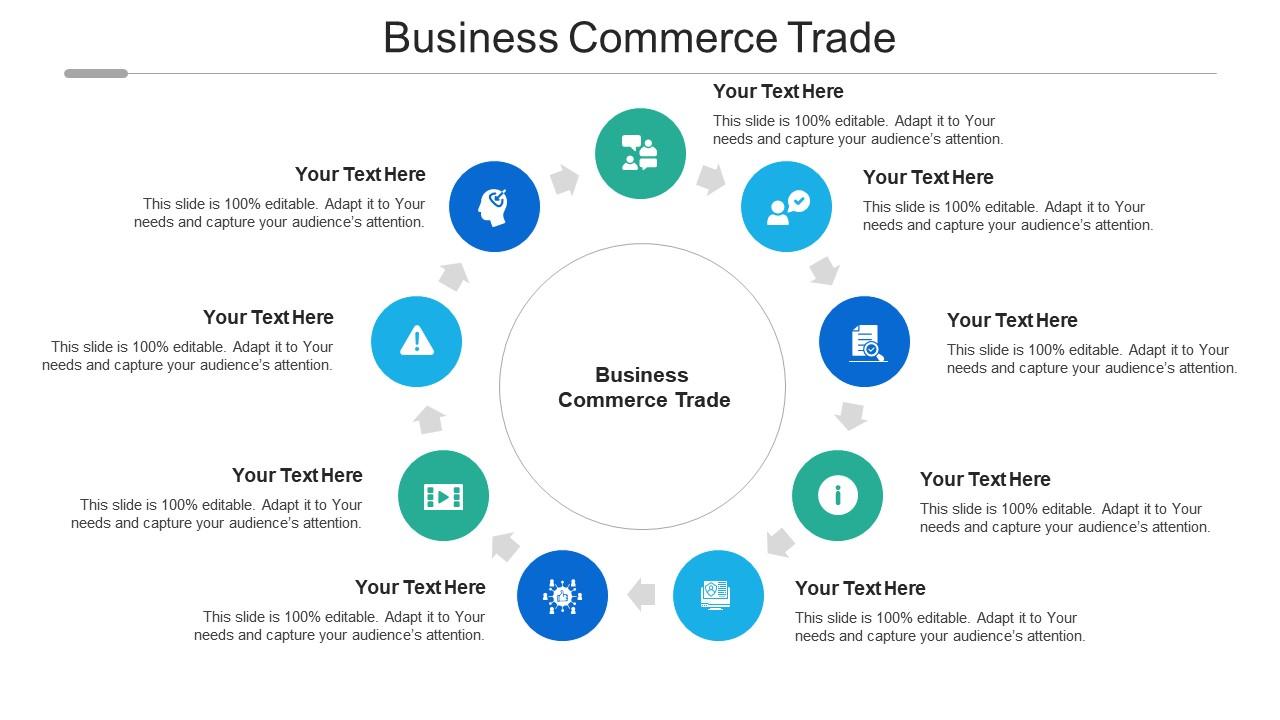
Business commerce trade ppt powerpoint presentation slides deck cpb
Try Before you Buy Download Free Sample Product
Audience
Editable
of Time
Our Business Commerce Trade Ppt Powerpoint Presentation Slides Deck Cpb are topically designed to provide an attractive backdrop to any subject. Use them to look like a presentation pro.
People who downloaded this PowerPoint presentation also viewed the following :
Business commerce trade ppt powerpoint presentation slides deck cpb with all 6 slides:
Use our Business Commerce Trade Ppt Powerpoint Presentation Slides Deck Cpb to effectively help you save your valuable time. They are readymade to fit into any presentation structure.
FAQs for Business commerce trade ppt powerpoint presentation
Key components driving successful business commerce today include digital transformation, customer experience optimization, data analytics, supply chain efficiency, and strategic partnerships. These elements work together by streamlining operations, enhancing customer engagement, and enabling real-time decision-making, with many organizations finding that integrating these components delivers competitive advantage and sustainable growth.
E-commerce has revolutionized traditional trade by digitizing transactions, eliminating geographical barriers, enabling direct-to-consumer models, and automating supply chain processes. These transformations have streamlined operations across retail, manufacturing, and financial services, with many businesses finding that digital platforms deliver faster market access, reduced overhead costs, and enhanced customer experiences while driving unprecedented global reach.
Emerging technologies like artificial intelligence, blockchain, IoT sensors, robotic process automation, and cloud computing revolutionize business commerce by streamlining supply chains, automating transactions, and enhancing customer experiences. These technologies enable faster payment processing, real-time inventory tracking, and predictive analytics, with many retail and manufacturing organizations finding significantly reduced operational costs and improved competitive positioning.
Businesses leverage data analytics for market insights through customer behavior analysis, sales pattern recognition, competitive intelligence gathering, demand forecasting, and market segmentation. These analytical approaches enable companies to identify emerging trends, optimize pricing strategies, and personalize customer experiences, with many retailers and e-commerce platforms finding that data-driven decisions significantly enhance operational efficiency and competitive advantage.
Small businesses face regulatory complexity, limited market knowledge, currency fluctuation risks, high logistics costs, and difficulty accessing international financing when entering global markets. These challenges, while significant in sectors like manufacturing and retail, present opportunities for strategic partnerships, technology adoption, and niche market positioning, with many small enterprises finding that focused international expansion ultimately delivers competitive advantages and revenue diversification.
Supply chain disruptions significantly impact business commerce by creating inventory shortages, increasing operational costs, and delaying product deliveries to customers. These disruptions force companies to diversify suppliers, implement risk management strategies, and enhance supply chain visibility, with many organizations finding that building resilient, flexible supply networks ultimately delivers competitive advantage and operational stability.
Companies can ensure international trade regulations compliance through comprehensive trade compliance programs, regular regulatory monitoring, automated documentation systems, staff training initiatives, and strategic partnerships with customs brokers. These strategies streamline operations by reducing penalty risks, accelerating customs clearance, and enhancing supply chain transparency, with many multinational organizations finding that proactive compliance delivers significant competitive advantages and operational efficiency.
Branding is crucial in business commerce as it establishes consumer trust, differentiates products from competitors, and creates emotional connections that drive purchasing decisions. Strong branding enables companies to command premium pricing, build customer loyalty, and reduce marketing costs over time, with many retail and service organizations finding that consistent brand messaging across touchpoints ultimately delivers sustained competitive advantage and long-term profitability.
Ethical considerations in global trade include fair labor practices, environmental sustainability, supply chain transparency, cultural sensitivity, and anti-corruption measures. These principles enable businesses to build trusted international partnerships, enhance brand reputation, and ensure regulatory compliance, while many organizations finding that ethical trade practices ultimately deliver competitive advantages and sustainable growth in increasingly conscious markets.
Cultural differences significantly influence international negotiation through varying communication styles, relationship-building priorities, decision-making hierarchies, time orientations, and risk tolerances. These cultural nuances affect everything from contract structures to meeting protocols, with many multinational corporations finding that understanding local business customs, adapting negotiation approaches, and investing in cultural competency ultimately delivers stronger partnerships, smoother deal closures, and sustained competitive advantage in global markets.
Best practices for managing cross-border e-commerce transactions include multi-currency payment processing, automated tax calculation systems, localized checkout experiences, compliance management tools, and real-time fraud detection. These technologies streamline international sales by reducing cart abandonment, ensuring regulatory compliance, and minimizing transaction risks, with many global retailers finding that integrated solutions ultimately deliver faster market expansion and enhanced customer trust across diverse markets.
Businesses can enhance trade relationships and customer engagement through social media by leveraging targeted content marketing, real-time customer support, influencer partnerships, community building, and data-driven insights. These platforms enable companies to streamline communication with international partners, showcase product capabilities, and build trust through transparent interactions, with many retail and manufacturing organizations finding that strategic social media presence ultimately delivers stronger customer loyalty and expanded market reach.
Digital marketing significantly enhances commerce venture visibility through search engine optimization, social media engagement, targeted advertising, content marketing, and email campaigns. These strategies streamline customer acquisition by expanding market reach, reducing advertising costs, and enabling precise audience targeting, with many retail and e-commerce businesses finding that digital approaches deliver measurable growth and competitive advantage.
Critical trade performance metrics include revenue growth, market penetration rates, customer acquisition costs, profit margins, and return on investment across international markets. These indicators enable businesses to evaluate operational efficiency, competitive positioning, and strategic expansion success, with many organizations finding that tracking trade volumes, compliance costs, and partnership effectiveness ultimately delivers comprehensive insights for optimizing global commerce strategies.
Businesses mitigate currency fluctuation risks through forward contracts, currency hedging strategies, natural hedging by matching revenues and expenses in same currencies, diversifying across multiple markets, and using financial derivatives. These approaches enable companies in sectors like manufacturing and retail to stabilize cash flows, reduce transaction costs, and maintain predictable profit margins, ultimately delivering greater financial stability and competitive advantage in global markets.
-
Informative design.
-
Really like the color and design of the presentation.