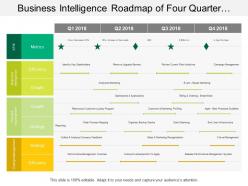
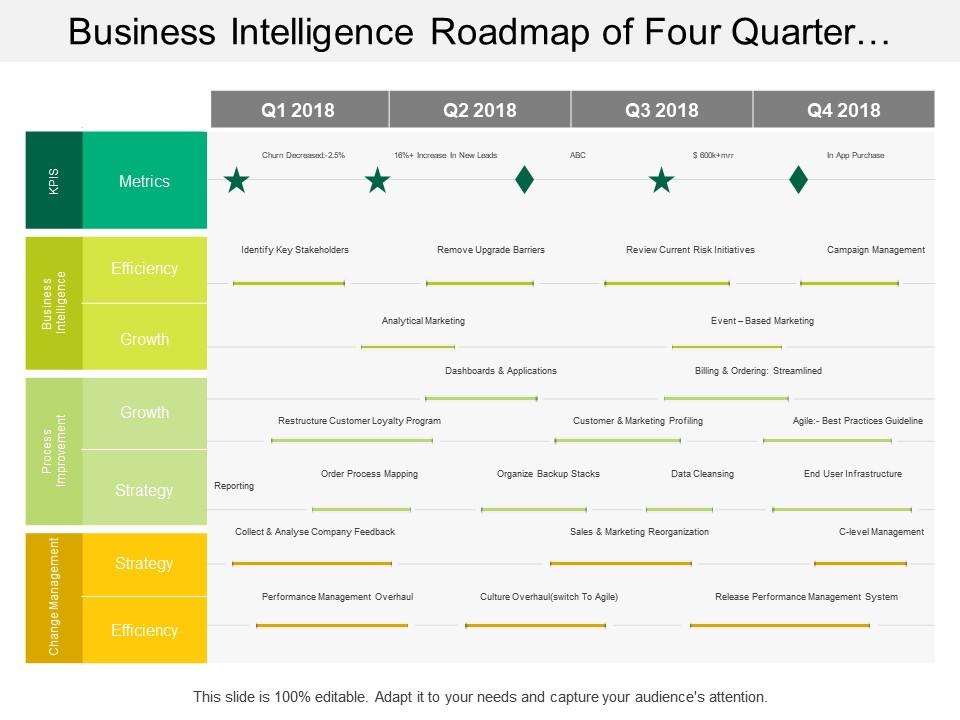
Business-Intelligence-Roadmap des Vier-Quartals-Zeitplans umfasst Prozessverbesserung und Änderungsmanagement
Try Before you Buy Download Free Sample Product
Audience
Editable
of Time
Planen Sie, Ideen zur Verbesserung von Geschäftsprozessen für die nächsten Quartale zu kommunizieren? Unsere professionell gestaltete Business-Intelligence-Roadmap mit einem Zeitrahmen von vier Quartalen, einschließlich einer Präsentationsvorlage für Prozessverbesserungen und Änderungsmanagement, kann Ihnen dabei helfen, dies effizient zu tun. Verwenden Sie diese PPT-Vorlage, um alle Aspekte von Business Intelligence wie Data Mining und Analyse für Abfragen und Berichte zu visualisieren und zu kommunizieren. Diese äußerst vielseitige PPT-Vorlage für Business-Intelligence-Strategie-Roadmaps kann von Business-Intelligence-Managern verwendet werden, um zu planen, wie das Team die Geschäftsprozesse optimieren kann, um die Geschäftsziele zu erreichen. Die BI-Roadmap-PPT-Vorlage ermöglicht es dem Team, seine internen Aktivitäten für die nächsten vier Quartale mit Schwerpunkt auf Qualitätsverbesserungsplänen zu planen. Die Designstruktur zeigt alle notwendigen Details unter Verwendung des Change-Management-Ansatzes, um die Geschäftsziele effizient zu erreichen. Das Design-Layout ist einfach und leicht verständlich, hochwertige Bilder und Symbole wurden im PPT-Design verwendet. Warten Sie also nicht, sondern laden Sie einfach diese einzigartige Business-Intelligence-Strategieplan-PPT-Designvorlage herunter, indem Sie auf die Download-Schaltfläche klicken, und verwenden Sie sie in Ihren anstehenden Präsentationen. Entmutigen Sie Anspielungen mit unserer Business-Intelligence-Roadmap der Vier-Quartals-Zeitachse, einschließlich Prozessverbesserung und Änderungsmanagement. Bringen Sie die Leute dazu, immer offen zu sein.
Merkmale dieser PowerPoint-Präsentationsfolien:
Das wichtigste Merkmal dieser BI-Roadmap-PPT-Designvorlage ist, dass sie vollständig editierbar ist. Sie können das Design entsprechend Ihren Geschäftsanforderungen ändern und anpassen. Anleitungen zum Vornehmen von Änderungen wurden von unseren professionellen PPT-Experten bereitgestellt. Sie können die Diashow in JPEG- und PDF-Formate konvertieren. Die Diashow ist in der normalen und Vollbildansicht zugänglich, keine Zugeständnisse an die Designqualität in der Vollbildansicht.
People who downloaded this PowerPoint presentation also viewed the following :
Business-Intelligence-Roadmap des Vier-Quartals-Zeitplans umfasst Prozessverbesserung und Änderungsmanagement mit allen 5 Folien:
Zeigen Sie Besorgnis und Empathie mit unserer Business Intelligence-Roadmap der Vier-Quartals-Zeitleiste, einschließlich Prozessverbesserung und Änderungsmanagement. Ihre Gefühle bekommen gebührenden Ausdruck.
FAQs for Business intelligence roadmap of four quarter timeline include process improvement
Key components include data governance frameworks, technology infrastructure planning, stakeholder alignment processes, performance metrics definition, and implementation timelines with clear milestones. These elements work together by establishing data quality standards, ensuring scalable technology choices, and creating measurable outcomes, with many organizations finding that strategic roadmaps deliver faster decision-making and competitive advantage.
Organizations can effectively assess their current BI capabilities through comprehensive data audits, technology stack evaluations, user competency assessments, and gap analysis against industry benchmarks. This assessment process enables companies to identify strengths and weaknesses across their analytics infrastructure, with many finding that systematic evaluation reveals opportunities for streamlined reporting, enhanced data quality, and improved decision-making workflows, ultimately delivering strategic clarity for their BI roadmap development.
Stakeholder engagement ensures BI roadmaps align with diverse organizational needs, priorities, and technical requirements across departments like finance, operations, and marketing. Through collaborative workshops and feedback sessions, organizations identify critical data sources, define meaningful KPIs, and establish realistic implementation timelines, ultimately delivering solutions that drive adoption and measurable business value.
Businesses align their BI roadmap with strategic goals by identifying key performance indicators, mapping data requirements to business priorities, and establishing cross-functional governance teams. This strategic combination enables organizations to prioritize analytics investments, streamline decision-making processes, and measure progress against objectives, with many companies finding that integrated BI planning accelerates strategic execution and competitive advantage.
Common pitfalls include inadequate stakeholder engagement, unrealistic timelines, insufficient data quality assessment, lack of clear success metrics, and ignoring organizational change management. These oversights often lead to implementations that fail to deliver expected ROI, with many organizations finding that addressing data governance, user training, and scalable infrastructure from the outset ultimately streamlines adoption and enhances long-term strategic value.
Data governance integrates into a business intelligence roadmap through establishing data quality standards, defining clear ownership roles, implementing security protocols, and creating consistent metadata management practices. These frameworks enable organizations to build scalable BI architectures that deliver reliable insights, with many financial services and healthcare institutions finding that strong governance foundations ultimately accelerate decision-making and regulatory compliance.
Essential BI roadmap technologies include data warehouses, ETL tools, analytics platforms, visualization software, and cloud infrastructure. These technologies streamline data integration, automate reporting processes, and enhance decision-making capabilities, with many organizations finding that strategic combinations of tools like Tableau, Power BI, and AWS deliver faster insights, improved operational efficiency, and significant competitive advantages.
BI initiatives should be prioritized by evaluating business impact, resource requirements, data readiness, and strategic alignment with organizational goals. Organizations typically start with high-impact, low-complexity projects like executive dashboards or operational reporting, then progress to advanced analytics and predictive modeling, ultimately delivering faster decision-making and competitive advantage across departments.
Strategies include comprehensive user training, intuitive dashboard design, stakeholder involvement in tool selection, continuous feedback collection, and phased implementation approaches. These methods enhance adoption by ensuring tools meet actual business needs, minimizing learning curves, and demonstrating clear value, with many organizations finding that early user champions and regular success showcases significantly accelerate enterprise-wide acceptance.
Organizations should measure BI success through key performance indicators like decision-making speed, data accuracy improvements, cost reductions, and user adoption rates across departments. By tracking metrics such as faster reporting cycles, reduced manual processes, and enhanced operational efficiency, companies can quantify ROI while demonstrating how strategic data initiatives ultimately deliver competitive advantage and measurable business outcomes.
Best practices for continuously updating BI roadmaps include regular stakeholder feedback sessions, quarterly technology assessments, performance metric reviews, competitive landscape analysis, and iterative planning cycles. These approaches enable organizations to adapt to evolving business needs, emerging technologies, and market changes, with many enterprises finding that consistent roadmap refinement delivers enhanced operational efficiency and sustained competitive advantage.
Organizations can incorporate advanced analytics and AI into their BI roadmap through predictive modeling, machine learning algorithms, automated data processing, natural language processing, and real-time analytics capabilities. These technologies enhance decision-making by identifying patterns, forecasting trends, and streamlining data interpretation, with many financial services and retail companies finding that AI-powered BI delivers faster insights and competitive advantage.
Data quality significantly impacts business intelligence roadmap effectiveness by determining accuracy of insights, reliability of forecasting models, and trustworthiness of strategic decisions derived from analytics platforms. Poor data quality leads to flawed reporting and misguided business strategies, while high-quality data enables organizations to streamline operations, enhance customer experiences, and accelerate decision-making processes, ultimately delivering competitive advantage and measurable ROI.
Training and support should be structured as phased programs aligned with each BI roadmap milestone, incorporating hands-on workshops, role-specific curricula, and continuous mentorship systems. Through progressive skill-building initiatives, organizations enable smoother technology adoption, reduce implementation resistance, and accelerate user competency, with many enterprises finding that structured training programs ultimately deliver faster ROI and enhanced analytical capabilities.
Key BI initiative metrics include user adoption rates, data quality scores, query response times, cost per insight, and business impact measurements like revenue attribution and decision speed improvements. These metrics enable organizations to assess technical performance, user engagement, and strategic value delivery, with many companies finding that combining operational efficiency indicators with business outcome measures provides the most comprehensive view of BI success.
-
Awesome presentation, really professional and easy to edit.
-
It saves your time and decrease your efforts in half.