Businessplan Executive Summary Marketingplan Unternehmensziele Hintergrund
Try Before you Buy Download Free Sample Product
Audience
Editable
of Time
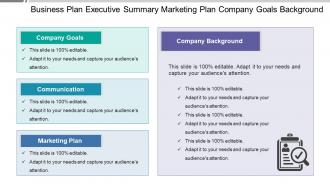
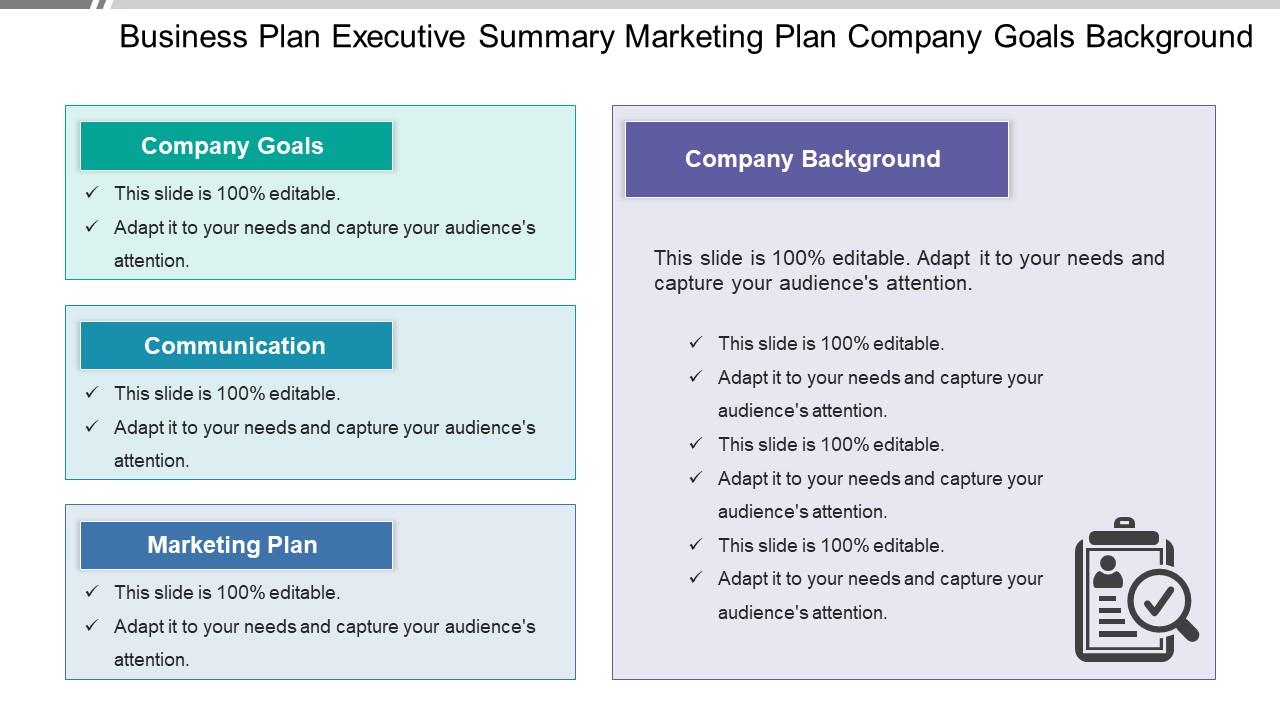
Die Executive Summary ist wahrscheinlich der wichtigste Abschnitt eines jeden Businessplans. Unter Berücksichtigung dieser Sichtweise hat unser Designerteam diese PPT-Vorlage für den Geschäftsplan Executive Summary Marketingplan Unternehmensziele Hintergrund erstellt. Sie sollten unsere Präsentationsfolie mit der Zusammenfassung des Geschäftsplans beifügen, da dies normalerweise der erste Teil Ihres Plans ist, den potenzielle Investoren lesen, und er muss interessant und prägnant sein. Die richtige Zusammenfassung der Zusammenfassung ist für jedes Unternehmen, das nach Investitionen und Finanzierung sucht, von entscheidender Bedeutung. Ihr Team kann unseren Marketingplan PPT-Visual vollständig nutzen, um die wichtigsten Stärken Ihres Unternehmens darzustellen. Ihr Publikum wird eine gute Vorstellung davon haben, was die Mission, Visionen, Ziele, Fähigkeiten, der Hintergrund usw. Ihrer Unternehmensorganisation sind. Die PowerPoint-Folie der Executive Summary kann ganz einfach nach Ihren Bedürfnissen geändert werden, und Sie können sogar den Inhalt nach Ihren Anforderungen ändern. Unser Businessplan Executive Summary Marketingplan Unternehmensziele Hintergrund sorgen für ein dramatisches Erlebnis. Die Leute werden völlig gefesselt.
Eigenschaften dieser PowerPoint-Präsentationsfolien:
Einführung des Geschäftsplans Zusammenfassung Marketingplan Unternehmensziele Hintergrund PPT-Diashow. Nützlich für Marketing- und Vertriebsmitarbeiter, Business-Analysten, Marktforscher. Vollständig editierbarer Inhalt einschließlich Schriftarten, Text, Farben usw. Personalisieren Sie die Präsentation mit individuellem Firmennamen und Logo. Hervorragende Bildqualität auch bei Breitbildausgabe. Flexible Option zur Konvertierung in PDF- oder JPG-Formate. Kompatibel mit Google-Folien. Erhältlich in Standard- und Widescreen-Foliengröße. Ersetzen Sie den Dummy-Inhalt in Textplatzhaltern durch Ihren Präsentationsinhalt.
People who downloaded this PowerPoint presentation also viewed the following :
Businessplan Executive Summary Marketingplan Unternehmensziele Hintergrund mit allen 5 Folien:
Verdienen Sie ihre Dankbarkeit für Ihre Großzügigkeit mit unserem Businessplan Executive Summary Marketingplan Hintergrund zu den Unternehmenszielen. Schenken Sie gute Ratschläge.
FAQs for Business plan executive summary marketing plan
So you'll need the usual suspects: exec summary, market analysis, your products/services breakdown, marketing strategy, operations, team bios, and financials. Start with whatever section feels easiest - builds momentum that way. The exec summary is make-or-break since honestly, half the people won't read past it. Market analysis has to prove you actually get your customers and aren't clueless about competitors. Oh, and don't lowball the financial projections - investors can smell BS revenue forecasts from miles away. Include realistic startup costs and when you'll hit break-even. Each section needs enough detail to show you've actually thought this through.
Honestly, market analysis is what separates real business plans from total fantasy. It gives you actual data to back up your ideas instead of just winging it. You'll catch opportunities other people are missing - like when established companies completely ignore Gen Z (seriously, how do they not see that market?). Direct competitors are your starting point, then branch out from there. The research also helps you spot threats coming before they wreck your plans. And you can actually size up your market realistically instead of throwing around vague numbers. Investors eat this stuff up because it shows you've done your homework.
Look, financial forecasting is what separates real business plans from pipe dreams. Investors want to see you've crunched the actual numbers - revenue, expenses, cash flow projections for like 3 years minimum. Honestly, it does feel like fancy guesswork half the time, but everyone knows that. The trick is being realistic about sales, operating costs, and when you'll actually turn a profit. My cousin learned this the hard way when his investors laughed at his overly optimistic projections. Start conservative with your estimates. Without decent forecasts, you're just pitching hopes and dreams.
So here's the deal - startup business plans are all about proving there's actually demand for your thing, while established companies get to show off their existing numbers. Lucky bastards, right? You'll be selling a vision with basically zero proof, so go heavy on market research and realistic money projections. Don't sugarcoat the risks either - investors expect that honesty from startups. Meanwhile, established businesses can just point to their revenue streams and customer data, then focus on how they're gonna scale up. Your plan needs to be assumption-heavy but totally researched.
Dude, don't make your financial projections ridiculously optimistic - investors see right through that. Market research is huge too, way more than people think. Length-wise, avoid writing either a book or some tiny pamphlet. Focus on how you'll actually make money, not just the cool product features. Honestly, the buzzword thing drives me crazy - every plan says "disruptive" like fifty times. Your executive summary needs to be solid since that's what gets read first. Oh, and explain how you'll beat competitors instead of pretending they don't exist. Start realistic, then build up.
Dude, definitely use visuals in your business plan. Charts make financial stuff so much easier to understand - like, who wants to stare at spreadsheet rows for 20 minutes? Infographics work great for showing your market research or how your business model actually works. Throw in some photos of your product or team too. Makes everything feel more real, you know? Oh, but don't get too crazy with the graphics. I've seen plans that look like a middle schooler's PowerPoint presentation. Keep it clean and make sure everything serves a purpose.
Your mission statement is like your business GPS - tells you why you exist and where you're headed. When investors ask what you do, boom, there's your answer. I'd keep it to one punchy sentence if possible (two max). It'll guide your team when they're making tough calls and attracts customers who actually care about what you stand for. Honestly, most mission statements are total garbage - all fluff about "excellence" and "innovation." Make yours specific enough that someone could pick it out of a lineup. Think less corporate speak, more "here's exactly what we're trying to fix in the world."
You gotta know what each group actually cares about, right? Investors want the money stuff upfront - projections, market size, how they'll get paid back. Pretty obvious when you think about it. Partners are way more interested in the nitty-gritty operations and whether your team knows what they're doing. I always start with one main plan, then pull out the parts that matter most to each audience. But here's the thing - don't just move sections around. Rewrite chunks using words that hit different for each group. Think about what's gonna make them lose sleep, then tackle those worries first.
Honestly, you need to watch both the money stuff and the behind-the-scenes metrics. Revenue growth, profit margins, cash flow - those are no-brainers. But also track things like customer retention and whether you're actually gaining market share. Employee productivity matters too, though that one's trickier to measure. Here's the thing though - don't go crazy with like 20 different numbers or you'll lose your mind. Pick maybe 5-7 key ones max. Set up some basic dashboard you can glance at monthly. Then just tweak your approach based on what's actually happening vs what you hoped would happen.
Look, at minimum do it once a year, but quarterly reviews are way better if you can manage it. Things change so damn fast now - what made sense in January might be completely wrong by summer. Investors definitely want fresh numbers, not some stale projections from ages ago. I learned this the hard way actually. Set a calendar reminder for every 3 months, even if it's just 30 minutes to check your financials and see if you're still on track. Way better than realizing you've been chasing the wrong strategy for months.
Honestly, just nail your value prop with real numbers to back it up. Charts and visuals work way better than walls of text - investors hate reading novels. Don't hide your competition or risks either, that's super obvious and makes you look naive. The executive summary should be one page, period. Customer testimonials are gold if you have them (even better if they're actual letters of intent). Oh and make sure your market story is compelling but not totally pie-in-the-sky. The whole thing needs to be scannable since they're probably skimming anyway. Show you actually know your numbers inside and out.
Oh definitely do the competitor analysis - it's super important for your business plan. You gotta know what other companies are doing right and where they're screwing up. That way you can figure out how to stand out. Investors always ask about competition too, so you'll need good answers ready. It helps you spot gaps in the market and price things right. Honestly, I learned this the hard way on my last project - wish I'd researched competitors better from the start! Don't just make a boring list though. Really dig into their weak spots and what makes your idea actually better.
Honestly, just grab the SBA's free template first - it's surprisingly thorough and breaks everything down for you. SCORE has decent ones too. If you're feeling lost and want more guidance, LivePlan walks you through it step by step (though it costs money). Your local Small Business Development Center does free mentoring sessions which is clutch. I'd also check out "The Lean Startup" - totally changed how I think about business models. Oh, and Google Docs has basic templates if you just need something quick. Get a mentor to look it over before you spend cash on fancy software though.
Honestly, SWOT is like your business plan's BS detector. It makes you face the real deal - what you're actually good at, where you suck, what chances are out there, and what could totally screw you over. Do it early though, not at the end when you're already married to your ideas. Your strengths help you grab opportunities. Weaknesses? Figure out how to fix them or work around them. And threats - well, at least you won't be blindsided. Makes your whole strategy way more grounded in reality instead of wishful thinking.
Honestly, regulations can make or break your whole plan. Do your homework early because some rules are straight-up business killers if you don't see them coming. Your costs, timeline, even which markets you can touch - all of it gets shaped by compliance stuff. It's annoying but true. On the flip side, once you're in and compliant, those same barriers keep new competitors out. Oh, and if your industry's super regulated (looking at you, healthcare), maybe get a consultant. Don't wait to factor compliance costs into your numbers either.
-
Unique research projects to present in meeting.
-
Great designs, Easily Editable.