Business Process Assessment With Website Features

Rating:
90%
Business Process Assessment With Website Features
Slide 1 of 6
Favourites Favourites

Try Before you Buy Download Free Sample Product

Audience Impress Your
Audience
Editable 100%
Editable
Time Save Hours
of Time
The Biggest Sale is ending soon in
0
0
:
0
0
:
0
0
Rating:
90%
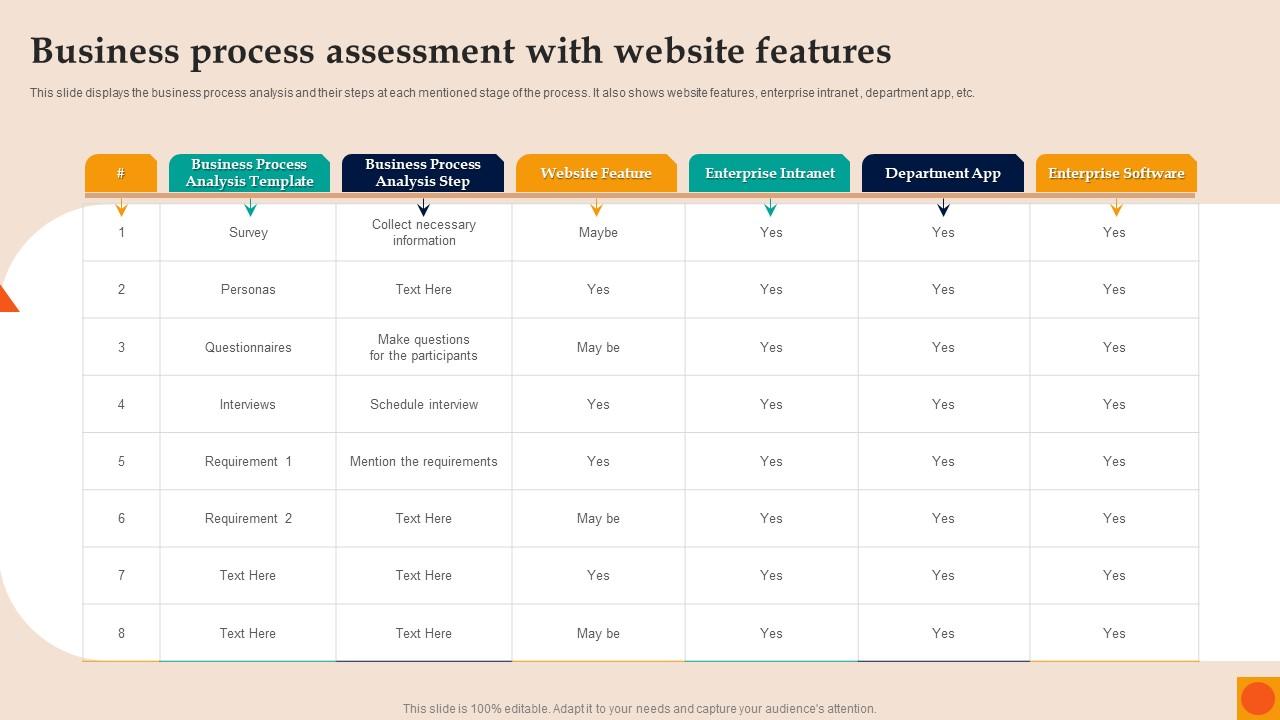
This slide displays the business process analysis and their steps at each mentioned stage of the process. It also shows website features, enterprise intranet , department app, etc. Presenting our well structured Business Process Assessment With Website Features. The topics discussed in this slide are Business Process, Analysis Template, Enterprise Software. This is an instantly available PowerPoint presentation that can be edited conveniently. Download it right away and captivate your audience.

FAQs for Business Process Assessment

Key components of a successful business process assessment include stakeholder mapping, workflow documentation, performance metrics analysis, technology evaluation, and bottleneck identification. These elements work together by providing comprehensive visibility into current operations, measuring efficiency gaps, and highlighting improvement opportunities, with many organizations finding that systematic assessment delivers streamlined processes and enhanced operational performance.

Identifying processes for assessment involves analyzing operational workflows, resource consumption patterns, customer touchpoints, compliance requirements, and performance bottlenecks across departments. Organizations typically prioritize by evaluating business impact, cost implications, and strategic alignment, with many finding that customer-facing processes and high-volume transactions deliver the most significant efficiency gains and competitive advantages.

Organizations should avoid conducting assessments without clear objectives, excluding key stakeholders from the evaluation process, focusing solely on technology rather than people and processes, and failing to establish baseline metrics for comparison. These oversights often lead to incomplete analysis, resistance to change, and missed optimization opportunities, with many companies finding that comprehensive stakeholder engagement and defined success metrics ultimately deliver more actionable insights and sustainable process improvements.

Data analytics enhances business process assessment by identifying bottlenecks, predicting outcomes, and revealing inefficiencies through pattern recognition and performance metrics analysis. Through advanced analytics tools, organizations streamline operations, reduce costs, and improve decision-making accuracy, with many companies finding that data-driven assessments deliver faster optimization and measurable competitive advantages.

Stakeholders provide critical insights into current processes, identify pain points, define requirements, and validate proposed improvements throughout the assessment. Their involvement ensures comprehensive understanding of operational realities, with department heads offering process expertise, end-users highlighting efficiency gaps, and leadership providing strategic direction, ultimately delivering more accurate assessments and higher implementation success rates.

Business process assessment success is measured through efficiency gains, cost reduction percentages, cycle time improvements, error rate decreases, and customer satisfaction scores. These metrics help organizations track operational enhancement, resource optimization, and competitive positioning, with many companies finding that comprehensive assessment delivers 15-30% productivity improvements and streamlined workflows across departments.

Business process assessment documentation best practices include creating detailed process maps, identifying specific inefficiencies and bottlenecks, cataloging stakeholder feedback, documenting performance metrics, and establishing clear improvement recommendations. These comprehensive records enable organizations to track implementation progress, measure outcomes, and maintain institutional knowledge, with many companies finding that structured documentation ultimately delivers faster decision-making and sustainable process optimization across departments.

Technology tools streamline business process assessment through automated data collection, real-time analytics, workflow mapping software, and AI-powered analysis capabilities. These solutions enable organizations to capture process metrics continuously, identify bottlenecks faster, and generate comprehensive reports automatically, ultimately delivering more accurate assessments while reducing manual effort and accelerating improvement initiatives.

Organizational culture significantly influences business process assessments by shaping employee engagement, resistance to change, and willingness to share process insights during evaluations. Companies with collaborative cultures typically experience more accurate assessments, faster implementation of recommendations, and sustained process improvements, while hierarchical organizations may face communication barriers, ultimately affecting the assessment's effectiveness and long-term success.

Business process assessment alignment requires establishing clear connections between strategic objectives and operational activities through comprehensive goal mapping, stakeholder engagement, and performance metric integration. Organizations achieve this by conducting strategic workshops with leadership teams, creating process-to-strategy matrices, and implementing continuous monitoring systems that track how operational improvements directly support competitive advantage, ultimately ensuring resource allocation delivers measurable strategic outcomes.

Effective business process assessment methodologies include value stream mapping, process mining, workflow analysis, stakeholder interviews, and performance benchmarking. These approaches streamline evaluation by identifying bottlenecks, measuring cycle times, and documenting current workflows, with many organizations finding that combining multiple methodologies delivers comprehensive insights, ultimately enabling targeted improvements and enhanced operational efficiency.

Organizations should conduct comprehensive business process assessments annually, with quarterly reviews of critical processes and continuous monitoring of key performance indicators. In rapidly evolving sectors like technology, healthcare, and financial services, many companies find that more frequent assessments enable faster adaptation to market changes, regulatory requirements, and competitive pressures, ultimately delivering sustained operational efficiency and strategic advantage.

Key metrics for evaluating business process efficiency include cycle time, cost per transaction, error rates, resource utilization, and customer satisfaction scores. These measurements enable organizations to identify bottlenecks, reduce operational costs, and streamline workflows, with many companies finding that combining quantitative data with qualitative feedback ultimately delivers enhanced productivity and competitive advantage.

Employee feedback enhances business process assessment results by providing frontline insights into operational inefficiencies, identifying bottlenecks that management might overlook, and revealing customer pain points directly experienced during service delivery. This ground-level perspective enables organizations to uncover hidden process gaps, streamline workflows more effectively, and ultimately improve both operational efficiency and customer satisfaction across departments.

Business process assessments facilitate continuous improvement by identifying inefficiencies, bottlenecks, and optimization opportunities across operational workflows, enabling organizations to systematically enhance performance metrics and resource allocation. Through regular evaluation cycles, companies streamline processes, reduce costs, and improve service delivery, with many finding that structured assessments ultimately deliver measurable productivity gains and competitive advantage.

Ratings and Reviews

90% of 100
Review Form
Write a review
Most Relevant Reviews
  1. 100%

    by Taylor Hall

    The design is very attractive, informative, and eye-catching, with bold colors that stand out against all the basic presentation templates. 
  2. 80%

    by Smith Diaz

    Happy to found you SlideTeam. You guys are value for money. Amazing slides.

2 Item(s)

per page: