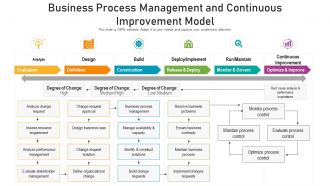
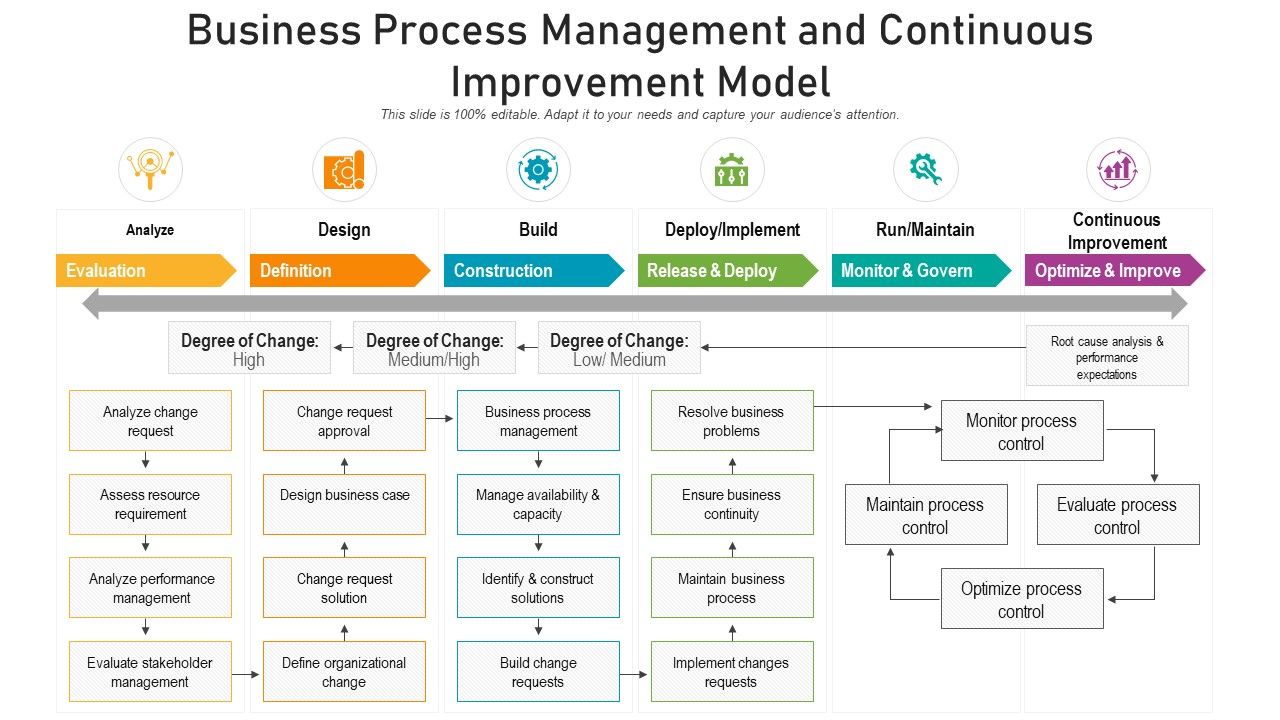
Business process management and continuous improvement model
Try Before you Buy Download Free Sample Product
Audience
Editable
of Time
Our Business Process Management And Continuous Improvement Model are topically designed to provide an attractive backdrop to any subject. Use them to look like a presentation pro.
People who downloaded this PowerPoint presentation also viewed the following :
Business process management and continuous improvement model with all 2 slides:
Use our Business Process Management And Continuous Improvement Model to effectively help you save your valuable time. They are readymade to fit into any presentation structure.
FAQs for Business process management and
So BPM is like the whole kitchen renovation - you're mapping out processes from start to finish, setting up governance, the works. Continuous improvement? More like swapping out your old coffee maker for a better one. Quick fixes, waste elimination, that sort of thing. BPM takes forever but gives you that bird's eye view of everything. CI models like Lean just focus on tweaking what's already there. Honestly, if your processes are completely broken, you'll want BPM. But if things are mostly working and you just need some fine-tuning, CI is way less of a headache.
So here's what I'd do - map out your processes first to spot where things get stuck. Then run those PDCA improvement cycles on the problem areas. Document everything with BPM tools, but don't go crazy with it. Test small changes and actually measure if they work. Pick one process, run a quick pilot, see what happens. The cool thing is when you mix BPM's structure with CI's fast testing - suddenly you're not just throwing stuff at the wall anymore. Though honestly, sometimes the simplest fixes are the ones nobody thinks to try first.
Data analytics is like having x-ray vision for your processes - you'll see exactly where things get stuck instead of playing guessing games. Track your cycle times and failure patterns so you know what's actually broken vs what just *looks* messy. Honestly, the data usually tells a completely different story than what management thinks is happening. Focus on 2-3 metrics that matter for your current project and build simple dashboards around those. The ROI insights help you figure out which fires to put out first. Way better than arguing with people about their "instincts" lol.
Honestly, automation is a total lifesaver for BPM and CI stuff. It cuts out all those annoying manual handoffs where things get dropped or forgotten. Your cycle times speed up because workflows just trigger automatically - no waiting around for Bob to remember his part of the process. The consistency is probably the best part though. No more "oh crap, did I skip that validation step?" moments. I've been there too many times. Map out what you're doing now first, then pick the most tedious manual steps to automate. Your team gets to do actual interesting work instead of clicking through the same boring tasks all day.
Honestly, most companies mess up by going way too big right out the gate. They'll try to overhaul everything without even figuring out what they're currently doing wrong - which is backwards if you ask me. Leadership support is huge too; without it you're basically dead in the water. Oh, and don't get obsessed with fancy tools when your actual processes are still broken. The people doing the work every day? Talk to them first - they'll tell you exactly where things suck. Just pick one small thing, fix it, show some results, then expand from there.
Dude, culture is everything for this stuff. When people are scared of getting blamed, they'll never tell you what's actually broken. Your front-line folks know the processes way better than management, but good luck getting them to speak up in some rigid corporate hierarchy. I've seen so many places where they just shut down anyone who suggests change - total waste. You really need that psychological safety thing where people can admit mistakes without fear. Oh, and celebrate the troublemakers who point out problems instead of shooting them down. Otherwise you're just spinning your wheels trying to improve anything.
Look, you definitely need both efficiency stuff (cycle time, defect rates, how well people follow the process) and business impact numbers (cost savings, customer happiness, ROI). But here's the thing - don't go crazy tracking everything or you'll drown in data. Pick maybe 3-5 metrics that actually matter to your goals. Set up dashboards so you're not stuck doing manual reports every month - learned that one the hard way. The real trick is being consistent with measurement. Without solid baseline data, you can't prove your improvements are doing anything worthwhile.
Honestly, the biggest mistake people make is just dumping changes on everyone at the end. Get them involved from the start - have them help map out current processes and spot what's broken. People buy into stuff they actually helped build, you know? Quick wins are your best friend here. Show some early results so they see it's not just another corporate BS initiative. Oh, and communication makes or breaks these things - I've seen so many fail just because nobody explained why changes matter to *them* personally, not just the company. Keep checking in regularly. Treat them like partners, not roadblocks.
Here's my take - tie your BPM stuff directly to what your company actually cares about. Don't just optimize because it sounds smart. I've watched so many teams get pumped about streamlining workflows but then... nothing changes where it counts. Your executives need to see how this connects to real numbers - revenue, customer happiness, cutting costs. Quick alignment check-ins help a ton too. Oh, and here's the test I always use: "Will this process tweak actually help us beat our competition?" If you can't answer that clearly, maybe step back first. The flashy process improvements mean nothing if they don't move the business forward.
So AI and ML can seriously automate all that tedious process stuff you're doing by hand right now. They'll spot bottlenecks automatically and predict where things might break before it happens. Machine learning gets smarter over time too - better at catching weird patterns and figuring out what went wrong. It's honestly pretty cool having something work around the clock on your processes. The predictive part is huge though - you stop putting out fires and actually prevent them. I'd say try a process mining tool on just one workflow first. See what happens, you know?
So you'll need your people trained in three main areas - process mapping, data analysis, and change management. Lean Six Sigma certs are the gold standard if you can swing the budget. But honestly? Even basic improvement workshops get people thinking differently. Don't sleep on the soft skills either. Stakeholder engagement and project management matter way more than most people realize since this isn't just about pretty flowcharts. Statistical analysis tools are pretty much required now, plus workflow automation stuff. My advice - find your process champions first and get them certified. They can train everyone else internally and save you a ton of money.
Honestly, you've got to weave customer feedback right into how you design and fix your processes. Grab feedback through surveys, interviews, whatever - then figure out exactly where customers are hitting walls in your actual workflows. Most companies do this backwards though. They collect tons of feedback but never connect it to the specific processes causing the headaches. Make that feedback a core part of your continuous improvement stuff - use it to spot problems and track if you're actually fixing things. Oh, and pick one process that really matters to customers and walk through it from their perspective this week.
Dude, Toyota's whole kaizen thing is probably the best example - they've been doing continuous improvement for decades and it shows. Amazon's warehouses are insane too, constantly tweaking everything with real-time data. Oh, and Netflix totally crushed it when they ditched DVDs - kept refining those algorithms while making streaming seamless. These companies honestly make it look way easier than it actually is! Bottom line though, you need leadership that's actually committed and employees who give a damn at every level. Otherwise you're just wasting time.
Here's my take - when you track process metrics through BPM, you're basically giving your CI team a roadmap of what's broken. Then once they fix stuff, the new data shows you what actually worked (and what didn't, honestly). It becomes this cool feedback loop where each improvement gives you better info for the next round. I've seen teams get addicted to this cycle because the wins start compounding. You don't need to overthink it though - just pick one process metric that ties directly to something your CI efforts are trying to improve.
Dude, AI automation is completely changing the game right now. Machine learning can actually predict bottlenecks before they happen - it's crazy how accurate it's getting. Low-code platforms are huge too since regular business folks can build workflows without bugging IT constantly. Customer journey mapping is getting baked right into BPM tools now, which makes sense. Oh, and sustainability metrics are becoming standard KPIs everywhere (finally). Honestly? Start playing around with AI-powered process mining tools ASAP. Get your team used to making decisions based on actual data instead of gut feelings, because that's definitely where this is all headed.
-
Easy to edit slides with easy to understand instructions.
-
Very unique, user-friendly presentation interface.
-
Commendable slides with attractive designs. Extremely pleased with the fact that they are easy to modify. Great work!
-
Amazing product with appealing content and design.
-
Easily Editable.