Business Questionnaire For Customers Powerpoint PPT Template Bundles Survey

Rating:
90%
Business Questionnaire For Customers Powerpoint PPT Template Bundles Survey
Slide 1 of 10
Favourites Favourites

Try Before you Buy Download Free Sample Product

Audience Impress Your
Audience
Editable 100%
Editable
Time Save Hours
of Time
The Biggest Sale is ending soon in
0
0
:
0
0
:
0
0
Rating:
90%
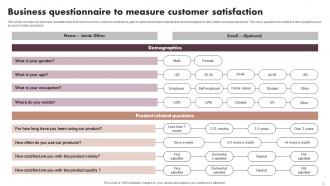
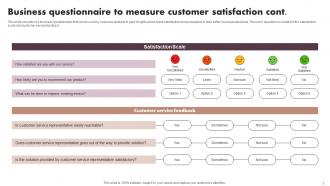
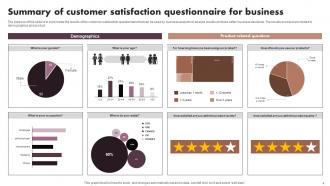
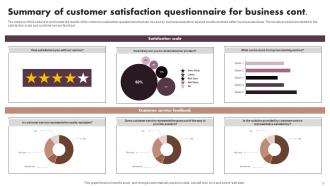
Engage buyer personas and boost brand awareness by pitching yourself using this prefabricated set. This Business Questionnaire For Customers Powerpoint PPT Template Bundles Survey is a great tool to connect with your audience as it contains high-quality content and graphics. This helps in conveying your thoughts in a well-structured manner. It also helps you attain a competitive advantage because of its unique design and aesthetics. In addition to this, you can use this PPT design to portray information and educate your audience on various topics. With Five slides, this is a great design to use for your upcoming presentations. Not only is it cost-effective but also easily pliable depending on your needs and requirements. As such color, font, or any other design component can be altered. It is also available for immediate download in different formats such as PNG, JPG, etc. So, without any further ado, download it now.

People who downloaded this PowerPoint presentation also viewed the following :

FAQs for Business Questionnaire For Customers Powerpoint PPT

The primary goals of business questionnaires include gathering customer feedback, assessing market needs, evaluating employee satisfaction, measuring service quality, and identifying improvement opportunities. These strategic tools streamline decision-making by providing data-driven insights, enhancing customer experiences, and optimizing operational efficiency, with many organizations finding that structured questionnaires ultimately deliver competitive advantages and improved business outcomes.

Our target audience includes current customers, potential clients, industry stakeholders, employees, and market research participants, depending on specific business objectives and data requirements. Through strategic audience segmentation, organizations can gather valuable insights for product development, service enhancement, and market positioning, with many companies finding that targeted questionnaires deliver more actionable feedback and competitive intelligence.

Business questionnaires typically gather demographic data, customer preferences, satisfaction levels, purchasing behavior, and market feedback to inform strategic decisions. These surveys enable organizations to understand target audiences, identify market opportunities, and enhance product offerings, with many companies finding that comprehensive questionnaires streamline decision-making and deliver competitive advantages through data-driven insights.

Ensuring clear, unambiguous questions involves using simple language, avoiding jargon, testing questions with sample respondents, and structuring them logically with single-focus inquiries. Through pilot testing and feedback collection, organizations can identify confusing elements, refine wording, and eliminate double-barreled questions, ultimately delivering higher response rates and more accurate data for strategic decision-making.

Business questionnaires typically include open-ended questions for detailed feedback, multiple choice questions for categorical data, rating scale questions for satisfaction measurement, Likert scale questions for opinion assessment, and ranking questions for priority identification. These question types work together strategically, with quantitative formats like rating scales providing measurable benchmarks while open-ended questions capture nuanced insights, ultimately delivering comprehensive data that enables organizations to make informed decisions and enhance customer experiences.

**INPUT**: How will you structure the questionnaire for optimal flow and engagement? **OUTPUT**: Structure questionnaires by starting with engaging, easy questions, grouping related topics together, using clear section headers, and placing sensitive questions toward the end. This approach enhances completion rates through logical progression, minimizes survey fatigue, and maintains respondent interest, with many organizations finding that strategic sequencing delivers higher-quality responses and improved data collection outcomes. **Word count: 54 words**

Data protection measures include encryption protocols, secure servers, anonymization techniques, access controls, and GDPR compliance frameworks. These security approaches enhance respondent trust by safeguarding personal information, minimizing data breach risks, and ensuring regulatory adherence, with many organizations finding that transparent privacy policies ultimately deliver higher response rates and stronger stakeholder confidence.

Data analysis from business questionnaires involves statistical analysis, trend identification, cross-tabulation of responses, and correlation analysis to extract meaningful insights. Through advanced analytics tools and visualization software, organizations can segment responses by demographics, identify patterns in customer behavior, and benchmark performance metrics, ultimately delivering actionable intelligence that drives strategic decision-making and competitive advantage.

The ideal questionnaire length is 5-10 questions or 3-5 minutes completion time, balancing comprehensive data collection with participant engagement. Shorter questionnaires typically achieve 15-20% higher response rates, while longer surveys risk abandonment, with many organizations finding that focused, strategic questions deliver more actionable insights than exhaustive approaches.

Effective distribution methods include email campaigns, social media platforms, website integration, direct mail, and mobile applications. These approaches enhance reach by leveraging digital channels, targeting specific demographics, and providing multiple touchpoints, with many organizations finding that combining online and offline methods delivers broader audience engagement and higher response rates.

**INPUT**: How will you incentivize participation in your questionnaire? **OUTPUT**: Effective questionnaire incentives include monetary rewards, exclusive access to results, prize drawings, product discounts, and recognition programs tailored to your target audience. Many organizations find that combining immediate value with strategic benefits, such as early access to insights or personalized recommendations, significantly enhances response rates while building stronger stakeholder relationships and delivering more comprehensive data collection outcomes. **Word count: 56 words**

Business questionnaire timelines typically span 2-4 weeks, encompassing development (3-5 days), distribution (1-2 weeks), and analysis (3-7 days), depending on complexity and response requirements. Organizations with structured feedback processes often streamline this to 10-14 days by leveraging digital distribution platforms, automated reminders, and real-time analytics tools, ultimately delivering faster insights and more agile decision-making capabilities.

**INPUT**: How will you tailor your questions to align with your business objectives? **OUTPUT**: Tailoring questionnaire questions involves mapping each question to specific business goals, using targeted language that resonates with your audience, and structuring inquiries to capture actionable data points. Strategic question design enables organizations to gather relevant insights, identify growth opportunities, and make data-driven decisions, with many companies finding that well-aligned questionnaires ultimately deliver higher response rates and more valuable business intelligence. [Word count: 58 words]

Popular questionnaire tools include SurveyMonkey, Google Forms, Typeform, Microsoft Forms, and Qualtrics, each offering different features for design, distribution, and analytics. These platforms streamline data collection by providing customizable templates, automated response tracking, and real-time analytics, with many organizations finding that cloud-based solutions deliver faster deployment and enhanced accessibility across multiple channels.

Business questionnaire frequency depends on your improvement goals, industry dynamics, and organizational capacity, with most companies conducting quarterly assessments for operational insights and annual comprehensive reviews for strategic planning. While monthly pulse surveys work well for fast-moving sectors like retail and technology, organizations in stable industries like manufacturing often find semi-annual questionnaires sufficient, ultimately delivering consistent feedback loops that enhance decision-making and competitive advantage.

Ratings and Reviews

90% of 100
Write a review
Most Relevant Reviews
  1. 100%

    by Clarence Mendoza

    Thrilled to see several customizable templates catering various verticals and industries. 
  2. 80%

    by Dean Dixon

    Satisfied with the way SlideTeam resolved my query regarding the right business PPTs that I was having difficulty finding. I found the perfect match with their assistance.

2 Item(s)

per page: