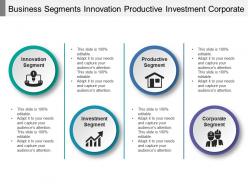
Business segments innovation productive investment corporate

Rating:
90%
Business segments innovation productive investment corporate
Slide 1 of 5
Favourites Favourites

Try Before you Buy Download Free Sample Product

Audience Impress Your
Audience
Editable 100%
Editable
Time Save Hours
of Time
The Biggest Sale is ending soon in
0
0
:
0
0
:
0
0
Rating:
90%
Presenting this set of slides with name - Business Segments Innovation Productive Investment Corporate. This is a four stage process. The stages in this process are Business Segments, Business Part, Market Segments.

FAQs for Business segments innovation

Successful corporate innovation strategies include clear strategic alignment, dedicated resource allocation, systematic risk management, cultural transformation initiatives, and robust measurement frameworks. These approaches streamline innovation processes by fostering cross-functional collaboration, establishing innovation labs, and creating fail-fast environments, with many organizations finding that balanced portfolios of incremental and disruptive innovations ultimately deliver sustained competitive advantage.

Companies foster innovation culture through open communication channels, dedicated innovation time, cross-functional collaboration, risk tolerance, and recognition programs that reward creative thinking. These approaches streamline idea generation by encouraging experimentation, providing resources for pilot projects, and celebrating both successes and learning failures, with many organizations finding that empowering employees ultimately delivers competitive advantage and accelerated growth.

Leadership drives corporate innovation by establishing strategic vision, allocating resources, fostering risk-taking cultures, and championing experimental mindsets across organizational levels. Through clear communication and commitment, leaders enable cross-functional collaboration, streamline decision-making processes, and create psychological safety for creative exploration, with many organizations finding that executive sponsorship ultimately accelerates innovation adoption and competitive advantage.

Organizations can effectively measure innovation success through key performance indicators including revenue from new products, time-to-market metrics, patent applications, customer satisfaction scores, and return on innovation investment. These measurement frameworks enable companies across sectors like technology and pharmaceuticals to track both short-term milestones and long-term strategic outcomes, ultimately delivering data-driven insights that optimize resource allocation and accelerate future innovation cycles.

Common barriers to innovation within corporations include risk-averse cultures, rigid hierarchical structures, limited resource allocation, resistance to change, and siloed departmental thinking. Organizations overcome these challenges by fostering cross-functional collaboration, implementing dedicated innovation budgets, establishing clear failure-tolerance policies, and creating specialized innovation teams, with many companies finding that structured innovation frameworks ultimately deliver faster product development and sustained competitive advantage.

Collaboration with startups enhances corporate innovation by bringing fresh perspectives, agile methodologies, and cutting-edge technologies that complement established resources and market reach. Through strategic partnerships, accelerator programs, and joint ventures, corporations like General Electric, Walmart, and JPMorgan Chase accelerate product development, access emerging markets, and reduce innovation risks while startups gain scaling capabilities and industry expertise.

Digital transformation fundamentally reshapes corporate innovation strategies by accelerating development cycles, enabling data-driven decision making, and fostering cross-functional collaboration through cloud platforms and AI analytics. Organizations increasingly leverage these digital tools to streamline R&D processes, enhance customer insights, and create agile innovation frameworks, with many companies finding that integrated digital approaches deliver faster time-to-market and sustainable competitive advantages.

Companies leverage customer feedback to drive innovation by systematically collecting insights through surveys, social media monitoring, focus groups, and direct interactions to identify unmet needs and improvement opportunities. This customer-centric approach enables organizations to develop targeted solutions, enhance existing products, and streamline services based on real user experiences, ultimately delivering better customer satisfaction and competitive advantage.

Best practices for managing innovation pipelines include establishing clear stage-gate processes, creating dedicated innovation teams, implementing robust idea management systems, setting measurable innovation metrics, and fostering cross-functional collaboration. These approaches enable organizations to systematically evaluate opportunities, allocate resources strategically, and accelerate time-to-market, with many large enterprises finding that structured pipeline management ultimately delivers higher success rates and sustainable competitive advantage.

Corporate innovation and sustainability initiatives intersect through circular economy models, clean technology development, sustainable supply chain optimization, and ESG-driven product innovation. These strategic combinations enable organizations to reduce operational costs, meet regulatory requirements, and capture emerging market opportunities, with many companies finding that sustainability-focused innovations ultimately deliver competitive advantages while addressing environmental challenges.

Open innovation enables corporations to leverage external expertise, partnerships, and collaborative ecosystems to accelerate development while reducing internal costs and risks. In today's competitive landscape, companies across sectors like pharmaceuticals, technology, and automotive increasingly adopt open innovation models to access diverse talent pools, share research expenses, and bring products to market faster, ultimately delivering enhanced competitive advantage and sustainable growth opportunities.

Organizations balance innovation with risk management by implementing structured frameworks, establishing innovation portfolios with varying risk levels, and creating controlled testing environments for new initiatives. Through strategic risk assessment processes, companies can pursue breakthrough opportunities while maintaining operational stability, with many financial services and technology firms finding that phased implementation and cross-functional governance ultimately deliver sustainable growth and competitive advantage.

Technologies most conducive to fostering corporate innovation include artificial intelligence, cloud computing platforms, automation tools, data analytics systems, and collaborative software solutions. These technologies streamline research processes, enhance cross-functional collaboration, and accelerate product development cycles, with many organizations finding that strategic integration of these tools delivers faster time-to-market, improved operational efficiency, and sustainable competitive advantages.

Diverse teams improve corporate innovation by bringing varied perspectives, experiences, and problem-solving approaches that challenge conventional thinking and identify blind spots. These multidisciplinary groups enhance creativity through cross-functional collaboration, cultural insights, and different technical expertise, with many organizations finding that diverse teams generate more breakthrough solutions and better understand evolving market needs, ultimately delivering competitive advantage.

Corporate innovation drives business growth through new product development, market expansion, operational efficiency improvements, and competitive differentiation strategies. These initiatives enhance revenue streams by creating novel solutions, reduce costs through streamlined processes, and strengthen market positioning, with many organizations finding that systematic innovation programs deliver measurable increases in profitability and long-term sustainability.

Ratings and Reviews

90% of 100
Review Form
Write a review
Most Relevant Reviews
  1. 100%

    by Duane Ray

    Graphics are very appealing to eyes.
  2. 80%

    by Alexander Ramirez

    Out of the box and creative design.

2 Item(s)

per page: