Estrategia de 3 Años de Fortalecimiento de Negocios
Try Before you Buy Download Free Sample Product
Audience
Editable
of Time
Déjate enamorar por toda la atención que recibe nuestra Estrategia de 3 Años de Fortalecimiento de Negocios. Descubre que son una excelente elección.
Características de estas diapositivas de presentación de PowerPoint:
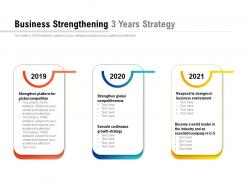
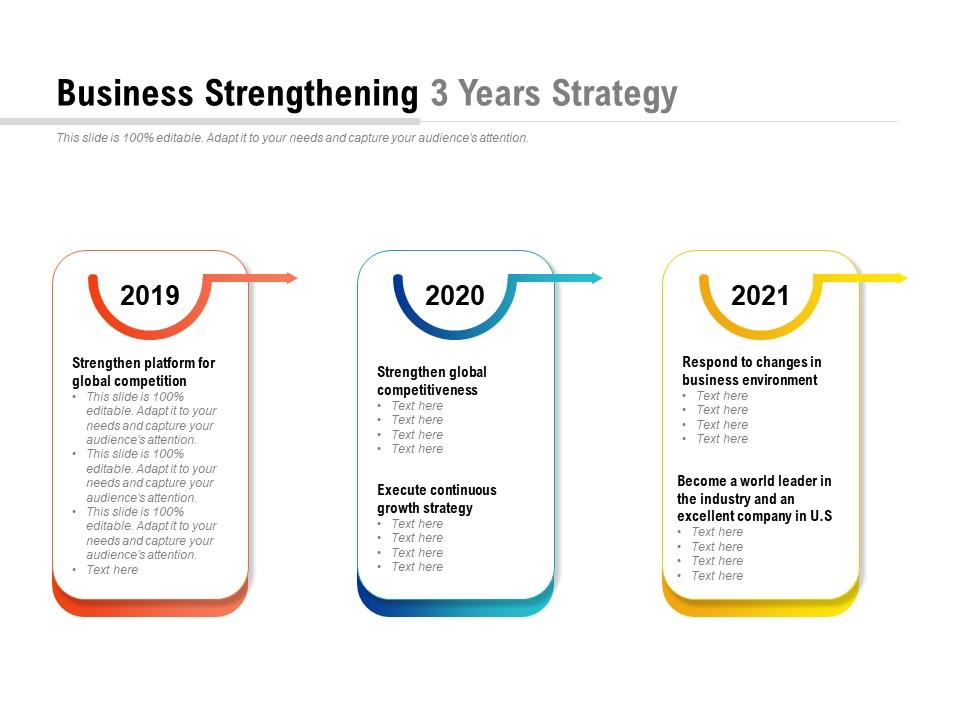
Presentación de este conjunto de diapositivas con el nombre Fortalecimiento empresarial Estrategia de 3 años. Este es un proceso de tres etapas. Las etapas de este proceso son Fortalecer la plataforma para la competencia global, Fortalecer la competitividad global, Ejecutar una estrategia de crecimiento continuo, Responder a los cambios en el entorno empresarial, Convertirse en un líder mundial en la industria y una excelente empresa en EE. UU. Esta es una presentación de PowerPoint completamente editable y está disponible para su descarga inmediata. Descárguelo ahora e impresione a su audiencia.
People who downloaded this PowerPoint presentation also viewed the following :
Estrategia de 3 años de fortalecimiento empresarial con las 2 diapositivas:
Nuestra Estrategia de Fortalecimiento Empresarial a 3 Años puede llegar a cualquier grado. Ellos ejercerán toda la fuerza que tienen.
FAQs for Business strengthening
Key indicators of personal growth in professional settings include enhanced problem-solving abilities, improved communication skills, increased emotional intelligence, greater adaptability to change, and stronger leadership capabilities. These developments manifest through taking on complex projects, mentoring colleagues, and driving strategic initiatives, with many professionals finding that continuous skill development ultimately delivers career advancement, increased responsibilities, and enhanced value to their organizations.
Businesses can measure employee growth impact through performance metrics, productivity indicators, retention rates, internal promotion statistics, and revenue per employee calculations. These assessments enable organizations to track skill development outcomes, career advancement success, and operational efficiency improvements, with many companies finding that strategic employee development ultimately delivers enhanced competitiveness and sustainable growth.
Continuous learning drives organizational growth by enhancing employee capabilities, accelerating innovation, and improving operational efficiency across departments. This strategic approach enables companies to adapt quickly to market changes, develop competitive advantages, and retain top talent, with many forward-thinking organizations finding that learning-focused cultures ultimately deliver stronger performance and sustainable expansion.
Effective leadership fosters growth culture by establishing clear development expectations, providing regular constructive feedback, and creating opportunities for skill advancement and strategic thinking. Leaders who model continuous learning, delegate meaningful challenges, and celebrate both successes and learning from failures enable teams to embrace innovation, ultimately delivering higher performance and competitive advantage.
Common barriers to growth in startups include limited funding, talent acquisition challenges, market competition, operational inefficiencies, and scaling infrastructure demands. These obstacles can be overcome by securing diverse funding sources, implementing strategic hiring practices, and leveraging automation technologies, with many successful startups finding that partnerships and data-driven decision making ultimately deliver sustainable growth and competitive advantage.
Emotional intelligence enhances growth by improving self-awareness, empathy, communication skills, conflict resolution abilities, and decision-making under pressure. Organizations utilizing emotionally intelligent leadership find that teams demonstrate better collaboration, reduced turnover, enhanced productivity, and stronger client relationships, ultimately delivering competitive advantage and sustained performance improvements across departments.
Effective feedback mechanisms include regular one-on-ones, 360-degree reviews, peer feedback systems, real-time performance tracking, and goal-setting frameworks that align individual development with organizational objectives. These structured approaches enhance employee engagement, accelerate skill development, and improve retention rates, with many organizations finding that consistent feedback cultures ultimately deliver higher productivity and stronger talent pipeline development.
Companies can implement strategies including market diversification, customer retention programs, operational efficiency improvements, strategic partnerships, and innovation investment to promote sustainable growth. These approaches enable organizations to expand market share, reduce costs, and enhance customer experiences while building competitive advantages, with many businesses finding that combining multiple strategies delivers stronger resilience and long-term profitability in increasingly competitive environments.
Innovation drives growth by creating new revenue streams, improving operational efficiency, and enhancing competitive positioning through systematic experimentation, strategic resource allocation, and cultural transformation. Best practices include fostering cross-functional collaboration, implementing structured ideation processes, investing in employee development programs, and establishing innovation metrics, with many organizations finding that combining dedicated innovation labs with company-wide innovation challenges delivers sustainable growth and market differentiation.
Growth psychology encompasses mindset shifts, resilience building, goal visualization, self-efficacy development, and cognitive reframing techniques. These psychological principles can be strategically integrated into personal development plans through structured reflection practices, progressive skill-building frameworks, and accountability systems, with many professionals finding that combining behavioral psychology with measurable milestones ultimately delivers sustained motivation and accelerated personal advancement.
Mentorship and coaching accelerate individual growth by providing personalized guidance, skill development frameworks, and strategic career planning. These relationships enhance professional capabilities through targeted feedback, expanded networks, and accountability structures, with many professionals finding that consistent mentoring delivers faster promotions, increased confidence, and clearer advancement pathways within their organizations.
Diversity and inclusion significantly enhance growth potential by expanding market reach, improving innovation through varied perspectives, attracting top talent, and strengthening decision-making processes. Companies with diverse teams consistently outperform competitors in revenue growth and profitability, with many organizations finding that inclusive cultures drive customer loyalty, operational efficiency, and ultimately deliver sustainable competitive advantage in increasingly global markets.
SMART goals accelerate growth by providing specific targets, measurable benchmarks, achievable milestones, relevant objectives, and time-bound deadlines that create clear accountability and direction. Through structured goal-setting frameworks, professionals streamline their development efforts, enhance focus on priority areas, and deliver measurable progress in career advancement, skill acquisition, and performance improvement.
Growth mindset benefits in corporate environments include enhanced innovation, improved employee resilience, increased adaptability to change, stronger collaborative teamwork, and accelerated skill development. Organizations embracing this approach streamline talent retention, enhance problem-solving capabilities, and deliver superior customer experiences, with many companies finding that growth-oriented cultures ultimately provide significant competitive advantages in increasingly dynamic markets.
Technology and digital tools aid growth tracking through analytics platforms, CRM systems, performance dashboards, automated reporting tools, and real-time monitoring solutions. These technologies streamline data collection, enhance decision-making accuracy, and minimize manual oversight, with many organizations finding that integrated digital ecosystems ultimately deliver faster insights, improved resource allocation, and sustained competitive advantage in increasingly data-driven markets.
No Reviews