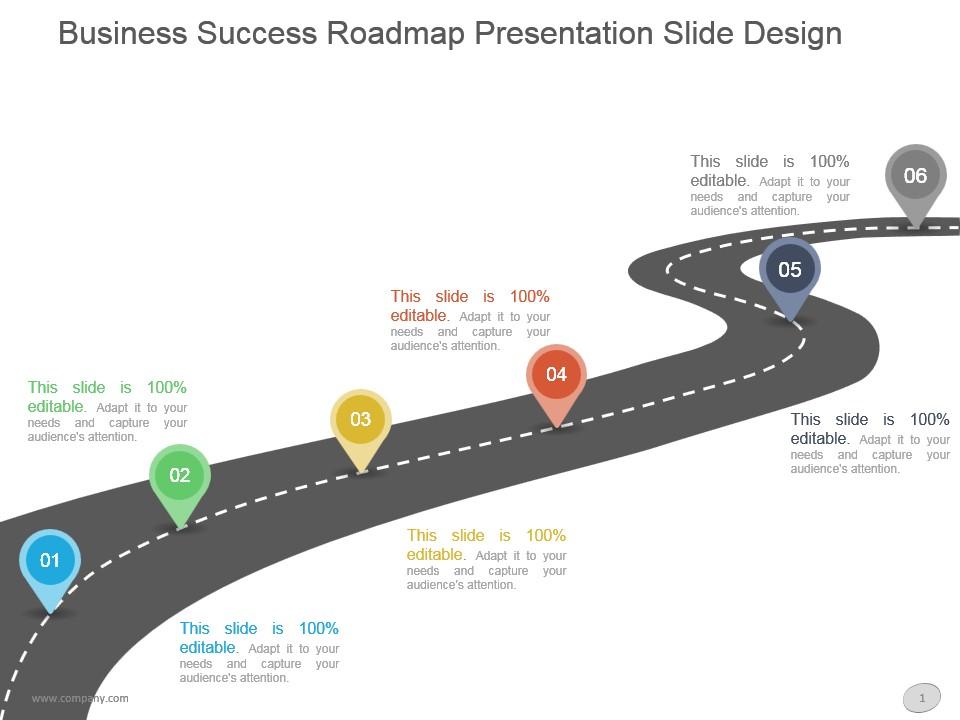
Conception de diapositives de présentation de feuille de route de réussite commerciale
Try Before you Buy Download Free Sample Product
Audience
Editable
of Time
Soyez entre de bonnes mains avec notre conception de diapositive de présentation de feuille de route de réussite commerciale. Leur dextérité est une garantie absolue.
Caractéristiques de ces diapositives de présentation PowerPoint :
Présentation de la conception des diapositives de présentation de la feuille de route du succès commercial. Il s'agit d'une conception de diapositive de présentation de feuille de route de réussite commerciale. Il s'agit d'un processus en six étapes. Les étapes de ce processus sont les affaires, le marketing, les pointeurs, le succès, la feuille de route.
People who downloaded this PowerPoint presentation also viewed the following :
Conception des diapositives de présentation de la feuille de route du succès commercial avec les 5 diapositives :
Revenez à votre meilleur avec notre conception de diapositives de présentation de feuille de route de réussite commerciale. Sentez-vous que cette motivation commence à se reconstruire.
FAQs for Business success roadmap
Key components of a successful business roadmap include clear strategic objectives, defined milestones, resource allocation plans, risk assessment frameworks, and performance metrics. These elements work together by aligning team efforts, establishing accountability, and providing measurable benchmarks, with many organizations finding that comprehensive roadmaps ultimately deliver improved operational efficiency and sustainable competitive advantage.
Businesses can effectively set goals by establishing clear short-term milestones that support broader long-term objectives, using SMART criteria, and creating measurable benchmarks with regular review cycles. Through strategic alignment and data-driven tracking, organizations in retail, healthcare, and manufacturing can streamline resource allocation, enhance operational efficiency, and maintain competitive advantage while adapting to market changes.
Market research provides critical foundation data for business success roadmaps by identifying customer needs, competitive landscapes, market opportunities, pricing strategies, and demand patterns. Through comprehensive market analysis, companies can strategically position products, minimize risks, and allocate resources effectively, with many organizations finding that data-driven roadmaps deliver significantly higher success rates and sustainable competitive advantage.
Businesses should prioritize initiatives by evaluating strategic alignment, resource requirements, market impact, implementation complexity, and expected ROI timeframes. Through systematic scoring frameworks and stakeholder input, organizations can sequence high-impact, low-complexity projects first, while balancing quick wins with long-term strategic investments, ultimately delivering measurable progress and sustained competitive advantage.
Common pitfalls include setting unrealistic timelines, lacking stakeholder input, failing to prioritize initiatives, ignoring resource constraints, and creating overly rigid plans without flexibility. These challenges often derail strategic execution, with many organizations finding that successful roadmaps require regular reviews, cross-functional collaboration, and adaptive frameworks that balance ambitious goals with practical implementation timelines.
Businesses can adapt their roadmaps by continuously monitoring market indicators, conducting quarterly strategic reviews, maintaining flexible resource allocation, and implementing agile planning methodologies. This approach enables organizations to pivot quickly when opportunities arise, reallocate investments toward emerging trends, and adjust timelines based on competitive pressures, ultimately maintaining strategic advantage in increasingly dynamic markets.
Key performance indicators (KPIs) like revenue growth, customer acquisition cost, market share, operational efficiency metrics, and milestone completion rates provide comprehensive roadmap tracking. These metrics enable organizations to monitor financial performance, customer relationships, and strategic objectives simultaneously, with many companies finding that combining leading indicators with lagging indicators delivers better forecasting accuracy and competitive positioning.
Visual presentation templates enhance business roadmap communication by standardizing formats, improving clarity through consistent layouts, and enabling stakeholders to quickly grasp complex timelines and dependencies. These templates streamline the creation process while ensuring professional appearance, with many organizations finding that well-designed roadmap presentations increase stakeholder buy-in and facilitate more productive strategic discussions across departments.
Effective strategies include transparent communication about roadmap benefits, involving team members in planning processes, addressing concerns directly, providing clear role definitions, and establishing regular feedback mechanisms. Through collaborative workshops and one-on-one discussions, leaders can demonstrate how the roadmap aligns with both organizational goals and individual career growth, ultimately fostering ownership and commitment across departments.
Ensuring roadmap-vision alignment requires regular strategic reviews, clear communication cascades, and measurable milestones that directly support overarching company goals. Through quarterly alignment audits and cross-functional workshops, organizations can verify that roadmap initiatives advance their strategic vision, while stakeholder feedback sessions help identify disconnects early, ultimately delivering coherent progress and sustained competitive advantage.
Business roadmap tools include Roadmunk, ProductPlan, Aha!, Monday.com, and Microsoft Project, which streamline strategic planning through visualization, collaboration, and progress tracking capabilities. These platforms enhance organizational alignment by enabling real-time updates, stakeholder collaboration, and milestone management, with many companies finding that integrated roadmap software ultimately delivers improved project transparency and faster strategic execution.
Business roadmaps should be reviewed quarterly and updated bi-annually, with additional reviews triggered by major market shifts, competitive changes, or strategic pivots. This balanced approach enables organizations to maintain strategic direction while adapting to evolving conditions, with many companies finding that regular reviews enhance agility, improve resource allocation, and ultimately deliver sustained competitive advantage.
Customer feedback serves as a critical validation and refinement tool, helping businesses identify gaps, prioritize features, validate assumptions, and adjust timelines based on real market demands. Through surveys, interviews, and usage analytics, organizations can pivot strategies, enhance product development, and allocate resources more effectively, ultimately delivering solutions that resonate with their target audience and drive sustainable growth.
Businesses balance innovation and risk by implementing staged rollouts, diversifying innovation portfolios, and establishing clear risk assessment frameworks. Through pilot programs and phased implementations, organizations can test new initiatives while maintaining operational stability, with many companies finding that strategic risk tolerance combined with measurable milestones ultimately delivers sustainable growth and competitive advantage.
Best practices for presenting roadmaps to stakeholders include clear timeline visualization, defined milestones, resource requirements, risk assessments, and measurable outcomes tied to business objectives. These approaches enhance stakeholder buy-in by demonstrating strategic alignment, realistic planning, and accountability measures, with many organizations finding that interactive presentations and regular progress updates ultimately deliver stronger project support and organizational commitment.
-
Innovative and Colorful designs.
-
Enough space for editing and adding your own content.