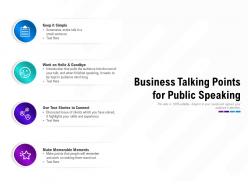
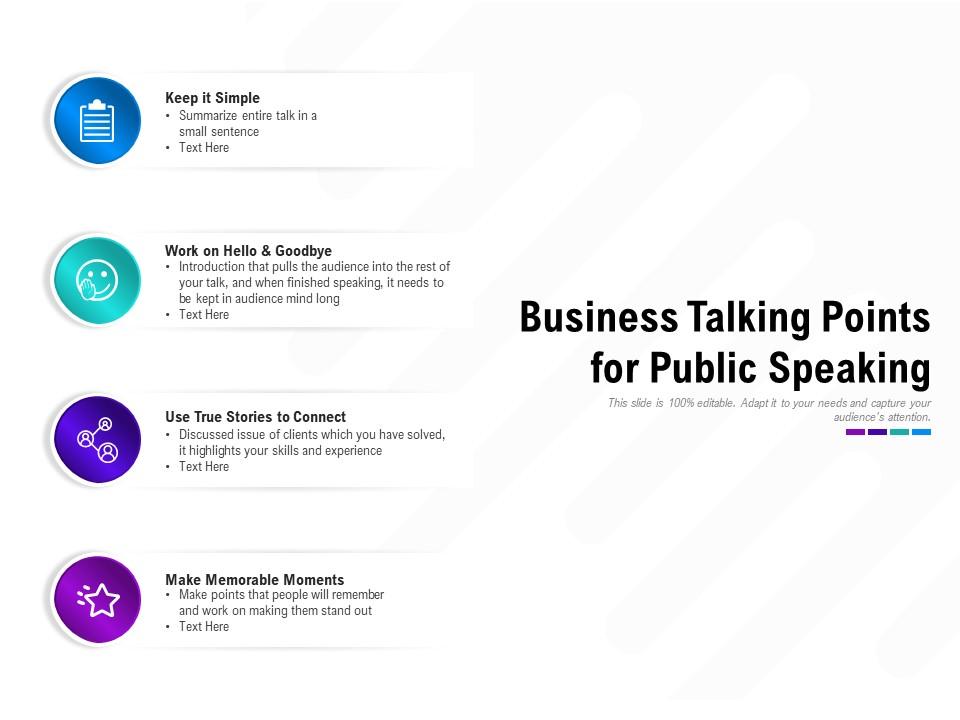
Business talking points for public speaking
Try Before you Buy Download Free Sample Product
Audience
Editable
of Time
Color up the event with our Business Talking Points For Public Speaking. They will create a brighter environment.
People who downloaded this PowerPoint presentation also viewed the following :
Business talking points for public speaking with all 2 slides:
Bring in brightness with our Business Talking Points For Public Speaking. Add color to the entire endeavour.
FAQs for Business talking points
Effective business public speaking includes clear messaging, confident delivery, audience engagement, strategic storytelling, and compelling visual support. These elements work together by building credibility, enhancing persuasion, and driving action, with many executives finding that mastering these skills accelerates career advancement, improves stakeholder relationships, and ultimately delivers measurable business outcomes.
Presentation templates enhance business clarity by providing consistent formatting, logical flow structures, professional visual hierarchy, standardized data visualization, and strategic content organization. These design frameworks enable presenters to communicate complex information more effectively, reduce audience cognitive load, and maintain focus on key messages, with many executives finding that well-structured templates significantly improve stakeholder engagement and decision-making outcomes.
Business professionals can manage public speaking anxiety through thorough preparation, visualization exercises, controlled breathing techniques, gradual exposure practice, and strategic audience engagement methods. These approaches work by building confidence through rehearsal, reducing physical stress responses, and creating positive mental frameworks, with many executives finding that consistent practice and preparation ultimately transform anxiety into focused energy that enhances their presentation impact.
Audience analysis shapes business presentation strategies by determining content depth, communication style, visual design choices, and messaging focus to match stakeholder needs and expertise levels. Through demographic research and role assessment, presenters customize technical complexity, emphasize relevant ROI metrics, and structure arguments that resonate with decision-makers, ultimately delivering more persuasive outcomes and stronger stakeholder engagement.
Storytelling enhances business presentations by creating emotional connections, simplifying complex data, and making key messages more memorable and relatable. These narrative techniques help presenters in financial services, healthcare, and retail capture audience attention, build trust through authentic examples, and drive decision-making, ultimately delivering more persuasive communications and stronger business outcomes.
Body language plays a crucial role in business public speaking by conveying confidence, credibility, and engagement through posture, gestures, eye contact, and facial expressions. These non-verbal elements significantly enhance message delivery and audience connection, with many executives finding that strategic body language reinforces their verbal content, builds trust with stakeholders, and ultimately strengthens their professional influence and persuasive impact.
Visual aids in presentation templates support speakers by organizing complex information clearly, reinforcing key messages through visual hierarchy, and maintaining audience engagement through consistent design elements. These templates enable speakers to deliver more impactful presentations by streamlining content flow, reducing cognitive load on audiences, and enhancing message retention, with many business professionals finding that well-designed visual frameworks significantly improve communication outcomes and audience comprehension.
Common mistakes include poor preparation, overwhelming slides with text, lack of audience engagement, monotone delivery, and failing to practice timing. These presentation pitfalls undermine professional credibility by creating confusion, losing audience attention, and missing key messaging opportunities, with many executives finding that structured preparation and interactive elements significantly enhance communication effectiveness and business outcomes.
Tailoring presentation style to different audiences is crucial for effective business communication, as it significantly enhances message reception, engagement levels, and desired outcomes. By adapting tone, content depth, and delivery methods to match audience expertise, cultural backgrounds, and business priorities, presenters achieve stronger stakeholder buy-in, clearer decision-making processes, and ultimately deliver more persuasive and actionable communications.
Engaging remote audiences requires interactive polls, breakout sessions, multimedia elements, strategic pauses for questions, and direct name usage to maintain personal connection. These techniques combat virtual fatigue by encouraging participation, creating dialogue opportunities, and leveraging technology features, with many organizations finding that structured interaction points and visual storytelling significantly improve audience retention and meeting outcomes.
Peer feedback enhances public speaking skills by identifying blind spots, highlighting strengths and weaknesses, and providing real-time insights from diverse perspectives. Through structured feedback sessions, business professionals can refine their delivery, clarify messaging, and build confidence, with many organizations finding that peer coaching circles ultimately deliver stronger presentations and improved leadership communication.
Strong openings capture audience attention and establish credibility, while compelling closings reinforce key messages and drive desired actions. These strategic bookends significantly enhance presentation effectiveness by creating memorable first impressions, maintaining engagement throughout, and ensuring audiences retain critical information, with many executives finding that well-crafted openings and closings ultimately deliver measurable business outcomes and competitive advantage.
Data and statistics enhance presentation credibility by providing objective evidence, supporting key arguments with quantifiable proof, and demonstrating thorough research and preparation. When presenters incorporate relevant metrics, industry benchmarks, and compelling visualizations, they transform subjective claims into authoritative insights, with many business leaders finding that data-driven presentations significantly increase stakeholder confidence and decision-making speed.
Practicing speeches in front of audiences builds confidence, identifies delivery weaknesses, and helps refine timing, pacing, and audience engagement techniques. Through rehearsals with colleagues or focus groups, business professionals enhance their persuasive impact, minimize presentation anxiety, and adapt their messaging for maximum effectiveness, ultimately delivering more compelling pitches and strategic communications.
Networking opportunities during public speaking events can be maximized through strategic pre-event research, interactive presentation elements, early arrival for mingling, and structured follow-up protocols. Business professionals increasingly leverage speaking platforms by incorporating audience polls, Q&A sessions, and post-presentation discussions, ultimately building valuable industry connections while establishing thought leadership and expanding their professional influence within their sector.
No Reviews