Call Center Smart Action Plan Training Program For BPO Call Center Agents Ppt Icon Show
Try Before you Buy Download Free Sample Product
Audience
Editable
of Time
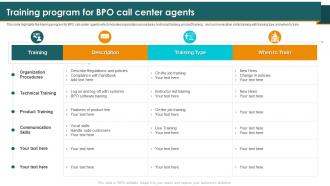
This slide highlights the training program for BPO call center agents which includes organization procedures, technical training, product training, and communication skills training with training type and when to train.
People who downloaded this PowerPoint presentation also viewed the following :
Call Center Smart Action Plan Training Program For BPO Call Center Agents Ppt Icon Show with all 6 slides:
Use our Call Center Smart Action Plan Training Program For BPO Call Center Agents Ppt Icon Show to effectively help you save your valuable time. They are readymade to fit into any presentation structure.
FAQs for Call Center Smart Action Plan Training Program For BPO Call Center Agents
Effective call center training programs include product knowledge mastery, communication skills development, CRM system proficiency, conflict resolution techniques, and performance metrics understanding. These components work together by building agent confidence, streamlining customer interactions, and enhancing service quality, with many organizations finding that comprehensive training ultimately delivers faster resolution times and improved customer satisfaction scores.
Role-playing scenarios enhance call center training by simulating real customer interactions, building confidence through practice, and developing problem-solving skills in controlled environments. These immersive exercises enable agents to handle difficult conversations, practice de-escalation techniques, and refine communication approaches, with many organizations finding that hands-on simulation significantly improves first-call resolution rates and customer satisfaction scores.
Call center training program success metrics include customer satisfaction scores, first-call resolution rates, average handle time, agent retention rates, and quality assurance scores. These measurements enable organizations to assess training effectiveness by tracking improved customer experiences, reduced operational costs, and enhanced agent performance, with many companies finding that comprehensive metric tracking ultimately delivers measurable ROI and competitive service advantages.
Technology revolutionizes call center training through AI-powered simulations, interactive e-learning platforms, real-time performance analytics, and virtual reality scenarios that replicate customer interactions. These digital solutions enable personalized learning paths, immediate feedback mechanisms, and scalable training delivery, with financial services and retail companies finding that technology-enhanced programs reduce training time while improving agent readiness and customer satisfaction scores.
Techniques to boost agent engagement include interactive role-playing scenarios, gamification with points and leaderboards, microlearning modules, peer-to-peer learning sessions, and real-time feedback systems. These approaches enhance knowledge retention by creating immersive experiences, fostering healthy competition, and enabling personalized learning paths, with many call centers finding that engaged agents deliver significantly better customer experiences and higher performance metrics.
Training programs can be tailored by incorporating visual presentations, interactive simulations, hands-on practice sessions, audio-based learning modules, and peer-to-peer mentoring approaches. These diverse methodologies enable call centers to enhance agent retention, accelerate skill development, and improve customer service quality, with many organizations finding that customized training reduces onboarding time while boosting performance metrics.
Effective approaches include de-escalation techniques, active listening skills, empathy training, scenario-based role-playing, and product knowledge mastery. These methods enhance agent confidence and customer satisfaction by teaching professionals to remain calm under pressure, understand customer perspectives, and provide solution-focused responses, ultimately delivering improved service experiences and reduced escalation rates across customer service operations.
Ongoing training proves crucial for maintaining service quality, adapting to evolving customer expectations, and reducing agent turnover in call centers. Through continuous skill development programs, agents enhance communication abilities, master new technologies, and stay current with product updates, while organizations experience improved customer satisfaction scores, increased first-call resolution rates, and ultimately stronger competitive positioning in service delivery.
Team collaboration enhances call center training effectiveness by fostering knowledge sharing, peer-to-peer learning, and collective problem-solving skills that mirror real workplace dynamics. Through collaborative exercises, role-playing scenarios, and group discussions, trainees develop communication strategies, build confidence in handling complex customer interactions, and create supportive networks that ultimately improve service quality and reduce turnover rates.
Call center training programs can incorporate agent feedback through regular surveys, focus groups, post-training evaluations, peer mentoring sessions, and performance review discussions. These feedback mechanisms enable organizations to identify skill gaps, refine training modules, and enhance learning approaches, with many companies finding that agent-driven insights significantly improve program effectiveness and employee engagement.
Remote call center training faces challenges including limited hands-on practice with systems, reduced supervisor oversight, technology connectivity issues, distracting home environments, and difficulties building team cohesion. These obstacles can be addressed through interactive virtual simulations, regular video check-ins, cloud-based training platforms, flexible scheduling options, and virtual team-building activities, ultimately delivering consistent agent performance and maintaining service quality standards.
Cultural sensitivity training can be integrated through role-playing exercises simulating diverse customer interactions, comprehensive modules on cultural communication styles, unconscious bias workshops, and mentorship programs pairing agents from different backgrounds. These approaches enhance customer satisfaction by reducing miscommunications, improving first-call resolution rates, and building stronger rapport across cultural boundaries, with many organizations finding that culturally competent agents deliver significantly better customer experiences and retention.
A well-structured call center training program significantly enhances customer satisfaction by improving agent communication skills, product knowledge, problem-solving abilities, and emotional intelligence. Through comprehensive training modules, organizations achieve faster issue resolution, reduced call transfer rates, and more personalized customer interactions, ultimately delivering higher retention rates and competitive advantage in customer service excellence.
Trainers can measure knowledge retention through post-training assessments, skill simulations, call monitoring evaluations, periodic refresher quizzes, and performance metric tracking over extended periods. Through quality assurance scorecards and customer satisfaction surveys, call centers effectively gauge how well agents apply learned techniques in real interactions, ultimately delivering improved service quality and reduced training costs.
Gamification in call center training delivers enhanced engagement, improved knowledge retention, accelerated skill development, increased motivation, and measurable performance tracking through interactive learning experiences. Through point systems, leaderboards, and achievement badges, organizations streamline onboarding processes, reduce training costs, and boost agent confidence, with many call centers finding that gamified programs ultimately deliver higher customer satisfaction scores and lower employee turnover rates.
-
My team has been relying on SlideTeam’s professional PPT designs for a while now. It has greatly sped up quality work at my organization. So thanks!
-
Use of different colors is good. It's simple and attractive.