Checklist For Validating Transaction Monitoring Using AML Monitoring Tool To Prevent
Try Before you Buy Download Free Sample Product
Audience
Editable
of Time
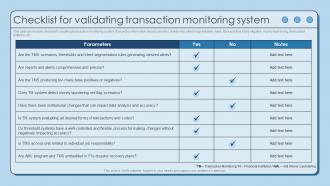
This slide showcases checklist for auditing transaction monitoring system. It provides information about scenarios, thresholds, client segmentation, rules, false positive, false negative, money laundering, transaction patterns, etc.
People who downloaded this PowerPoint presentation also viewed the following :
Checklist For Validating Transaction Monitoring Using AML Monitoring Tool To Prevent with all 6 slides:
Use our Checklist For Validating Transaction Monitoring Using AML Monitoring Tool To Prevent to effectively help you save your valuable time. They are readymade to fit into any presentation structure.
FAQs for Checklist For Validating Transaction Monitoring Using AML Monitoring
So basically you want to make sure your transaction monitoring actually catches the sketchy stuff and keeps regulators happy. Your scenarios need to detect the right patterns without drowning your team in false alarms - nobody wants that headache. Think of it like a regular health check for your whole monitoring setup. The checklist helps you test everything systematically and document it all properly. You're looking for gaps where bad actors might sneak through undetected. Oh, and don't wait until exam time to run these validations. Do them regularly or you'll regret it later.
Run test scenarios with suspicious patterns you know should trigger alerts - most systems fail here, honestly. Track your alert volumes and false positive rates monthly. Document everything because regulators want proof you're actually validating the system works, not just crossing your fingers. Different schemes like structuring need separate monitoring too. Set up reviews to catch trends early... though finding time for monthly deep-dives is always the real challenge. False positives will eat your team alive if you don't stay on top of this stuff.
Start with transaction amounts and frequency patterns - those catch most issues. Geographic flags are huge too, especially for sketchy jurisdictions. Velocity checks work great for spotting rapid-fire transactions. Customer risk scoring integration is honestly where most people mess up, but it's super effective. Historical pattern analysis helps spot weird account behavior. Also throw in beneficiary screening and keep an eye on cash-heavy businesses. The thing is, your parameters need to match your actual customer base, not just what regulators want to see. Otherwise you'll get buried in false positives.
Look, annually is what regulators want as the absolute minimum, but you're gonna want to do it every 6 months honestly. Your transaction patterns change constantly - new fraud schemes pop up, customer behavior shifts, you know how it goes. Plus anytime you tweak rules or thresholds, validate right after. I throw in quarterly spot checks too because catching stuff early beats dealing with surprises later. Trust me on this - having a set schedule saves your butt when examiners show up asking questions. Way better than trying to scramble through validation docs while they're sitting there watching you sweat.
Look, you can't really do AML validation without decent tech backing you up. Automated testing frameworks are huge for checking your monitoring rules actually work. Data quality tools matter too - garbage data means garbage results, obviously. Honestly though? Sometimes basic SQL queries save the day more than fancy AI stuff. You'll want model performance monitoring to catch false positives and something for alert tuning. Oh, and reporting systems to track everything. Main thing is getting tools that let you test scenarios systematically instead of doing it all by hand. Trust me on this one.
Just focus your testing based on actual risk levels. Wire transfers and correspondent banking? Hit those hard - more samples, frequent threshold checks, deep dives on false positives. Medium/low risk stuff gets basic testing because honestly, why waste time on low-impact areas? Start by sorting your scenarios into risk buckets first. Then adjust everything - testing frequency, sample sizes, how much documentation you need. Way more efficient than the one-size-fits-all approach most places do. Put your effort where it actually moves the needle for your AML program.
Honestly, the worst mistake is only testing with perfect, clean data instead of the messy stuff you'll actually see. Real-world transactions are chaotic - partial matches, weird timing, currency conversions that break everything. Don't just check if alerts work, make sure they're not garbage that'll bury your analysts in false positives. Nobody has time for that noise. Test your scariest transaction types first, then work down from there. Edge cases will bite you if you ignore them. Oh, and write down what you're doing as you go - trying to remember your testing logic weeks later is basically impossible.
Basically treat any new AML rules like they just broke your monitoring system - because they kinda did. Each regulatory change hits different scenarios and controls, so you've gotta re-validate those specific areas. The annoying part? There's always some new regulation dropping. Set up alerts so you're not blindsided, then figure out which changes actually mess with your transaction monitoring rules. Honestly, don't wait around for your annual validation cycle. Jump on these right away. Your compliance folks will definitely appreciate not scrambling at the last minute.
Track three main things: detection rate (are you catching the sketchy stuff?), false positives (trust me, too many alerts will drive everyone crazy), and how fast your team resolves investigations. Watch for sudden spikes in alert volume - that's usually a sign your rules are off. Also monitor what percentage of transaction types you're actually covering. The tricky part? You want to catch everything but not overwhelm your investigators. I'd start checking these monthly, then tweak your thresholds based on what your team can realistically handle.
Look, data quality is make-or-break for transaction monitoring - honestly, bad data will torpedo your whole program. Your monitoring rules can't work properly if there are gaps, duplicates, or wonky records in the system. Customer info needs to be solid, transaction amounts have to be right, timestamps can't be all over the place. I've seen missing data create these huge blind spots that regulators pick up on immediately during exams. Run your data quality checks first before you start testing scenarios. Trust me, it'll save you so much pain down the road when everything actually works like it's supposed to.
Okay so basically you want to document EVERYTHING as you go - don't wait until the end because you'll forget stuff. Start with your validation plan, then track all your testing, data sources, samples, any problems that pop up. Screenshots are clutch for system configs and results. Here's the thing though - auditors actually care more about WHY you made certain decisions than just what you did. So explain your reasoning behind choices. Oh and keep it all in one place that everyone can access. Trust me, trying to piece together documentation later is a nightmare you don't want.
Build flexibility into your validation setup right from the start - modular test scenarios that adapt fast when new threats pop up. Update test cases every quarter using FinCEN advisories, industry reports, and your own suspicious activity data. I've watched teams completely panic when crypto mixing services exploded onto the scene! Better to maintain a dynamic library of validation scenarios instead of those boring static annual tests. Get alerts set up for emerging risks from compliance, then create quick-deployment test scripts. Your validation needs to be as nimble as the bad guys you're chasing.
Track three main things: detection rate (what percentage of sketchy stuff you catch), false positive rate (basically how much useless noise you're creating), and how fast you close cases. High detection is great, but if your analysts are buried in garbage alerts, that's a problem. Also keep an eye on regulatory exam results and any cases you missed that regulators found later - those sting. Here's the thing though: don't try copying other banks' numbers since everyone's risk profile is different. Compare against your own past performance instead. Set quarterly goals and actually sit down with your team to review them.
Internal audits are like having someone double-check your transaction monitoring stuff actually works. They'll dig into your scenario settings, pull random alerts to see if they're decent quality, and make sure your investigation team follows the rules. Pretty much your backup when compliance misses things during regular work. They also check if you're hitting regulatory requirements and can catch blind spots in your monitoring - which honestly happens more than people admit. Just make sure they get access to your system docs and transaction data so they can actually test things properly and give you feedback worth using.
Getting other people to look at your validation checklist is honestly a game-changer. Business users will catch weird edge cases you'd never think of sitting at your computer. Compliance folks are great at spotting regulatory stuff that'll bite you later. IT teams - and trust me, they're usually annoyingly right about this - will tell you what's actually going to break in production. Risk managers know all the latest fraud tricks too. Just set up some regular check-ins with different groups. Write down what they say and actually use it. You'll be surprised how much you miss on your own.
-
I downloaded some of the presentations for work. They were simple to modify and saved me a lot of time and effort.
-
Kudos to SlideTeam for achieving the high success rate in delivering the top-notch slides.Â