

Cloud Data Encryption Implementation Plan Powerpoint Presentation Slides




Try Before you Buy Download Free Sample Product
 Impress Your
Audience
 100%
Editable
 Save Hours
of Time


Check out our professionally designed Cloud Data Encryption Implementation Plan. This Cryptography PowerPoint presentation briefly explains how to secure cloud data and has covered the key challenges that organizations experience with legacy encryption systems, various performance tracking metrics, and performance gap analysis. In addition, this Data in Transit PPT demonstrates the working and architecture of client-side and server-side encryption using a Key Management System KMS and Customer Keys CMK. Also, the Cybersecurity PPT presentation discusses the process of zero-knowledge encryption using Cryptomator and Nordlocker software, along with the significant risks involved in cloud encryption implementation and mitigation strategies. Furthermore, this Data protection template compares the scenario after integrating encryption protocols in the organizational networks based on several parameters. Moreover, this Cryptomator deck comprises a budget overview, including estimated costs for cloud security implementation and employee training. Lastly, this Data privacy PowerPoint Presentation contains a performance tracking dashboard and the impact of encryption deployment on the organization. Download our 100 percent editable and customizable template, which is also compatible with Google Slides.
People who downloaded this PowerPoint presentation also viewed the following :
Content of this Powerpoint Presentation
Slide 1: The slide introduces Cloud Data Encryption Implementation Plan.
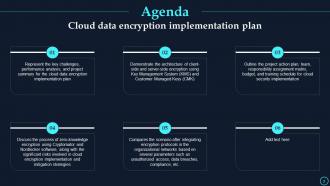
Slide 2: This is an Agenda slide. State your agendas here.
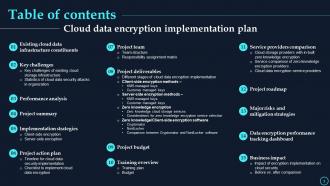
Slide 3: The slide displays Table of contents for presentation.
Slide 4: The slide continues Table of contents.
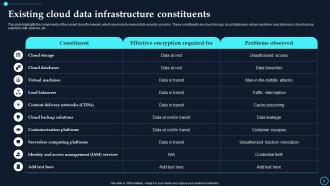
Slide 5: This slide highlights the components of the current cloud framework, which are prone to several data security concerns.
Slide 6: The slide represents title of contents further.
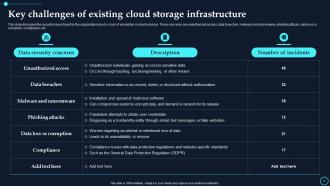
Slide 7: This slide discusses the security issues faced by the organization due to a lack of encryption in cloud services.
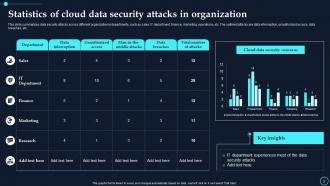
Slide 8: This slide summarizes data security attacks across different organizational departments.
Slide 9: The slide describes title of contents which is to be discussed further.
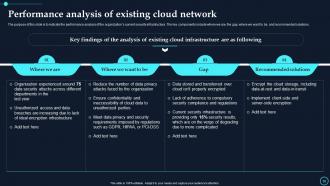
Slide 10: The slide is to indicate the performance analysis of the organization’s current security infrastructure.
Slide 11: The slide also presents title of contents.
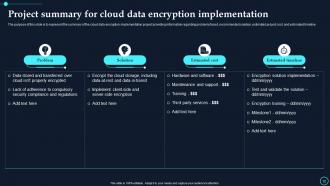
Slide 12: The slide represents the summary of the cloud data encryption implementation project providing information.
Slide 13: The slide describes title of contents further.
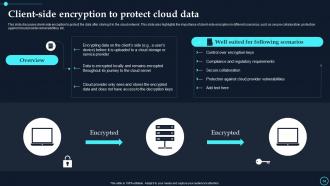
Slide 14: This slide discusses client-side encryption to protect the data after storing it in the cloud network.
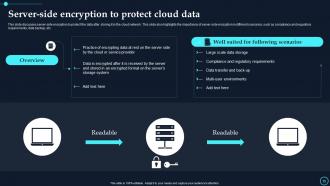
Slide 15: This slide renders server-side encryption to protect the data after storing it in the cloud network.
Slide 16: The slide also highlights title of contents.
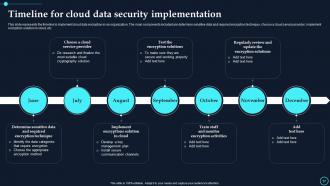
Slide 17: This slide represents the timeline to implement cloud data encryption in an organization.
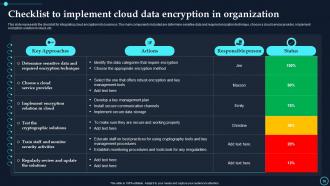
Slide 18: This slide highlights the checklist for integrating cloud encryption into business.
Slide 19: The slide also renders title of contents.
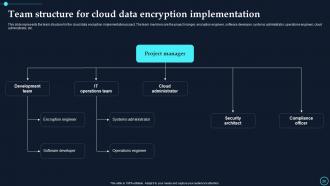
Slide 20: This slide represents the team structure for the cloud data encryption implementation project.
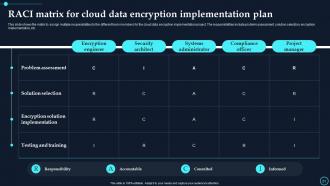
Slide 21: This slide shows the matrix to assign multiple responsibilities to the different team members for the cloud data encryption implementation project.
Slide 22: The slide displays title of contents further.
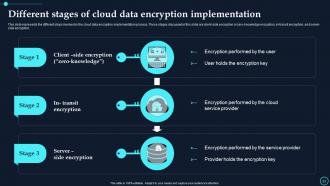
Slide 23: This slide represents the different steps involved in the cloud data encryption implementation process.
Slide 24: The slide shows another title of contents.
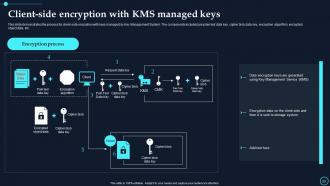
Slide 25: This slide demonstrates the process for client-side encryption with keys managed by Key Management System.
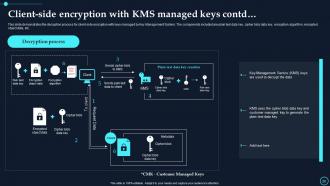
Slide 26: This slide describes the decryption process for client-side encryption with keys managed by Key Management System.
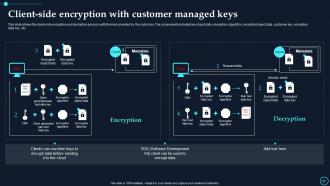
Slide 27: This slide shows the client-side encryption and decryption process with the keys provided by the customer.
Slide 28: The slide showcases title of contents which is to be discussed further.
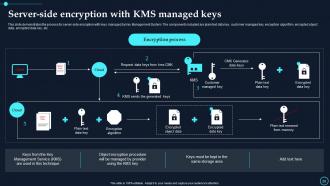
Slide 29: This slide demonstrates the process for server-side encryption with keys managed by Key Management System.
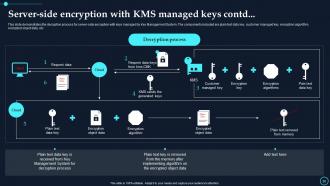
Slide 30: This slide displays the decryption process for server-side encryption with keys managed by Key Management System.
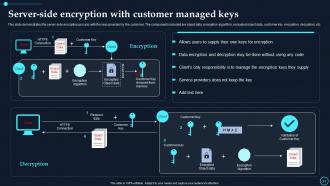
Slide 31: This slide renders the server-side encryption process with the keys provided by the customer.
Slide 32: The slide covers another title of contents which is to be discussed further.
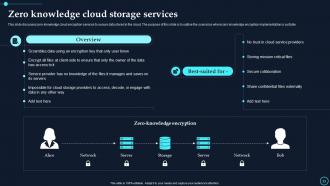
Slide 33: This slide discusses zero-knowledge cloud encryption services to secure data stored in the cloud.
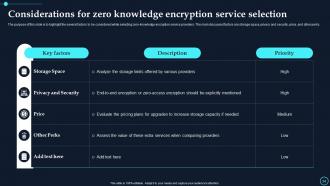
Slide 34: The slide is to highlight the several factors to be considered while selecting zero-knowledge encryption service providers.
Slide 35: The slide exhibits title of contents further.
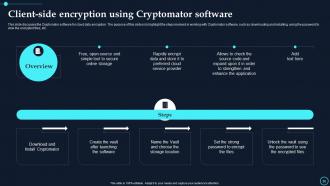
Slide 36: This slide discusses the Cryptomator software for cloud data encryption.
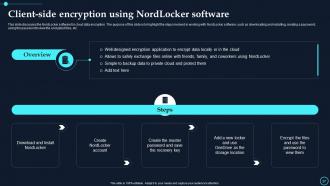
Slide 37: This slide contains the NordLocker software for cloud data encryption.
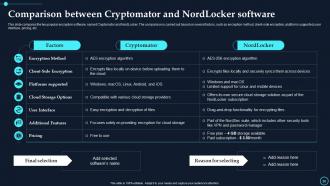
Slide 38: This slide compares the two popular encryption software, named Cryptomator and NordLocker.
Slide 39: The slide also exhibits title of contents.
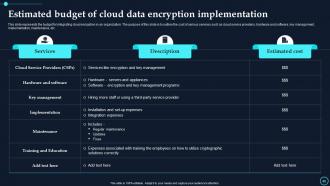
Slide 40: This slide represents the budget for integrating cloud encryption in an organization.
Slide 41: The slide depicts title of contents further.
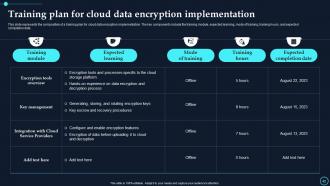
Slide 42: This slide represents the composition of a training plan for cloud data encryption implementation.
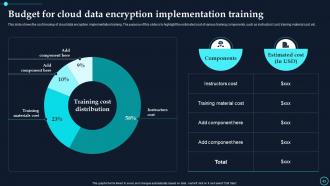
Slide 43: This slide shows the cost breakup of cloud data encryption implementation training.
Slide 44: The slide illustrates another title of contents.
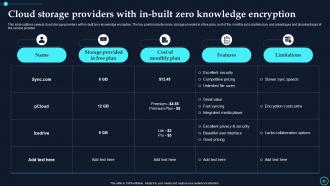
Slide 45: This slide outlines several cloud storage providers with in-built zero-knowledge encryption.
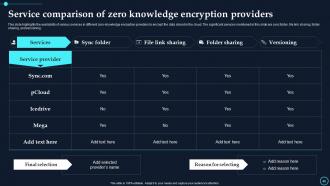
Slide 46: This slide highlights the availability of various services in different zero-knowledge encryption providers to encrypt the data stored in the cloud.
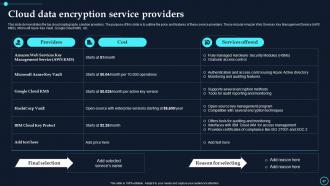
Slide 47: This slide demonstrates the top cloud cryptography solution providers.
Slide 48: The slide describes title of contents further.
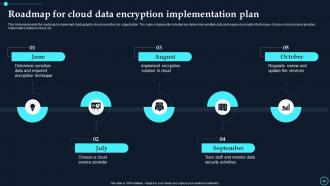
Slide 49: This slide presents the roadmap to implement cryptographic cloud security in an organization.
Slide 50: The slide also renders title of contents.
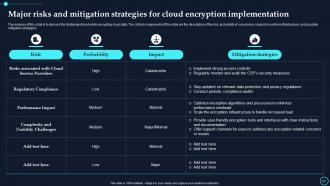
Slide 51: The slide is to discuss the challenges faced while encrypting cloud data.
Slide 52: The slide again covers title of contents.
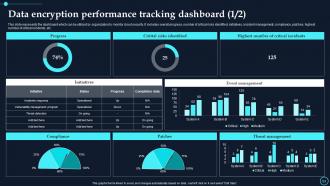
Slide 53: This slide represents the dashboard which can be utilized by organization to monitor cloud security.
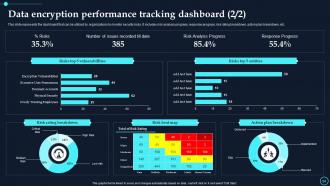
Slide 54: This slide presents the dashboard that can be utilized by organizations to monitor security risks.
Slide 55: The slide contains title of contents further.
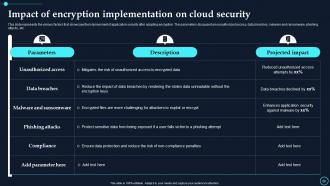
Slide 56: This slide highlights the various factors that showcase the improvement of application security after adopting encryption.
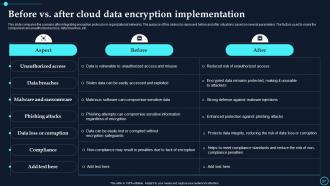
Slide 57: This slide compares the scenario after integrating encryption protocols in organizational networks.
Slide 58: This slide shows all the icons included in the presentation.
Slide 59: This slide is titled as Additional Slides for moving forward.
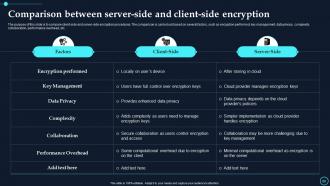
Slide 60: The slide is to compare client-side and server-side encryption procedures.
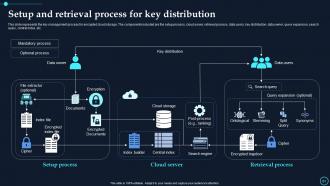
Slide 61: This slide represents the key management process for encrypted cloud storage.
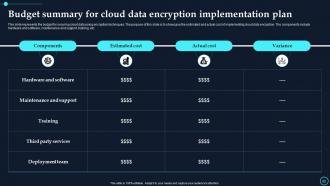
Slide 62: This slide presents the budget for securing cloud data using encryption techniques.
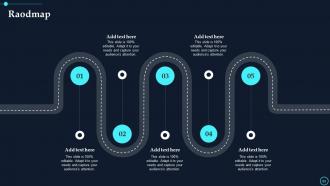
Slide 63: This slide displays Roadmap with additional textboxes.
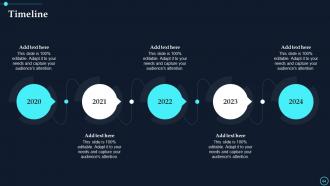
Slide 64: This is a Timeline slide. Show data related to time intervals here.
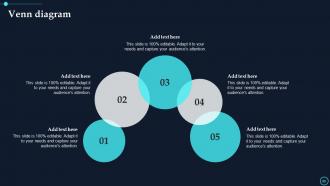
Slide 65: This slide depicts Venn diagram with text boxes.
Slide 66: This slide shows Post It Notes. Post your important notes here.
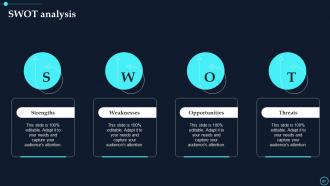
Slide 67: This slide shows SWOT describing- Strength, Weakness, Opportunity, and Threat.
Slide 68: This is a Thank You slide with address, contact numbers and email address.
Cloud Data Encryption Implementation Plan Powerpoint Presentation Slides with all 76 slides:
Use our Cloud Data Encryption Implementation Plan Powerpoint Presentation Slides to effectively help you save your valuable time. They are readymade to fit into any presentation structure.








FAQs for Cloud Data Encryption Implementation Plan
Dude, cloud encryption is honestly a no-brainer. Hackers break in? Your data just looks like random nonsense to them. Most compliance stuff requires it anyway, so you're killing two birds with one stone there. Customers definitely feel better knowing their info is encrypted - I mean, wouldn't you? The cool thing is cloud providers usually handle all the technical key management crap for you. My cousin's company just turned it on and boom, protected. Way easier than I expected it to be.
So basically, end-to-end encryption means your stuff gets locked up on YOUR device before it even hits the cloud. You're the only one with the key - not Google, not Apple, nobody. Regular cloud encryption is different though. Sure, they encrypt your data, but they can still peek at it since they control the keys. Think of it like this - would you rather mail a locked box where only you have the key, or hand your stuff to someone else to put in their safe? Even if hackers break in or the government comes knocking, they literally can't unlock your E2E encrypted files. Most cloud services don't actually do this by default btw, so definitely check your settings.
So most cloud services default to AES-256 for your actual data encryption - it's ridiculously secure, like would take billions of years to crack. Then they use RSA for managing the encryption keys themselves. AWS, Google Cloud, Azure, they all do this pretty much the same way. A lot of them are switching to elliptic curve stuff too since it's faster than RSA. Honestly though? You probably won't need to mess with these settings yourself. The defaults are solid. Just maybe peek at your provider's security docs if you're curious what's actually running under the hood.
First thing - figure out which regulations you're actually dealing with. GDPR, HIPAA, whatever applies to your situation. AES-256 encryption is pretty much the gold standard, so stick with that. Key management is where most people mess up though - you need solid documentation on who can access keys and how often you rotate them. Your cloud provider should let you pick where data gets stored geographically (some regulations are picky about this). Oh, and definitely loop in your compliance folks before you build anything. Trust me, it's way easier than fixing it later.
Think of encryption keys like the master passwords for your cloud stuff. Without them, hackers just see scrambled nonsense even if they grab your files. There's two main types - symmetric keys (same one locks and unlocks) and asymmetric with public/private pairs. Most people totally botch the key management though, which is honestly where everything falls apart. Your data's only safe if you actually protect and rotate those keys properly. Oh, and don't store them with your data - that's basically putting your spare key under the doormat. Use a real key management service instead.
Honestly, just go with AWS KMS, Azure Key Vault, or Google Cloud KMS. Don't even think about building your own - I've seen too many teams mess that up badly. These services handle rotation automatically and tie into your existing cloud setup perfectly. Set up IAM policies to control access. Oh, and definitely keep key backups somewhere separate from your encrypted data (learned that one the hard way). Start by figuring out what you're encrypting now, then move everything under one system. Way cleaner.
Dude, you're basically leaving your front door wide open. Credit card info, customer data, proprietary stuff - it's all just sitting there unprotected for hackers to grab. If you're in healthcare or finance, you'll get slammed with regulatory fines since most frameworks require encryption anyway. Your reputation takes a hit too when customers realize their data wasn't secured. Honestly, the compliance stuff alone should scare you into action. I'd check what encryption you currently have running and upgrade to stronger algorithms if needed.
Yeah, encryption does slow things down but we're talking microseconds - your users won't even notice. The real pain is managing all the keys and making sure your team knows how to work with encrypted stuff. Debugging gets annoying too since you can't just look at the raw data anymore (learned that the hard way). Performance-wise though? Not a big deal with decent cloud providers. Just pick one that does the encryption transparently so you don't have to think about it much. Way less headache that way.
So basically, symmetric encryption uses one key for everything - like having a single house key that locks and unlocks all your doors. Asymmetric is different - it uses two keys that work together (public and private). Way more secure for sharing stuff, but honestly it's painfully slow for big files. Cloud storage mostly relies on symmetric since it can actually handle large uploads without taking forever. The asymmetric part usually just helps services swap those keys securely. Most cloud providers mix both anyway, so you don't really need to worry about it.
Dude, you gotta set up key backups BEFORE you lose them - can't fix this after the fact. Most companies use key management services that automatically backup your keys to different secure spots, or they split keys across multiple systems. Some places have recovery agents too, but honestly the approval process is usually a nightmare. Without planning ahead? Your encrypted data is toast. I'd recommend setting up automated backups now and actually test the recovery process every few months. Don't be that person who waits until everything's on fire.
Alright, so first things first - encrypt everything, both when it's sitting there and when it's moving around. AES-256 is solid, but whatever you do, don't build your own encryption from scratch. I've seen that disaster movie before. Get a proper key management service instead of just shoving keys next to your encrypted stuff like some amateur hour move. Set up access controls too so random people can't decrypt your sensitive data. Oh, and rotate those keys regularly - maybe set a reminder or something. Actually, before you do any of this, figure out what sensitive data you even have up there. Might surprise you.
So basically with client-side encryption, your stuff gets scrambled before it even leaves your device. Way better than server-side where you're just hoping the cloud company doesn't peek at your files (spoiler: they totally can if they want to). Even if hackers break in or the feds show up with paperwork, your data's still locked down tight. Yeah it's more of a pain to set up, but honestly? For anything you actually care about keeping private, just do it. The peace of mind is worth the extra hassle.
Honestly, encryption standards are your first priority - you'll want AES-256 minimum. Make sure they do both data-at-rest and in-transit protection. The key management thing is huge though - can you control your own keys or are you stuck with theirs? I'd pick key control over fancy features any day. Look into their compliance stuff too. HIPAA, SOX, whatever you need. Data center locations matter for regulatory reasons - something people forget about. Just ask them straight up for security docs and how they actually implement encryption. Most decent providers won't dodge those questions.
Check if they have SOC 2 or ISO 27001 certifications first - those are the main ones that matter. Their security whitepapers usually break down encryption methods and data policies pretty well. Third-party audits are clutch though, don't just trust what they tell you. Ask to see how they actually implement encryption during your evaluation. AES-256 is what you want, plus proper key rotation. Honestly, most vendors get weird if you ask too many technical questions upfront, but push anyway. Document everything they promise you.
Honestly, quantum computing's gonna break everything we use now, so companies are scrambling to build quantum-resistant algorithms. NIST is almost done with the standards - you should probably start looking into that sooner rather than later. There's also this crazy thing called homomorphic encryption where you can actually run calculations on encrypted data without ever decrypting it (sounds like sci-fi but it's real). Zero-trust is pushing encryption everywhere now. AI's handling more of the key management stuff automatically, which is nice because that was always a pain. Even smaller companies can access cloud-based hardware security modules now too.
-
The website is jam-packed with fantastic and creative templates for a variety of business concepts. They are easy to use and customize.
-
I am not the best at presentations but using SlideTeam’s PPT template made it easier for me. Thank you SlideTeam!