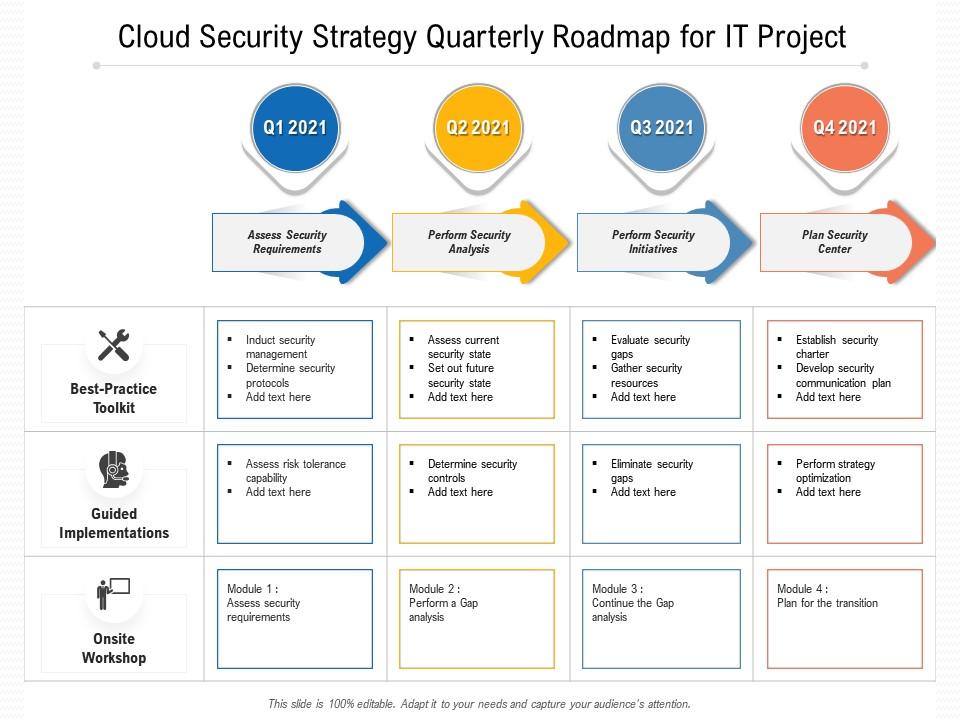
Feuille de route trimestrielle de la stratégie de sécurité cloud pour le projet informatique

Rating:
88%
Cloud security strategy quarterly roadmap for it project
Slide 1 of 2
Favourites Favourites

Try Before you Buy Download Free Sample Product

Audience Impress Your
Audience
Editable 100%
Editable
Time Save Hours
of Time
The Biggest Sale is ending soon in
0
0
:
0
0
:
0
0
Rating:
88%

Caractéristiques de ces diapositives de présentation PowerPoint :

Présentation de la feuille de route trimestrielle de la stratégie de sécurité dans le cloud pour la diapositive PowerPoint du projet informatique. Cette présentation PPT est compatible avec Google Slides, elle est donc facilement accessible. Ce thème PPT est disponible dans les formats d'image 4,3 et 16,9. Ce modèle PowerPoint est personnalisable afin que vous puissiez modifier la taille de la police, le type de police, la couleur et les formes selon vos besoins. Vous pouvez télécharger et enregistrer cette mise en page PowerPoint dans différents formats tels que PDF, PNG et JPG.

FAQs for Cloud security strategy quarterly roadmap

Key components of an effective cloud security strategy include identity and access management, data encryption, network security controls, compliance monitoring, and incident response planning. These elements work together by establishing multi-layered protection, automating threat detection, and ensuring regulatory adherence, with many organizations finding that this comprehensive approach delivers enhanced operational efficiency and competitive advantage.

Organizations can assess their cloud security posture through comprehensive security audits, vulnerability assessments, compliance evaluations, configuration reviews, and penetration testing across their infrastructure. These methodologies enable systematic identification of security gaps, misconfigurations, and potential threats, with many enterprises finding that regular assessments ultimately deliver enhanced risk management, regulatory compliance, and stronger overall security resilience.

Data encryption serves as a fundamental safeguard in cloud security by converting sensitive information into unreadable code during storage and transmission, protecting against unauthorized access, data breaches, and compliance violations. Through advanced encryption protocols, organizations across sectors like healthcare, finance, and retail can securely migrate critical workloads while maintaining data integrity, ultimately enabling confident cloud adoption and competitive advantage.

Multi-factor authentication enhances cloud security by requiring multiple verification methods, combining passwords with biometrics, SMS codes, or hardware tokens to create layered protection. Through MFA implementation, organizations significantly reduce unauthorized access risks, streamline compliance requirements, and minimize data breach vulnerabilities, with many financial services and healthcare institutions finding that this strategic approach delivers enhanced customer trust and operational security.

Cloud security access controls include multi-factor authentication, role-based permissions, zero-trust architecture, regular access audits, and privileged access management. These practices streamline security by minimizing unauthorized access, enforcing least-privilege principles, and maintaining compliance standards, with many financial institutions and healthcare organizations finding that strategic access controls ultimately deliver enhanced data protection and operational efficiency.

Organizations ensure cloud compliance through comprehensive due diligence, selecting certified providers, implementing robust data governance frameworks, and maintaining continuous monitoring systems. Many financial institutions and healthcare organizations leverage shared responsibility models with their cloud providers, establishing clear audit trails, data encryption protocols, and regular compliance assessments, ultimately delivering regulatory adherence while maintaining operational efficiency and scalability.

**INPUT**: What are the most common cloud security threats, and how can they be mitigated? **OUTPUT**: Common cloud security threats include data breaches, misconfigured storage, insider threats, account hijacking, and insecure APIs. These risks can be mitigated through multi-factor authentication, encryption protocols, and continuous monitoring, with many organizations finding that strategic security frameworks ultimately deliver enhanced protection and operational confidence. **Word count: 51 words**

Cloud incident response plans should incorporate cloud-specific elements like multi-tenant architectures, shared responsibility models, API-based forensics, automated scaling responses, and cross-region coordination capabilities. These tailored approaches enable faster threat containment, seamless collaboration with cloud providers, and comprehensive logging across distributed infrastructures, with many organizations finding that cloud-native incident response tools significantly reduce response times while enhancing security visibility.

API security strategies include authentication and authorization protocols, rate limiting, input validation, encryption, and continuous monitoring. These approaches protect cloud applications by controlling access through OAuth or API keys, preventing abuse through traffic controls, and detecting threats in real-time, with many financial services and healthcare organizations finding that comprehensive API security frameworks ultimately reduce breach risks while enabling scalable digital services.

Continuous monitoring improves cloud security defenses by detecting threats in real-time, automatically responding to anomalies, and providing comprehensive visibility across multi-cloud environments. Through advanced analytics and machine learning, organizations streamline incident response, minimize breach windows, and enhance compliance reporting, with many financial services and healthcare institutions finding that proactive monitoring ultimately delivers stronger security postures and reduced operational costs.

Shared responsibility models create clear security boundaries between cloud providers and customers, with providers securing infrastructure while customers protect their data, applications, and access controls. This division enables organizations to leverage enterprise-grade security capabilities while maintaining control over sensitive assets, though many businesses find that understanding these boundaries requires strategic planning and specialized expertise to avoid coverage gaps.

Organizations manage third-party vendor risks through comprehensive due diligence assessments, continuous security monitoring, and stringent contract requirements that include data protection clauses, audit rights, and compliance certifications. Financial services and healthcare institutions increasingly implement multi-layered vendor management frameworks, requiring regular penetration testing and incident response protocols, ultimately delivering enhanced data security and regulatory compliance across their cloud ecosystems.

Cloud security tools include identity and access management (IAM) platforms, cloud security posture management (CSPM) solutions, cloud workload protection platforms (CWPP), encryption services, and security information and event management (SIEM) systems. These technologies streamline compliance monitoring, automate threat detection, and enhance data protection across multi-cloud environments, with organizations finding that integrated security frameworks deliver comprehensive visibility and significantly reduce operational risks.

Businesses should approach cloud security training through comprehensive programs covering data classification, access management, threat recognition, compliance requirements, and incident response protocols. These initiatives enhance security posture by reducing human error, improving threat detection, and ensuring regulatory compliance, with many organizations finding that regular training significantly minimizes security breaches while enabling confident cloud adoption.

Cloud security effectiveness metrics include security incident frequency, mean time to detection and response, compliance audit scores, vulnerability remediation rates, and access control violations. These measurements enable organizations to assess their security posture comprehensively, with many financial institutions and healthcare providers finding that tracking user behavior analytics, data encryption coverage, and backup recovery times ultimately delivers measurable risk reduction and regulatory compliance confidence.

Ratings and Reviews

88% of 100
Review Form
Write a review
Most Relevant Reviews
  1. 80%

    by Clemente Myers

    Commendable slides with attractive designs. Extremely pleased with the fact that they are easy to modify. Great work!
  2. 100%

    by Columbus Vasquez

    Unique and attractive product design.
  3. 100%

    by Taylor Hall

    It saves your time and decrease your efforts in half.
  4. 80%

    by Darron Hunter

    Excellent design and quick turnaround.
  5. 80%

    by Christian Brooks

    Excellent template with unique design.

5 Item(s)

per page: