


Communication Network Time Management News Announcement Ppt Icons Graphics
You must be logged in to download this presentation.




Try Before you Buy Download Free Sample Product
 Impress Your
 Audience
 100%
100% Editable
 Save Hours
 of Time


Doubts and fears are part of growth. Remove apprehensions with our Communication Network Time Management News Announcement Ppt Icons Graphics.
People who downloaded this PowerPoint presentation also viewed the following :
Content of this Powerpoint Presentation
Description:
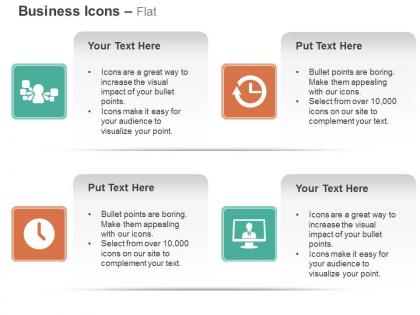
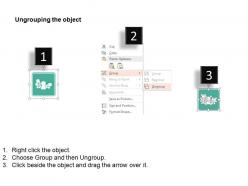
The image displays a PowerPoint slide with the title "Business Icons – Flat" and contains four sections, each with a different colored icon, a place for text, and bullet points beneath. The icons include a group of people, a clockwise arrow, a clock, and a figure at a computer, suggesting themes of collaboration, process or update, time management, and online communication respectively. The bullet points emphasize the importance of using icons to make presentations more visually engaging and easier for the audience to understand, noting that icons can replace boring bullet points and that there is a large selection to choose from.
Use Cases:
This approach can be leveraged in various sectors to enhance communication:
1. Marketing:
Use: Creating visually engaging client presentations.
Presenter: Marketing Specialist.
Audience: Clients, Marketing Teams.
2. Education:
Use: Developing interactive teaching materials.
Presenter: Curriculum Developer.
Audience: Teachers, Students.
3. Technology:
Use: Illustrating software features or updates.
Presenter: Product Manager.
Audience: Users, Stakeholders.
4. Healthcare:
Use: Visualizing health protocols or patient guidelines.
Presenter: Healthcare Administrator.
Audience: Medical Staff, Patients.
5. Finance:
Use: Enhancing reports on financial performance.
Presenter: Financial Analyst.
Audience: Investors, Management.
6. Human Resources:
Use: Clarifying company policies and procedures.
Presenter: HR Manager.
Audience: Employees, New Hires.
7. Real Estate:
Use: Showcasing property features and benefits.
Presenter: Real Estate Agent.
Audience: Potential Buyers, Investors.
Communication Network Time Management News Announcement Ppt Icons Graphics with all 4 slides:
Our Communication Network Time Management News Announcement Ppt Icons Graphics display completely factual data. You can draw accurate deductions.
FAQs for Communication Network Time Management News Announcement
Effective communication improves team project time management by establishing clear expectations, reducing misunderstandings, and streamlining decision-making processes. Through regular check-ins, centralized messaging platforms, and structured progress updates, teams eliminate redundant work, accelerate problem resolution, and maintain aligned priorities, ultimately delivering projects faster while minimizing resource waste and coordination delays.
Communication tools serve as central coordination hubs that enable real-time schedule sharing, automated meeting scheduling, instant availability updates, and cross-timezone calendar integration. These platforms streamline team synchronization by eliminating scheduling conflicts, reducing back-and-forth coordination emails, and providing transparent visibility into collective availability, with many organizations finding that integrated communication systems ultimately deliver faster project timelines and enhanced collaborative efficiency.
Miscommunication significantly disrupts project timelines by creating rework cycles, resource misallocation, and conflicting priorities that cascade across teams and departments. These breakdowns force organizations to extend deadlines, reallocate budgets, and compromise deliverable quality, with many project managers finding that poor communication channels ultimately cost 20-30% more time and resources than originally planned.
Managing communication across time zones requires strategic scheduling, asynchronous tools, clear protocols, flexible meeting rotations, and centralized documentation systems. These approaches streamline global collaboration by establishing core overlap hours, leveraging recorded updates and shared dashboards, and implementing follow-the-sun workflows, with many multinational organizations finding that structured communication frameworks ultimately enhance productivity while reducing coordination challenges across distributed teams.
Visual communication enhances clarity in time-sensitive tasks by presenting information through charts, diagrams, dashboards, and infographics that enable instant comprehension and faster decision-making. These visual tools streamline complex data interpretation, reduce miscommunication risks, and accelerate task coordination, with many project teams finding that visual workflows and status indicators deliver improved efficiency and meeting critical deadlines consistently.
Effective feedback contributes to better time management by identifying workflow bottlenecks, clarifying task priorities, reducing revision cycles, and streamlining decision-making processes. Through regular feedback loops, teams eliminate redundant activities, accelerate project timelines, and optimize resource allocation, with many organizations finding that structured feedback systems ultimately deliver faster project completion and enhanced operational efficiency.
Establishing clear communication protocols streamlines decision-making by defining information flow pathways, setting response timeframes, and designating decision authorities at each organizational level. These structured frameworks minimize redundant discussions, accelerate approval processes, and ensure relevant stakeholders receive timely updates, with many organizations finding that standardized protocols reduce decision cycles by 40-60% while enhancing accountability.
Common communication pitfalls that disrupt time management include unclear messaging, excessive meetings, delayed responses, information overload, and lack of prioritization frameworks. These issues create bottlenecks by causing repeated clarifications, scheduling conflicts, and workflow interruptions, with many organizations finding that streamlined communication protocols ultimately deliver faster decision-making and improved operational efficiency.
Regular check-ins improve communication and time efficiency by establishing consistent information flows, preventing miscommunications, and enabling proactive problem-solving before issues escalate. These structured touchpoints streamline decision-making processes, reduce lengthy email chains, and ensure team alignment, with many organizations finding that brief, frequent meetings ultimately deliver faster project completion and enhanced operational efficiency.
**INPUT**: What tools are best suited for real-time communication in time-sensitive environments? **OUTPUT**: Real-time communication tools for time-sensitive environments include instant messaging platforms, video conferencing systems, unified communications suites, mobile push notifications, and integrated project management dashboards. These technologies streamline urgent decision-making by enabling immediate responses, facilitating quick escalations, and providing seamless multi-channel connectivity, with many organizations in healthcare, finance, and emergency services finding that integrated communication systems ultimately deliver faster response times and enhanced operational efficiency. **Word count: 60 words**
Non-verbal communication significantly impacts team dynamics by conveying engagement, urgency, and understanding through body language, facial expressions, and tone, which directly influences meeting efficiency and decision-making speed. When team members demonstrate active listening and positive nonverbal cues, organizations experience faster consensus-building, reduced miscommunication, and streamlined project timelines, ultimately delivering enhanced productivity and stronger collaborative outcomes.
Best practices for maintaining focus during virtual meetings include setting clear agendas, using engagement techniques like polls and breakout rooms, minimizing distractions by muting notifications, and implementing structured speaking protocols. These approaches streamline communication by encouraging active participation, reducing meeting fatigue, and ensuring productive outcomes, with many organizations finding that focused virtual sessions ultimately deliver better decision-making and enhanced team collaboration.
Cultural differences significantly influence communication styles through direct versus indirect expression, formal versus informal approaches, high-context versus low-context messaging, and varying expectations for feedback timing. These variations affect time perceptions across cultures, with some prioritizing punctuality and structured schedules while others emphasize relationship-building and flexible timelines, ultimately requiring organizations to adapt their communication strategies for global teams and diverse stakeholders.
Empathy plays a crucial role in resolving time management conflicts by helping team members understand differing priorities, workload pressures, and scheduling constraints that affect colleagues' availability and productivity. Through empathetic communication, managers and teams can identify underlying causes of delays, negotiate realistic deadlines, and develop collaborative solutions, ultimately fostering better workflow coordination and reducing time-related stress across organizations.
Measuring communication strategy effectiveness on time management involves tracking response times, task completion rates, meeting efficiency metrics, and project delivery timelines before and after implementation. Organizations typically use productivity dashboards, employee surveys, and workflow analytics to assess improvements, with many companies finding that streamlined communication protocols reduce project cycles by 20-30%, ultimately delivering enhanced operational efficiency.
-
Informative design.
-
Content of slide is easy to understand and edit.
-
thanks
-
thanks
-
thanks
-
thanks