Comparative Checklist For Big Data Analytics Platforms
Try Before you Buy Download Free Sample Product
Audience
Editable
of Time
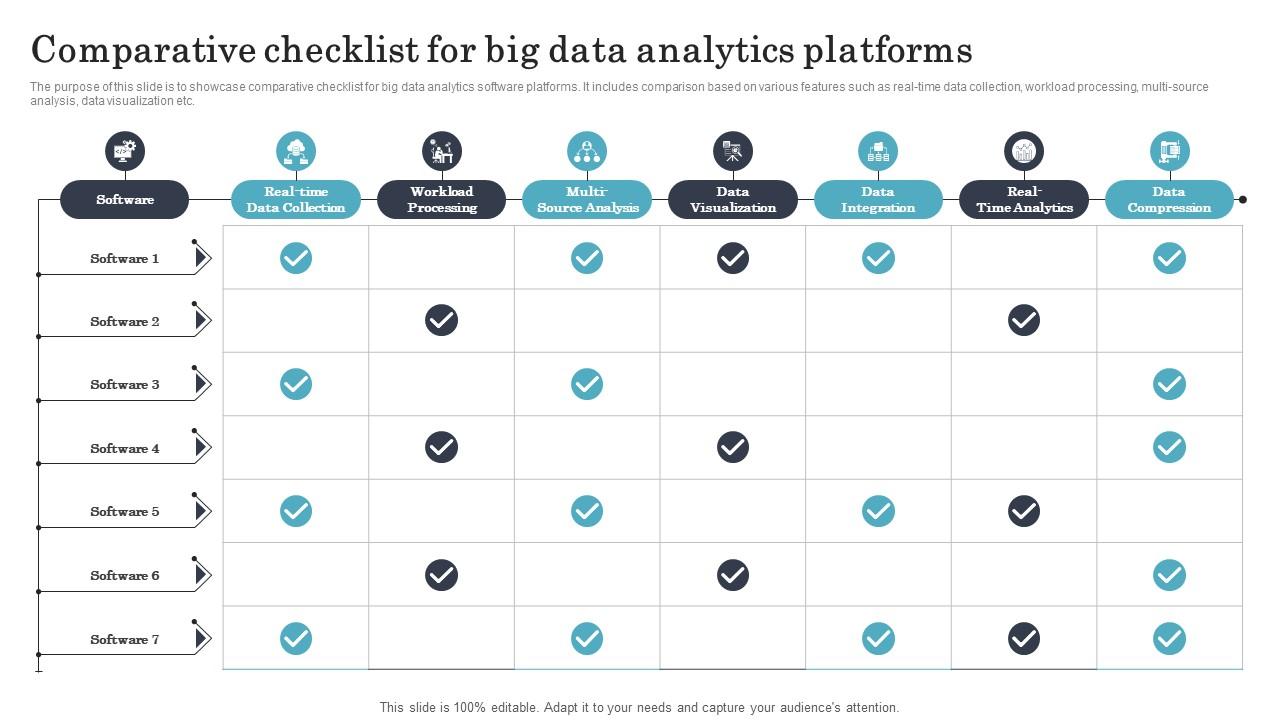
The purpose of this slide is to showcase comparative checklist for big data analytics software platforms. It includes comparison based on various features such as real-time data collection, workload processing, multi-source analysis, data visualization etc.
People who downloaded this PowerPoint presentation also viewed the following :
Comparative Checklist For Big Data Analytics Platforms with all 9 slides:
Use our Comparative Checklist For Big Data Analytics Platforms to effectively help you save your valuable time. They are readymade to fit into any presentation structure.
FAQs for Comparative Checklist For Big
Effective big data analytics platforms include data ingestion engines, distributed storage systems, processing frameworks, analytics tools, and visualization dashboards. These components work together by enabling seamless data collection, scalable storage, real-time processing, and actionable insights, with organizations across retail, healthcare, and finance finding enhanced decision-making capabilities and competitive advantages.
Big data analytics platforms ensure security and privacy compliance through encryption, access controls, audit trails, data masking, and automated compliance monitoring. These technologies enable organizations to meet regulations like GDPR and HIPAA while processing sensitive information, with healthcare providers and financial institutions finding that advanced security frameworks ultimately deliver both regulatory adherence and customer trust.
On-premise solutions offer complete data control, customization capabilities, and enhanced security for sensitive information, while cloud-based platforms provide scalability, cost-effectiveness, faster deployment, and reduced infrastructure management. Many organizations increasingly favor hybrid approaches, with financial services leveraging on-premise for compliance-heavy workloads and cloud solutions for variable analytics demands, ultimately delivering both security and operational flexibility.
Healthcare, financial services, retail, manufacturing, and telecommunications benefit most from big data analytics platforms due to their vast data volumes and complex operational requirements. These industries leverage analytics for personalized patient care, fraud detection, customer targeting, predictive maintenance, and network optimization, ultimately delivering improved outcomes, reduced costs, and enhanced competitive advantage in increasingly data-driven markets.
Businesses can determine the right big data analytics tools by evaluating their data volume, velocity, and variety requirements, assessing current infrastructure compatibility, and defining specific use cases like customer segmentation or predictive maintenance. Organizations across retail, healthcare, and finance increasingly find success by starting with pilot projects, considering scalability needs, and prioritizing platforms that integrate seamlessly with existing systems while delivering measurable ROI.
Machine learning enhances big data analytics by automating pattern recognition, enabling predictive modeling, and delivering real-time insights from massive datasets. Through advanced algorithms, organizations streamline fraud detection in banking, optimize supply chains in retail, and personalize customer experiences across industries, while significantly reducing manual analysis time and uncovering hidden correlations that drive competitive advantage.
Big data analytics platforms handle real-time data processing through stream processing engines, in-memory computing, distributed architectures, event-driven frameworks, and parallel processing capabilities. These technologies enable organizations to analyze data as it arrives, with financial services leveraging real-time fraud detection and retail companies optimizing inventory management, ultimately delivering faster decision-making and competitive advantage.
Organizations face challenges including legacy system compatibility, data silos, scalability limitations, security vulnerabilities, and skill gaps when integrating big data analytics platforms. While these integration complexities can initially slow implementation, many enterprises find that strategic phased approaches, cloud-hybrid solutions, and dedicated training programs ultimately streamline operations and deliver enhanced analytical capabilities.
Visualizations in big data analytics platforms transform complex datasets into intuitive charts, graphs, dashboards, and interactive maps that enable faster pattern recognition and trend identification. Through these visual tools, executives can quickly spot market opportunities, operational inefficiencies, and customer behavior patterns, ultimately accelerating strategic decisions while reducing analysis time from weeks to hours.
Data governance ensures data quality, security, and compliance across big data analytics platforms through standardized policies, access controls, and regulatory adherence. It enables organizations to minimize risks while maximizing insights, with many financial services and healthcare institutions finding that robust governance frameworks ultimately deliver greater operational efficiency, regulatory compliance, and competitive advantage in increasingly data-driven environments.
Big data analytics platforms support predictive analytics by processing vast datasets through machine learning algorithms, statistical modeling, and pattern recognition technologies. These platforms enable organizations across retail, healthcare, and financial services to forecast customer behavior, predict equipment failures, and anticipate market trends, ultimately delivering competitive advantages through data-driven decision making.
Key trends shaping big data analytics platforms include cloud-native architectures, real-time processing capabilities, automated machine learning integration, edge computing support, and enhanced data governance frameworks. These advancements enable organizations across healthcare, finance, and retail to streamline decision-making, reduce operational costs, and deliver faster insights, ultimately providing competitive advantage in increasingly data-driven markets.
Companies measure big data analytics ROI through revenue growth metrics, cost reduction analysis, operational efficiency improvements, customer acquisition costs, and time-to-market acceleration. These measurements typically involve comparing pre-implementation baselines with post-deployment outcomes, with many organizations finding that enhanced decision-making speed, reduced manual processes, and improved customer targeting deliver measurable competitive advantages within 12-18 months.
Essential skills include statistical analysis, programming languages like Python and R, data visualization, machine learning techniques, and database management systems like SQL and NoSQL. These competencies enable professionals to extract meaningful insights, build predictive models, and communicate findings effectively, with many organizations finding that combining technical expertise with business acumen delivers competitive advantage in data-driven decision making.
Open-source big data analytics tools offer cost-effectiveness, flexibility, and community-driven innovation, while proprietary solutions deliver enterprise support, advanced security features, and streamlined integration capabilities. Through platforms like Apache Spark versus commercial alternatives, organizations balance budget considerations with operational requirements, with many enterprises finding that hybrid approaches combining both open-source foundations and proprietary enhancements optimize performance while controlling costs.
-
I am extremely pleased with these PPT slides that we used for our event. They were easy to modify and came out great in all aspects!
-
A beautiful, professional design paired with high-quality images and content that is sure to impress. It is a must-use PPT template in my opinion.Â