Comparison Matrix To Select Suitable Vendor
Try Before you Buy Download Free Sample Product
Audience
Editable
of Time
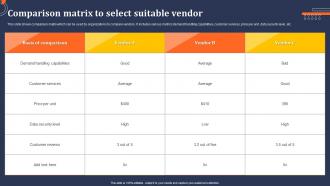
This slide shows comparison matrix which can be used by organizations to compare vendors. It includes various metrics demand handling capabilities, customer services, price per unit, data security level, etc.
People who downloaded this PowerPoint presentation also viewed the following :
Comparison Matrix To Select Suitable Vendor with all 6 slides:
Use our Comparison Matrix To Select Suitable Vendor to effectively help you save your valuable time. They are readymade to fit into any presentation structure.
FAQs for Comparison Matrix To
Vendor selection involves assessing financial stability, service offerings, technological capabilities, and reputation, alongside scalability and security protocols. These evaluations streamline operations by ensuring reliable partnerships, fostering innovation through collaborative technologies, and ultimately delivering cost efficiencies and competitive advantage, with many institutions finding that thorough due diligence minimizes risk.
Organizations can assess vendor financial stability through detailed reviews of credit reports, balance sheets, and cash flow statements, alongside industry-specific risk assessments. While due diligence can be time-consuming, it also minimizes supply chain disruptions and legal liabilities, with many financial services and healthcare institutions finding that proactive vetting delivers significant long-term cost savings and operational efficiency.
Vendor reputation significantly impacts selection, encompassing financial stability, service quality, and industry recognition, presenting both challenges and opportunities. While thorough due diligence—including reference checks and case study reviews—is crucial, a strong reputation often indicates reliability and a commitment to customer success, with many institutions finding that established vendors deliver streamlined integrations and ultimately, enhanced operational efficiency.
Aligning vendor capabilities with organizational goals is critically important, ensuring projects deliver expected value, minimize disruptions, and foster long-term strategic partnerships. While selecting vendors based solely on cost can be tempting, it also risks misalignment, potentially hindering innovation and scalability across industries like healthcare and finance. These strategic combinations enhance operational efficiency, ultimately delivering competitive advantage and improved customer experiences with many institutions finding that proactive alignment streamlines resource allocation.
Vendor selection often encounters pitfalls like unclear requirements, inadequate due diligence, and overlooking total cost of ownership, alongside insufficient contract negotiation and poor communication. These challenges present both opportunities and risks, with many organizations finding that a strategic combination of detailed RFPs, thorough background checks, and robust service level agreements streamlines operations and ultimately delivers enhanced efficiency and minimized disruptions.
Historical vendor performance data informs decision-making by revealing past reliability, cost-effectiveness, and service levels through metrics like on-time delivery, quality scores, and responsiveness. While past performance isn’t a guarantee, it enables organizations to streamline resource allocation, minimize risks, and negotiate better contracts, with many financial services institutions finding that data-driven selection delivers significant operational efficiency and competitive advantage.
Negotiating vendor contracts requires considering pricing models, service level agreements, data security protocols, and intellectual property rights, alongside termination clauses. These elements streamline operations by ensuring cost-effectiveness, reliable service delivery, and protection of sensitive information, with many financial services institutions finding that clear contracts minimize disputes and enhance long-term partnerships, ultimately delivering operational efficiency and competitive advantage.
Organizations can effectively communicate needs and expectations to potential vendors by crafting detailed RFPs, hosting thorough pre-bid meetings, and establishing clear service level agreements. These approaches streamline procurement by outlining scope, deliverables, and key performance indicators, with many institutions finding that transparent communication minimizes misunderstandings and ultimately delivers stronger partnerships and optimized resource allocation.
Vendor selection significantly impacts project success and timelines by influencing quality, cost, and delivery speed, with organizations increasingly recognizing its criticality. While choosing the lowest bid can seem appealing, it also necessitates careful evaluation of capabilities, scalability, and long-term support, ultimately delivering enhanced project outcomes and minimized risks.
Technology and tools aid vendor selection by automating research, streamlining communication, and enhancing due diligence through platforms for RFPs, scoring matrices, and risk assessments. These technologies facilitate comprehensive evaluations by centralizing data, comparing proposals, and tracking performance, with many procurement teams finding that automated workflows significantly reduce costs and accelerate timelines, ultimately delivering better supplier relationships and operational efficiency.
Vendor reference checks involve contacting past clients to assess a vendor’s reliability, performance, and service quality, including responsiveness, problem-solving, and adherence to agreements. These checks streamline risk assessment by verifying claims, uncovering potential issues in areas like project delivery and communication, with many financial services institutions finding that thorough vetting minimizes costly disruptions. Ultimately delivering enhanced operational efficiency and stronger, more dependable partnerships, these practices are crucial for long-term success.
Cultural fit between an organization and a vendor significantly impacts collaboration by fostering trust, streamlining communication, and aligning expectations. While shared values enhance project success, differing work styles can present both challenges and opportunities, particularly in long-term partnerships like those seen in financial services and healthcare. Ultimately delivering improved project outcomes and stronger, more productive relationships with many institutions finding that aligned cultures minimize friction and accelerate innovation.
Cross-functional teams in vendor selection deliver diverse perspectives, enhanced due diligence, and reduced risk, encompassing procurement, IT, legal, and end-user insights. While this collaborative approach can be time-intensive, it also fosters buy-in, streamlines implementation, and ensures alignment with organizational needs, with many institutions finding that comprehensive vetting ultimately delivers operational efficiency and stronger vendor partnerships.
Organizations should approach vendor selection in a global marketplace by prioritizing due diligence, risk assessment, and strategic alignment, considering factors like geopolitical stability, supply chain resilience, and cultural compatibility. While cost optimization remains crucial, it also necessitates evaluating total cost of ownership, including potential disruptions, with many institutions finding that diversified sourcing enhances operational efficiency and minimizes vulnerabilities, ultimately delivering competitive advantage and long-term stability.
Vendor relationships require diligent compliance and risk management through comprehensive due diligence, robust contract negotiation, and continuous monitoring. These processes involve assessing financial stability, security protocols, and regulatory adherence, while banks and healthcare institutions find that detailed service level agreements (SLAs) minimize disruptions. Ultimately delivering enhanced operational efficiency and reduced exposure to legal and reputational risks, with many organizations streamlining these efforts via automated vendor portals.
-
Great quality slides in rapid time.
-
I loved the hassle-free signup process. A few minutes and, I had this giant collection of beautiful designs.