

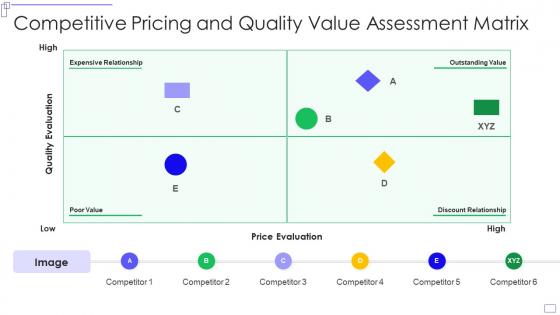
Competitive pricing and quality value assessment matrix




Try Before you Buy Download Free Sample Product
 Impress Your
 Audience
 100%
100% Editable
 Save Hours
 of Time


Our Competitive Pricing And Quality Value Assessment Matrix are topically designed to provide an attractive backdrop to any subject. Use them to look like a presentation pro.
People who downloaded this PowerPoint presentation also viewed the following :
Competitive pricing and quality value assessment matrix with all 6 slides:
Use our Competitive Pricing And Quality Value Assessment Matrix to effectively help you save your valuable time. They are readymade to fit into any presentation structure.





FAQs for Competitive pricing and quality
A competitive pricing matrix is a strategic tool that systematically compares your pricing against competitors across different products, services, or market segments, enabling data-driven pricing decisions. This analysis impacts business strategy by identifying pricing gaps, market positioning opportunities, and revenue optimization potential, with many retail and SaaS companies finding that regular matrix updates enhance competitive advantage and profit margins.
Determining optimal pricing points involves analyzing competitor rates, assessing your value proposition, evaluating customer price sensitivity, and considering market positioning goals. Through strategic pricing analysis, businesses can identify sweet spots that maximize profitability while remaining competitive, with many organizations finding that data-driven pricing matrices enable better market penetration and sustainable growth strategies.
Key factors include competitor pricing analysis, target market segmentation, cost structure evaluation, value proposition differentiation, and profit margin requirements. These elements work together by enabling strategic positioning through market research, customer willingness-to-pay assessment, and competitive gap identification, with many organizations finding that comprehensive matrices ultimately deliver optimized pricing strategies and sustainable competitive advantage.
A competitive pricing matrix reveals market gaps by mapping competitor prices across product categories, customer segments, and geographic regions, highlighting underserved areas and pricing inconsistencies. Through systematic price comparison analysis, businesses can identify premium positioning opportunities, uncontested market segments, and competitive vulnerabilities, ultimately enabling strategic pricing decisions that capture market share while maximizing profitability.
Consumer psychology significantly influences competitive pricing matrices through cognitive biases, price perception patterns, emotional purchasing triggers, and value anchoring behaviors. These psychological factors help businesses strategically position their offerings by understanding how customers process price comparisons, respond to discount framing, and make purchasing decisions, ultimately enabling companies to optimize their pricing strategies for maximum market penetration and profitability.
Companies should update their competitive pricing matrix monthly or quarterly, depending on market volatility, with dynamic industries like technology requiring more frequent updates than stable sectors. Regular monitoring enables businesses to respond quickly to competitor price changes, seasonal fluctuations, and market shifts, ultimately maintaining competitive advantage and optimizing revenue strategies in an increasingly fast-paced marketplace.
A competitive pricing matrix assists in benchmarking by organizing competitor price points, identifying market positioning gaps, tracking pricing trends over time, and revealing strategic pricing opportunities across product lines. This systematic approach enables businesses to optimize their pricing strategies, adjust market positioning, and maintain competitive advantage, with many organizations finding that structured price comparison ultimately delivers improved profit margins and enhanced market responsiveness.
Tools for creating competitive pricing matrices include Excel, Google Sheets, specialized pricing software like Pricefx, PROS, and Competera, along with market intelligence platforms such as Minderest and Price2Spy. These solutions streamline data collection, automate competitor tracking, and enable real-time price adjustments, with many retailers finding that integrated platforms deliver faster pricing decisions and enhanced market responsiveness.
A competitive pricing matrix influences sales forecasting by providing market position clarity, price elasticity insights, demand prediction accuracy, and competitive response modeling capabilities. Through systematic price comparison analysis, businesses can anticipate customer behavior shifts, adjust volume projections accordingly, and optimize revenue forecasts, with many organizations finding that strategic pricing intelligence delivers significantly improved forecast accuracy and enhanced revenue planning precision.
Common pitfalls include using outdated competitor data, focusing solely on price without considering value propositions, oversimplifying complex pricing structures, and neglecting regional market variations. These oversights can lead to misguided pricing strategies, with many organizations finding that regular data validation, comprehensive feature comparisons, and market-specific analysis ultimately deliver more accurate competitive positioning and strategic advantage.
B2B competitive pricing matrices focus on value-based pricing, relationship factors, contract terms, and total cost of ownership, while B2C matrices emphasize market positioning, psychological pricing, and consumer behavior patterns. B2B matrices typically analyze fewer competitors but with deeper relationship complexities, whereas B2C matrices track broader market segments, promotional pricing strategies, and seasonal variations, ultimately delivering strategic advantages tailored to each market's distinct purchasing dynamics.
Yes, competitive pricing matrices serve as foundational tools for dynamic pricing by providing real-time market benchmarks, competitor positioning data, and price sensitivity insights that algorithms can leverage. These matrices enable automated pricing systems to adjust rates based on competitive movements, demand fluctuations, and market conditions, with retailers and airlines finding that strategic integration delivers enhanced margins and competitive responsiveness.
Companies can leverage data analytics to enhance competitive pricing matrices by collecting real-time competitor pricing data, analyzing customer demand patterns, and identifying optimal price points through predictive modeling. Through advanced analytics tools, businesses streamline price monitoring, automate competitive responses, and optimize profit margins, with many retail and e-commerce organizations finding that data-driven pricing delivers increased revenue and strategic market positioning.
Key metrics include price positioning accuracy, market share changes, profit margin trends, customer acquisition rates, and competitor response speed. These measurements enable businesses to assess pricing effectiveness across different product segments, with many retail and SaaS companies finding that tracking win-loss ratios and pricing elasticity ultimately delivers strategic advantages in competitive markets.
A competitive pricing matrix aligns with value proposition strategy by mapping competitor pricing against unique value drivers, market positioning, and customer segments to identify optimal price points. This strategic combination enables companies to position offerings competitively while maintaining margin integrity, with many organizations finding that data-driven pricing decisions enhance customer acquisition and retention rates.
-
It saves your time and decrease your efforts in half.
-
Excellent work done on template design and graphics.