


Comprehensive Guide To Begin AIOps Journey Powerpoint Presentation Slides AI CD V




Try Before you Buy Download Free Sample Product
 Impress Your
 Audience
 100%
100% Editable
 Save Hours
 of Time


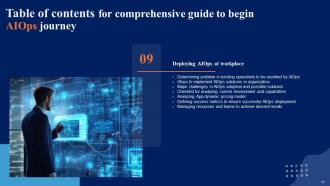
AIOps, short for Artificial Intelligence for IT Operations Management, involves implementing advanced analytics to automate and enhance IT operations. The presentation Comprehensive Guide to Begin AIOps Journey PowerPoint Presentation offers a concise introduction to AIOps, its various types, and the key advantages of using AIOps to simplify IT operations. This presentation is designed to help organizations understand the AIOps market, current trends, and how AIOps functions. It outlines the essential steps for deploying AIOps in the workplace. Additionally, the AI for IT operations management slides primarily focus on AIOps use cases, including anomaly detection, application performance monitoring, event correlation, and IT service management, among others. Furthermore, the AIOps platforms discuss how AIOps benefit various industries. The presentation showcases the top five AIOps platforms that simplify incident management, which include Dynatrace, AppDynamics, Splunk, Moogsoft, and BigPanda. It also illustrates the impact of implementing AIOps on enhancing business performance. Lastly, the presentation provides valuable dashboards and key performance indicators KPIs like MTTD Mean Time to Detect, MTTR Mean Time to Resolve, downtime, mean time between failures, service availability, ticket to incident ratio, and more. Download it now.
People who downloaded this PowerPoint presentation also viewed the following :
Content of this Powerpoint Presentation
Slide 1: This slide displays the title Comprehensive Guide to Begin AIOps Journey. State your company name and begin.
Slide 2: This slide displays the title Agenda.
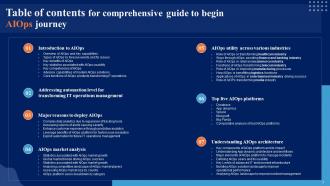
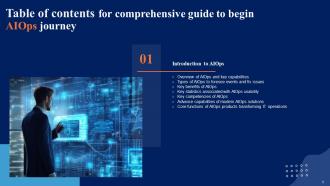
Slide 3: This slide exhibit table of content.
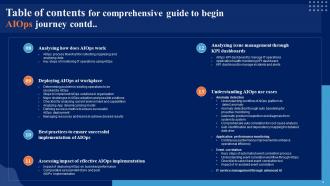
Slide 4: This slide exhibit table of content.
Slide 5: This slide exhibit table of content that is to be discuss further.
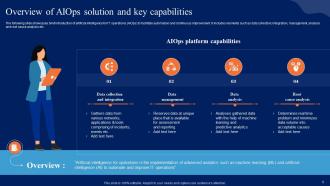
Slide 6: The following slide showcases brief introduction of artificial intelligence for IT operations (AIOps) to facilitate automation and continuous improvement.
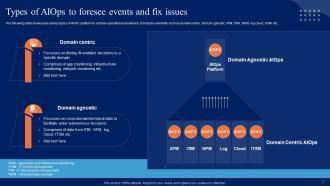
Slide 7: The following slide showcases various types of AIOPs platform to achieve operational excellence.
Slide 8: The following slide showcases key advantages of artificial intelligence for IT operations (AIOps).
Slide 9: The following slide highlights key statistics related with AIOps to enhance customer experience.
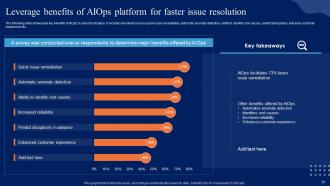
Slide 10: The following slide illustrates brief industry overview of AIOps market.
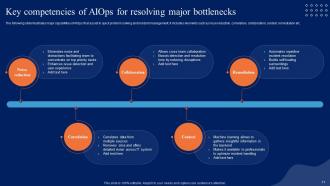
Slide 11: The following slide illustrates major capabilities of AIOps that assist in quick problem solving and incident management.
Slide 12: The following slide illustrates advance capabilities of AIOps platform to improve IT functions.
Slide 13: The following slide highlights key operations of AIOps to facilitate automated discovery of issues and data analysis.
Slide 14: This slide exhibit table of content that is to be discuss further.
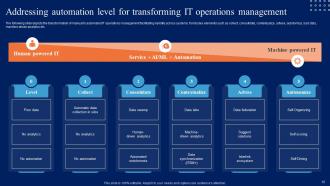
Slide 15: The following slide depicts the transformation of manual to automated IT operations management facilitating visibility across systems.
Slide 16: This slide exhibit table of content that is to be discuss further.
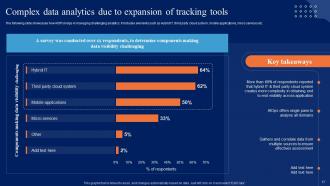
Slide 17: The following slide showcases how AIOPs helps in managing challenging analytics.
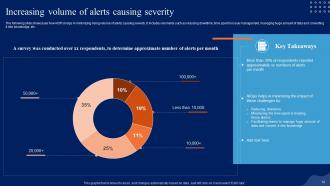
Slide 18: The following slide showcases how AIOPs helps in minimizing rising volume of alerts causing severity.
Slide 19: The following slide showcases how AIOPs helps in improving customer experience with predictive analytics.
Slide 20: The following slide showcases key benefits of AIOps to boost it adoption.
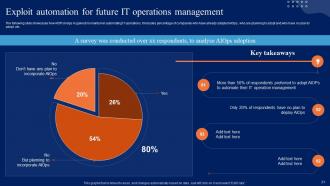
Slide 21: The following slide showcases how AIOPs helps in gained momentum in automating IT operations.
Slide 22: This slide exhibit table of content that is to be discuss further.
Slide 23: The following slide highlights key trends and stats promoting success of AIOps platforms.
Slide 24: The following slide showcases key market players of AIOps to gain competitive advantage and innovate their products and servces.
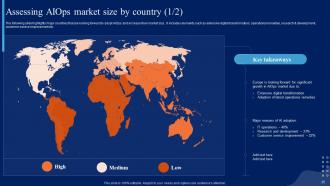
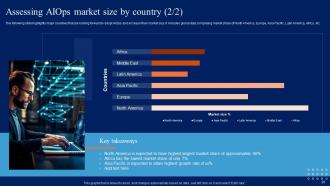
Slide 25: The following slide highlights major countries that are looking forward to adopt AIOps and increase their market size.
Slide 26: The following slide highlights major countries that are looking forward to adopt AIOps and increase their market size.
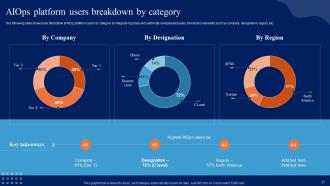
Slide 27: The following slide showcases bifurcation of AIOp platform users by category to integrate big data and automate complex decisions.
Slide 28: The following slide depicts market growth assessment of AIOPs platform and services by various sector type.
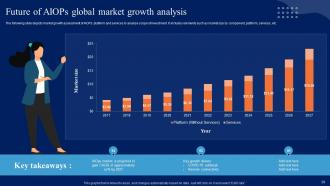
Slide 29: The following slide depicts market growth assessment of AIOPs platform and services to analyse scope of investment.
Slide 30: This slide exhibit table of content that is to be discuss further.
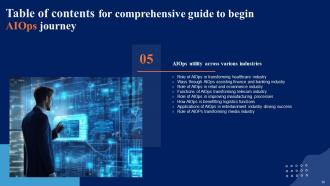
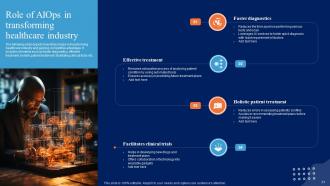
Slide 31: The following slide depicts how AIOps helps in transforming healthcare industry and gaining competitive advantage.
Slide 32: The following slide depicts how AIOps helps in improving functions of finance and banking industry.
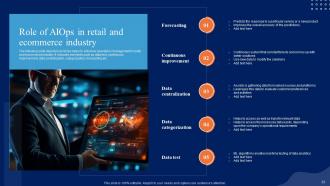
Slide 33: The following slide depicts how AIOps helps to enhance operations management in retail and ecommerce industry.
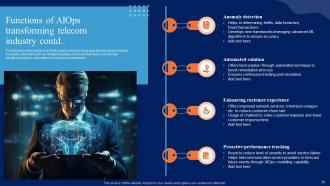
Slide 34: The following slide depicts how AIOps helps in transforming operation in telecom industry.
Slide 35: The following slide depicts how AIOps helps in transforming operation in telecom industry.
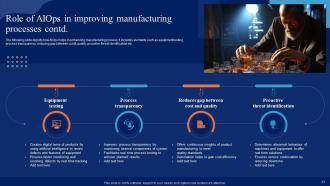
Slide 36: The following slide depicts how AIOps helps in enhancing manufacturing process.
Slide 37: The following slide depicts how AIOps helps in enhancing manufacturing process.
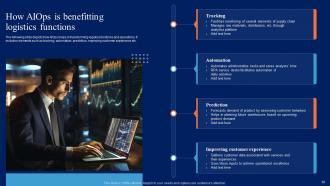
Slide 38: The following slide depicts how AIOps helps in transforming logistics functions and operations.
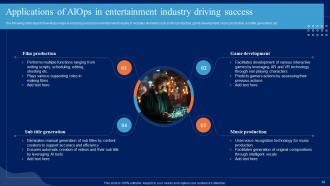
Slide 39: The following slide depicts how AIOps helps in ensuring success in entertainment industry.
Slide 40: The following slide depicts how AIOps helps in transforming functions in media industry.
Slide 41: The following slide depicts how AIOps helps in transforming functions in media industry.
Slide 42: This slide exhibit table of content that is to be discuss further.
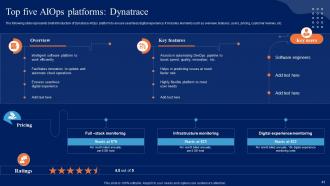
Slide 43: The following slide represents brief introduction of Dynatrace AIOps platform to ensure seamless digital experience.
Slide 44: The following slide represents brief introduction of App dynamic AIOps platform to review application infrastructure.
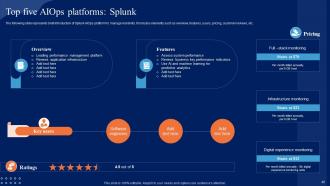
Slide 45: The following slide represents brief introduction of Splunk AIOps platform to manage incidents.
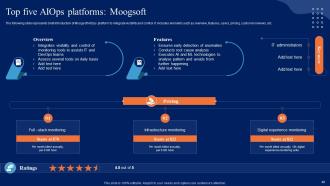
Slide 46: The following slide represents brief introduction of Moogsoft AIOps platform to integrate visibility and control.
Slide 47: The following slide represents brief introduction of big data AIOps platform to manage events.
Slide 48: The following slide depicts comparative assessment of AIOps tools to select the best alternative.
Slide 49: This slide exhibit table of content that is to be discuss further.
Slide 50: The following slide illustrates various elements of AIOps platform along with their effect on IT operations.
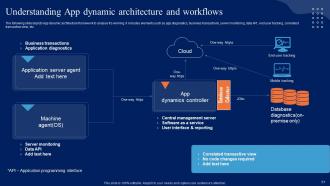
Slide 51: The following slide depicts App dynamic architecture framework to analyse it's working.
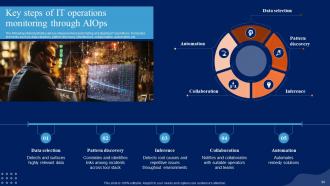
Slide 52: The following slide showcases AIOPs framework to simplify IT operations management.
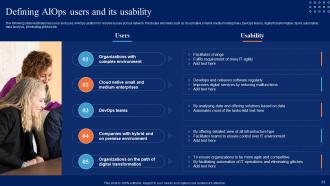
Slide 53: The following slide illustrates key users and uses of AIOps platform to resolve issues across network.
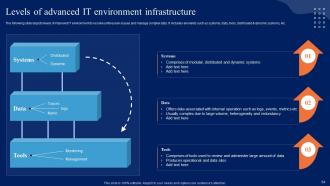
Slide 54: The following slide depicts levels of improved IT environment to resolve unforeseen issues and manage complex data.
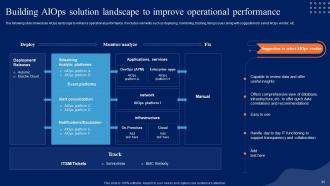
Slide 55: The following slide showcases AIOps landscape to enhance operational performance.
Slide 56: The following slide highlights key components of AIOPs to ensure patch and configuration management.
Slide 57: This slide exhibit table of content that is to be discuss further.
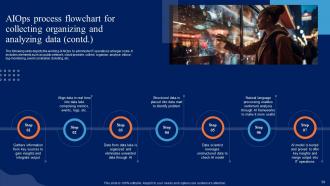
Slide 58: The following slide depicts the working of AIOps to administer IT operations at larger scale.
Slide 59: The following slide depicts the working of AIOps to administer IT operations at larger scale.
Slide 60: The following slide illustrates various steps involved automating and aligning IT operations.
Slide 61: This slide exhibit table of content that is to be discuss further.
Slide 62: The following slide showcases various issues resolved by AIOps to optimize business performance.
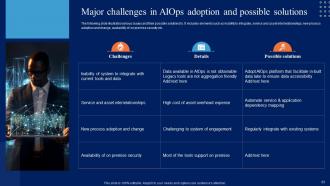
Slide 63: The following slide illustrates various issues and their possible solutions to.
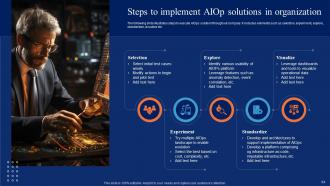
Slide 64: The following slide illustrates steps to execute AIOps solution throughout company.
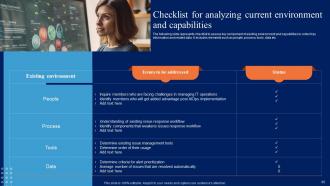
Slide 65: The following slide represents checklist to assess key component of existing environment and capabilities to collect key information and related data.
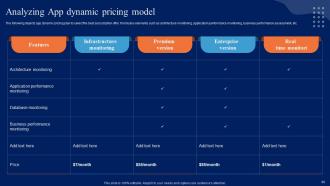
Slide 66: The following depicts app dynamic pricing plan to select the best subscription offer.
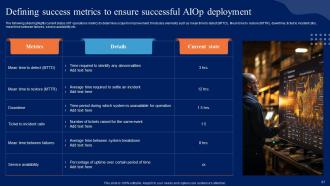
Slide 67: The following slide highlights current status of IT operations metrics to determine scope for improvement.
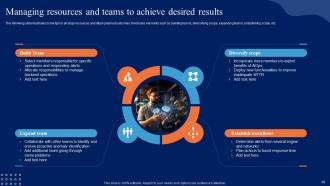
Slide 68: The following slide illustrates some tips to arrange resources and attain planned outcomes.
Slide 69: This slide exhibit table of content that is to be discuss further.
Slide 70: The following slide illustrates some tips to facilitate faster execution of AIOps platform.
Slide 71: This slide exhibit table of content that is to be discuss further.
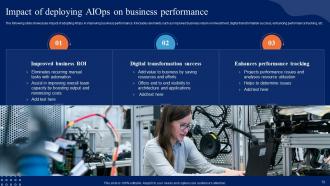
Slide 72: The following slide showcases impact of adopting AIOps in improving business performance.
Slide 73: The following slide highlights key performance indicators to review performance with and without AIOps implementation.
Slide 74: This slide exhibit table of content that is to be discuss further.
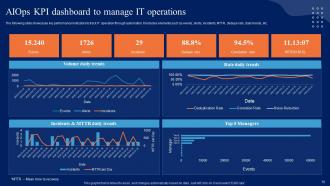
Slide 75: The following slide showcases key performance indicators to track IT operation through automation.
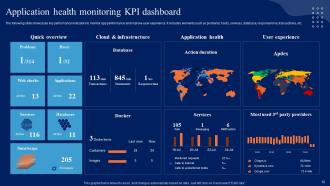
Slide 76: The following slide showcases key performance indicators to monitor app performance and improve user experience.
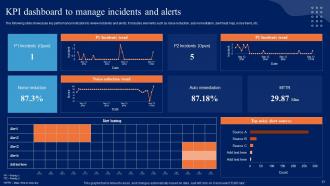
Slide 77: The following slide showcases key performance indicators to review incidents and alerts.
Slide 78: This slide exhibit table of content that is to be discuss further.
Slide 79: The following slide represents AIOPs framework to ensure faster identification of anomalies.
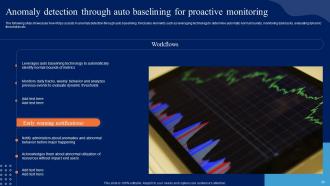
Slide 80: The following slide showcases how AIOps assists in anomaly detection through auto baselining.
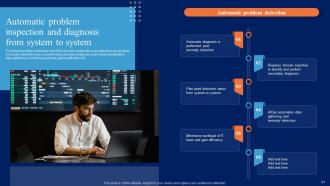
Slide 81: The following slide showcases how AIOps assist in automatic issue detection and analysis.
Slide 82: The following slide depicts how AIOPs helps in auto correlation and offer complete visibility.
Slide 83: The following slide showcases how AIOps helps in auto detection and mapping of data.
Slide 84: This slide exhibit table of content that is to be discuss further.
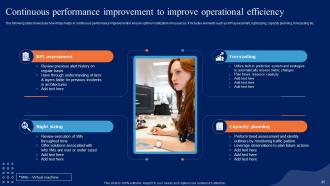
Slide 85: The following slide showcases how AIOps helps in continuous performance improvement to ensure optimum utilization of resources.
Slide 86: This slide exhibit table of content that is to be discuss further.
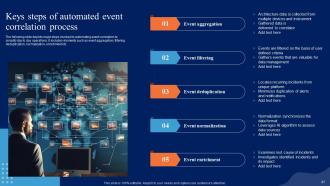
Slide 87: The following slide depicts major steps involved in automating event correlation to simplify day to day operations.
Slide 88: The following slide illustrates workflow process of event correlation through AIOps to manage day to day operations.
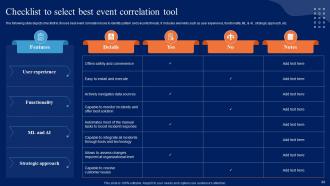
Slide 89: The following slide depicts checklist to choose best event correlation tools to identify pattern and security threats.
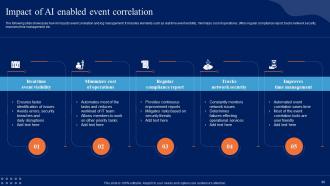
Slide 90: The following slide showcases how AI impacts event correlation and log management.
Slide 91: This slide exhibit table of content that is to be discuss further.
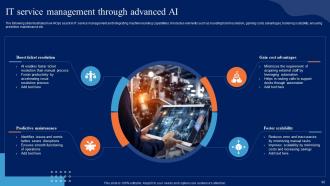
Slide 92: The following slide illustrates how AIOps assist in IT service management and integrating machine learning capabilities.
Slide 93: This is the icons slide.
Slide 94: This slide presents title for additional slides.
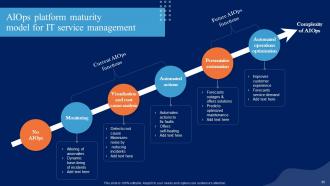
Slide 95: This slide display the title AIOps platform maturity model for IT service management.
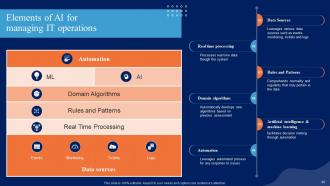
Slide 96: This slide showcase Elements of AI for managing IT operations.
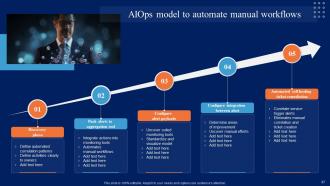
Slide 97: This slide showcase AIOps model to automate manual workflows.
Slide 98: This slide showcase Automating manual IT operations management workflow through AIOps.
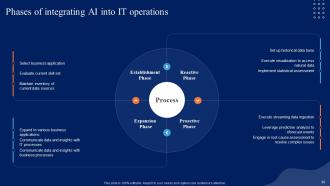
Slide 99: This slide display Phases of integrating AI into IT operations.
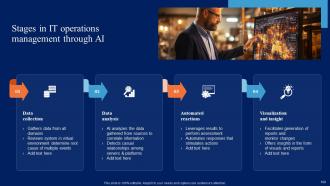
Slide 100: This slide showcase Stages in IT operations management through AI.
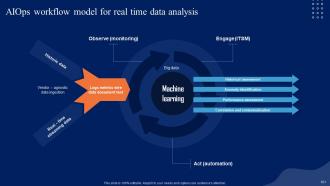
Slide 101: This slide showcase AIOps workflow model for real time data analysis.
Slide 102: This slide display the title AIOps framework for integrated and automated solutions.
Slide 103: This slide display Roadmap to implement AIOps platform at workplace.
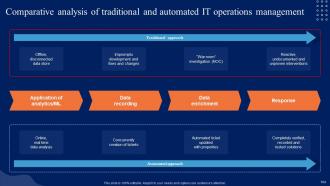
Slide 104: This slide display Comparative analysis of traditional and automated IT operations management.
Slide 105: This slide shows details of team members like name, designation, etc.
Slide 106: This slide showcase About us.
Slide 107: This slide depicts posts for past experiences of clients.
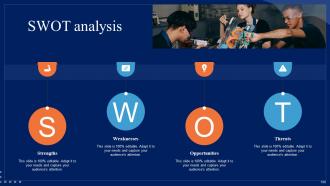
Slide 108: This slide display Swot analysis.
Slide 109: This slide exhibits ideas generated.
Slide 110: This slide presents your company's vision, mission and goals.
Slide 111: This slide display Venn diagram.
Slide 112: This slide display Clustered column for different products.
Slide 113: This slide showcase Mind map.
Slide 114: This slide display Location.
Slide 115: This slide display Quotes.
Slide 116: This is thank you slide & contains contact details of company like office address, phone no., etc.
Comprehensive Guide To Begin AIOps Journey Powerpoint Presentation Slides AI CD V with all 118 slides:
Use our Comprehensive Guide To Begin AIOps Journey Powerpoint Presentation Slides AI CD V to effectively help you save your valuable time. They are readymade to fit into any presentation structure.















































FAQs for Comprehensive Guide To Begin AIOps Journey Powerpoint Presentation Slides
So there's four main pieces: data ingestion, ML analytics, automation, and dashboards for visualizing everything. Basically you're pulling from all your current monitoring tools and SIEM systems - stuff that's already spitting out logs anyway. The ML part finds patterns and weird anomalies (honestly the coolest feature), then automation kicks in for routine stuff like creating tickets or scaling systems. Don't worry about replacing your current setup though. Everything just feeds into the AIOps platform instead. I'd start small - connect maybe one or two data sources first, see how it goes, then add more as you figure out what actually works for your environment.
First thing - check if your data's actually clean and flowing properly from all systems. Most places have a mess here, trust me. Your team needs to be comfortable with ML tools too, otherwise you're just setting everyone up to fail. Don't skip evaluating your current incident response process since AIOps will flip that upside down completely. Seriously though, way too many companies dive headfirst without doing the groundwork. Start small with a pilot on one critical system first. Test it out, see what breaks, then decide if you want to expand from there.
Track MTTD, MTTR, false positive rates, and how many incidents you're preventing - that's your ops stuff. Business metrics matter too though. System uptime, customer satisfaction, and honestly? The manual work your team isn't doing anymore. Leadership loves seeing that last one since it's basically free labor back in their pockets. Don't go crazy measuring everything right away. Pick 3-4 metrics that actually matter to your situation. You can always add more later once you've got the basics down and know what's working.
Honestly, AIOps is a game changer for incident response. You'll catch problems before they blow up into major outages - no more waiting around for angry user calls. The anomaly detection spots weird patterns automatically, and the alert correlation is clutch because it cuts through all that noise to show you what actually matters. My team started with just the automated alert stuff first (way easier to implement) and it probably saved us like 3-4 hours per incident. Root cause analysis happens fast too. Oh, and the predictive side means you're fixing things at weird hours before anyone even notices they're broken.
Honestly, ML is a game changer for this stuff. You're basically training algorithms on all your historical IT data - incidents, performance metrics, whatever you've got. They pick up on patterns that would take humans forever to spot. Way better than those old static alerts that went off constantly. The cool part? These models actually get smarter over time as your systems evolve. Fewer false alarms, more accurate predictions. I've seen some setups catch failures days before they happen, which is honestly kind of crazy when you think about it. Just make sure you're feeding it clean data from the start - garbage in, garbage out and all that.
Honestly, data silos are gonna be your biggest pain point. Teams hate changing their workflows - can't really blame them though. Integration is messy too, especially when your data quality is trash (which it probably is). Most companies have info scattered everywhere and it's inconsistent as hell. AIOps only works if you feed it clean data. Finding people who actually get both IT ops AND machine learning? Good luck with that. Those unicorns are expensive. My advice? Don't go crazy right away. Pick one small project, show it works, then expand from there.
Think of AIOps as having one brain watching all your cloud stuff instead of bouncing between a million dashboards. It pulls data from AWS, Azure, whatever you're running and actually learns what's normal vs. what's broken. Honestly, the best part is no more guessing if that weird spike means you should freak out or grab coffee. It knows your baseline patterns everywhere. My advice? Get your cross-cloud monitoring sorted first - that's the foundation. Then add the smart analytics on top. Way easier than doing it backwards.
Look, data quality makes or breaks AIOps - I can't stress this enough. Feed your tools garbage data and you'll get false alerts that'll make your team want to quit. Clean data from logs and metrics? That's when AI actually spots real problems instead of random noise. Honestly, most teams skip the boring stuff like auditing data sources and standardizing formats, but that's where the magic happens. It's like trying to drive with a cracked windshield otherwise. Trust me, do the grunt work upfront and your AIOps won't suck.
So AIOps basically saves you money by handling all the boring stuff automatically - monitoring, catching problems early, that kind of thing. No more paying people overtime for those awful middle-of-the-night alerts (seriously, those are the worst). The predictive side is pretty cool too - spots issues way before they'd normally blow up and cost you big time. Your team gets to do actual strategic work instead of constantly putting out fires. I'd probably start small though, maybe pick your most annoying manual process and see if AIOps can take it over. Resource optimization happens naturally once it's running.
Honestly, financial services and telecom are killing it with AIOps right now. Banks can't afford any downtime on their trading systems - we're talking millions lost per minute. Telecom companies deal with these crazy complex networks, and when things go down, customer service gets absolutely slammed. Healthcare's jumping on board too since patient systems can't ever go offline. Oh, and the pattern seems pretty clear - if you've got zero downtime tolerance and messy infrastructure, you'll see huge wins. Definitely worth putting on your roadmap if that sounds like your situation.
So AIOps helps break down those stupid silos between IT and DevOps teams. Both sides get the same real-time view of what's actually happening with your infrastructure. No more IT getting blamed for stuff they didn't break, or DevOps pushing changes without knowing what breaks downstream. The AI connects incidents across different tools so you're solving problems together instead of pointing fingers - which honestly happens way too much. Everyone works from the same dashboards and alerts. It's like you finally speak the same language! I'd start with one workflow where handoffs currently suck between teams.
Get your teams working with actual data from your systems - way better than those generic vendor demos. Pilot groups work great too. Pick a few people to mess around with alert correlation or anomaly detection first, then they can show everyone else what they figured out. Those vendor webinars are pretty useless honestly. Document what works and what doesn't as you go. Oh, and actually block out time for people to practice this stuff - don't just expect them to learn between handling tickets. Start small with one service. You'll see results faster that way.
So basically AIOps looks at your past usage data and spots trends you'd totally miss doing it manually. It'll warn you weeks ahead when your CPU or memory's about to max out - honestly beats the hell out of those janky Excel predictions we used to do. Plus it finds resources you're barely using that could be moved around. The algorithms suggest better configs based on how your systems actually behave too. I'd start with your most critical stuff first, then give the AI a few weeks to learn your setup before you really trust what it's telling you.
Okay so three big things to worry about here. First, don't dump sensitive customer data into your models without proper consent - that's just asking for legal trouble. Second thing is bias in your training data. If it's skewed, you'll end up with unfair incident handling that screws over certain teams or regions. Also keep your AI explainable so when stuff breaks (and it will), you can actually figure out what went wrong. Honestly, I'd start by just auditing what data you're using where and setting some basic rules around it.
Here's the thing - don't wait until later to build security into your AIOps setup. Your tools need proper encryption, access controls, and audit trails right from the start. The challenge is AI models are data hungry, but you can't just throw everything at them without considering privacy rules or sensitive information. Work with your security team early to set clear data policies. Monitor how the AI makes decisions and keep things transparent about the algorithm recommendations. Honestly, it's way easier than trying to retrofit security later. Treat it like any other mission-critical system you'd deploy.
-
It’s really cool, and you can find pretty much everything you could need for your work or school.
-
Loved the fact that SlideTeam provides clean, high-definition, and professional PowerPoint products.