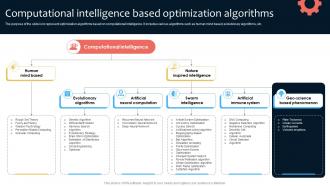
Computational Intelligence Based Optimization Algorithms
Try Before you Buy Download Free Sample Product
Audience
Editable
of Time
The purpose of the slide is to represent optimization algorithms based on computational intelligence. It includes various algorithms such as human mind based, evolutionary algorithms, etc.
People who downloaded this PowerPoint presentation also viewed the following :
Computational Intelligence Based Optimization Algorithms with all 9 slides:
Use our Computational Intelligence Based Optimization Algorithms to effectively help you save your valuable time. They are readymade to fit into any presentation structure.
FAQs for Computational Intelligence
Computational intelligence principles include adaptive learning through experience, bio-inspired algorithms, fuzzy logic for uncertainty handling, evolutionary optimization, and neural network pattern recognition. These methods differentiate from traditional AI by emphasizing learning from data rather than explicit programming, with financial services and healthcare organizations finding that evolutionary algorithms and neural networks deliver more flexible problem-solving capabilities and enhanced pattern recognition accuracy.
Fuzzy logic enhances decision-making in computational intelligence by handling uncertainty, processing imprecise data, and enabling gradual transitions between states rather than binary choices. Through fuzzy inference systems, organizations in healthcare, finance, and manufacturing streamline complex decisions like medical diagnoses, credit assessments, and quality control, ultimately delivering more nuanced and human-like reasoning capabilities.
Neural networks can be optimized through model pruning, quantization, knowledge distillation, efficient architectures, and hardware acceleration techniques like GPUs and TPUs. These approaches streamline computational requirements while maintaining accuracy, with financial services using optimized networks for real-time fraud detection and manufacturing leveraging them for predictive maintenance, ultimately delivering faster decision-making and enhanced operational efficiency.
Swarm intelligence tackles complex optimization problems by mimicking collective behaviors of natural systems like ant colonies, bee swarms, and bird flocks to explore solution spaces efficiently. These algorithms, including particle swarm optimization and ant colony optimization, enable organizations to streamline supply chain logistics, enhance financial portfolio management, and optimize manufacturing processes, ultimately delivering faster problem-solving capabilities and competitive operational advantages.
Evolutionary computation enhances machine learning algorithms by optimizing neural network architectures, automatically selecting optimal features, tuning hyperparameters, and evolving algorithm parameters through natural selection principles. These genetic algorithms streamline model development across sectors like finance and healthcare, with many organizations finding that evolutionary approaches deliver more robust, adaptive solutions while significantly reducing manual optimization time.
Hybrid models in computational intelligence combine multiple AI techniques like neural networks, fuzzy logic, genetic algorithms, and expert systems to leverage each method's strengths while minimizing individual weaknesses. These strategic combinations enhance problem-solving capabilities across sectors, with financial institutions using neuro-fuzzy systems for risk assessment and manufacturing companies deploying genetic-neural hybrids for quality control, ultimately delivering superior accuracy and robust performance.
Computational intelligence enhances autonomous systems through machine learning algorithms, neural networks, fuzzy logic, evolutionary computing, and swarm intelligence that enable real-time decision-making and adaptive behavior. These technologies streamline navigation, object recognition, and predictive maintenance in manufacturing robots, autonomous vehicles, and drones, ultimately delivering improved safety, operational efficiency, and reduced human intervention across increasingly automated industries.
Ethical considerations include algorithmic bias, data privacy protection, transparency in decision-making processes, accountability for automated outcomes, and ensuring human oversight remains integral. These concerns require organizations to implement robust governance frameworks, regular bias audits, and explainable AI practices, with many financial services and healthcare institutions finding that proactive ethical guidelines ultimately enhance customer trust and regulatory compliance.
Computational intelligence enhances cybersecurity through machine learning algorithms, neural networks, fuzzy logic systems, evolutionary algorithms, and swarm intelligence techniques. These technologies streamline threat detection by analyzing network patterns, automating incident response, and predicting attack vectors, with financial institutions and healthcare organizations finding that AI-driven security ultimately delivers faster threat mitigation and reduced operational vulnerabilities.
Researchers face challenges including scalability limitations with massive datasets, algorithm complexity requiring specialized expertise, computational resource constraints, and data quality issues affecting model accuracy. While these obstacles present significant hurdles, many organizations find that strategic combinations of machine learning, neural networks, and parallel processing ultimately deliver enhanced pattern recognition and predictive capabilities, enabling competitive advantages in data-driven decision making.
Advances in computational intelligence revolutionize finance and healthcare by enabling automated decision-making, predictive analytics, and pattern recognition capabilities. Through machine learning algorithms, financial institutions streamline fraud detection and loan approvals while hospitals enhance diagnostic accuracy and treatment personalization, ultimately delivering faster services, reduced operational costs, and significantly improved customer experiences across both sectors.
Computational intelligence excels in fraud detection for financial institutions, medical diagnosis in healthcare systems, autonomous vehicle navigation, predictive maintenance in manufacturing, and personalized recommendation engines for e-commerce platforms. These AI-driven approaches outperform traditional methods by processing vast datasets, recognizing complex patterns, and adapting continuously, with many organizations finding significantly improved accuracy, reduced operational costs, and enhanced customer experiences.
Computational intelligence enhances natural language processing through machine learning algorithms, neural networks, fuzzy logic systems, and evolutionary computing techniques that enable more accurate text analysis, sentiment recognition, and language understanding. These technologies streamline automated translation, chatbot interactions, and content analysis by learning from vast datasets, ultimately delivering faster customer service responses and more sophisticated language-based applications across industries.
Emerging trends in computational intelligence include quantum-enhanced algorithms, neuromorphic computing, federated learning, explainable AI systems, and adaptive edge intelligence. These technologies revolutionize decision-making by enabling real-time processing, enhancing privacy protection, and delivering unprecedented computational power, with industries like autonomous vehicles, personalized medicine, and smart manufacturing increasingly finding that intelligent systems drive competitive advantage and operational efficiency.
IoT integration enhances computational intelligence systems by providing real-time data streams, expanding processing capabilities, and enabling distributed decision-making across connected networks. Through sensor-rich environments, organizations streamline predictive analytics, automate resource allocation, and accelerate response times, with manufacturing and healthcare sectors finding that this strategic combination ultimately delivers enhanced operational efficiency and competitive advantage.
-
SlideTeam just saved my project! Thank you so much. The variety of templates helped me showcase multiple perspectives easily.
-
A library of engaging, customizable and content-ready templates.Â