Consumer Buying Behavior Types Matrix Customer Research

Rating:
90%
Consumer Buying Behavior Types Matrix Customer Research
Slide 1 of 6
Favourites Favourites

Try Before you Buy Download Free Sample Product

Audience Impress Your
Audience
Editable 100%
Editable
Time Save Hours
of Time
The Biggest Sale is ending soon in
0
0
:
0
0
:
0
0
Rating:
90%
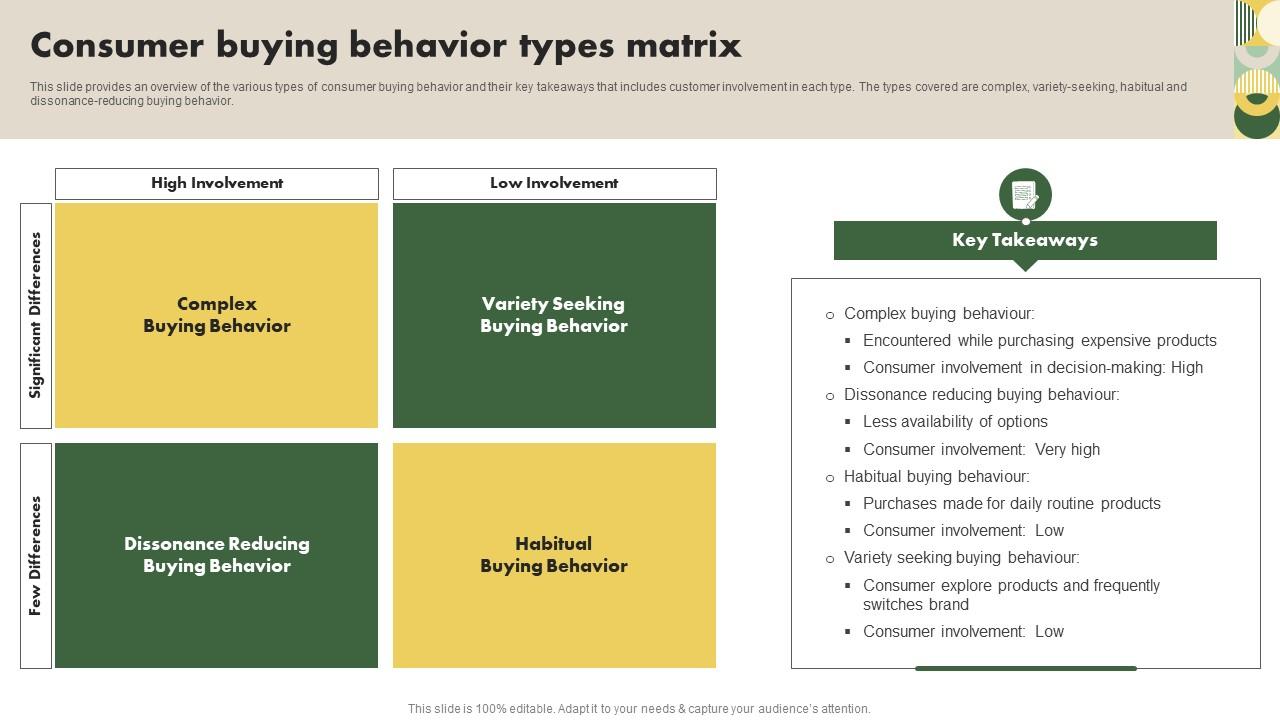
This slide provides an overview of the various types of consumer buying behavior and their key takeaways that includes customer involvement in each type. The types covered are complex, variety seeking, habitual and dissonance reducing buying behavior. Increase audience engagement and knowledge by dispensing information using Consumer Buying Behavior Types Matrix Customer Research This template helps you present information on Four stages. You can also present information on High Involvement, Low Involvement using this PPT design. This layout is completely editable so personaize it now to meet your audiences expectations.

People who downloaded this PowerPoint presentation also viewed the following :

FAQs for Consumer Buying Behavior Types

Psychological factors influencing consumer buying behavior include motivation, perception, learning, beliefs, attitudes, personality traits, and lifestyle preferences. These elements shape purchasing decisions by determining how consumers interpret product information, respond to marketing messages, and evaluate brand experiences, with retailers and marketers finding that understanding these psychological drivers enables more targeted strategies and enhanced customer engagement.

Cultural differences significantly impact purchasing decisions through varying values, social norms, communication styles, family structures, and religious beliefs that shape consumer preferences and behaviors. These cultural factors influence everything from product selection to brand loyalty, with companies like McDonald's adapting menus regionally and luxury brands adjusting marketing approaches, ultimately requiring businesses to customize strategies for diverse markets to enhance customer engagement and drive sales.

Social media affects consumer perceptions through influencer endorsements, peer reviews, targeted advertising, brand storytelling, and real-time feedback loops that shape purchase decisions. Platforms enable retailers, fashion brands, and food companies to build trust through authentic customer testimonials and social proof, ultimately driving higher conversion rates and brand loyalty in an increasingly connected marketplace.

Branding strategies shape consumer loyalty by creating emotional connections, establishing trust through consistent messaging, and differentiating products from competitors through unique value propositions. Strategic branding approaches enable companies to build long-term relationships with customers, increase repeat purchases, and command premium pricing, with many retail and technology organizations finding that consistent brand experiences ultimately drive higher customer lifetime value and sustainable competitive advantage.

Emotional appeal significantly influences consumer decision-making by creating personal connections, triggering impulse purchases, building brand loyalty, and overriding rational analysis. These psychological drivers streamline purchasing decisions through memory association, social validation, and aspirational messaging, with many retailers finding that emotionally-resonant campaigns ultimately deliver higher conversion rates and stronger customer retention than purely feature-focused approaches.

Economic factors significantly influence consumer spending through disposable income availability, employment security, and confidence in future financial stability, with higher incomes typically enabling discretionary purchases while unemployment reduces spending to essentials. During economic downturns, consumers across industries from retail to automotive shift toward value-oriented purchases and delayed gratification, while economic growth periods see increased spending on luxury goods, services, and long-term investments, ultimately creating predictable consumption patterns that businesses leverage for strategic planning.

Product placement significantly influences consumer buying behavior by creating subconscious brand associations, enhancing product visibility, and building emotional connections through storytelling contexts. This strategic marketing approach drives purchase intentions across demographics, with studies showing increased brand recall and preference, particularly in automotive, fashion, and technology sectors, ultimately delivering measurable sales growth and enhanced brand positioning.

Consumers increasingly prioritize sustainability through evaluating product lifecycle, environmental certifications, brand transparency, corporate social responsibility practices, and packaging materials when making purchasing decisions. While younger demographics often place higher value on eco-friendly attributes, many consumers across age groups find that sustainable options, despite potential price premiums, ultimately deliver personal satisfaction and align with values, driving long-term brand loyalty.

Peer influence and word-of-mouth significantly shape consumer behavior by building trust, reducing purchase uncertainty, and accelerating decision-making through authentic social validation. These powerful social mechanisms enable brands to leverage organic advocacy, enhance credibility through customer testimonials, and drive conversions more effectively than traditional advertising, with many retailers finding that peer recommendations ultimately deliver higher customer lifetime value and stronger brand loyalty.

Digital shopping experiences influence buying decisions through personalized recommendations, extensive product comparisons, and social proof via reviews, while traditional retail relies on tactile product interaction, immediate sales assistance, and sensory engagement. Online platforms enable data-driven personalization and convenient research, whereas physical stores deliver immediate gratification and human connection, with many retailers finding that omnichannel strategies combining both approaches maximize customer engagement and conversion rates.

Impulse buying is driven by emotional triggers, strategic product placement, limited-time offers, sensory marketing, and social influences. Retailers leverage these factors through checkout displays, flash sales, and personalized recommendations, with many finding that combining scarcity messaging with emotional appeals significantly increases spontaneous purchases, ultimately driving higher revenue per customer visit.

Generational differences significantly shape consumer preferences through distinct communication styles, technology adoption rates, value systems, and purchasing channels. Millennials prioritize sustainability and digital experiences, Gen Z favors authentic social media engagement and mobile commerce, while Baby Boomers emphasize quality and traditional customer service, ultimately requiring businesses to develop multi-generational marketing strategies for competitive advantage.

Consumer research provides critical insights into purchasing patterns, motivations, preferences, decision-making processes, and demographic influences that shape buying behavior trends. Through surveys, focus groups, analytics, and behavioral studies, businesses can identify emerging consumer needs, predict market shifts, and adapt their strategies accordingly, ultimately enabling more targeted marketing campaigns, improved product development, and enhanced customer experiences that drive competitive advantage.

Promotions and discounts significantly accelerate purchasing decisions by creating urgency, reducing perceived risk, and enhancing value perception among consumers. These strategies trigger immediate responses through psychological drivers like scarcity and savings, with retailers finding that limited-time offers and percentage discounts increase conversion rates, drive larger basket sizes, and attract price-sensitive customers who might otherwise delay purchases.

Reviews and ratings significantly enhance consumer confidence by providing social proof, reducing purchase uncertainty, and offering authentic experiences from previous buyers. Through detailed feedback and star ratings, potential customers evaluate product quality, seller reliability, and value proposition more effectively, with many finding that positive reviews accelerate purchasing decisions while negative feedback helps avoid poor choices, ultimately streamlining the buying process.

Ratings and Reviews

90% of 100
Write a review
Most Relevant Reviews
  1. 80%

    by Rhys Moore

    Amazing slides! Unique, attractive, and easy to understand.
  2. 100%

    by O'Neill Reyes

    I joined SlideTeam last month and there’s no doubt that I tend to find our bond only strengthening over time. Best place to find world-class themes, templates, and icons.

2 Item(s)

per page: