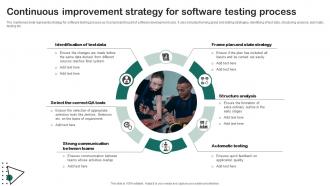
Continuous Improvement Strategy For Software Testing Process
Try Before you Buy Download Free Sample Product
Audience
Editable
of Time
The mentioned slide represents strategy for software testing process as it comprises the part of software development cycle. It also includes framing plans and stating strategies, identifying of test data, structuring analysis, automatic testing etc.
People who downloaded this PowerPoint presentation also viewed the following :
Continuous Improvement Strategy For Software Testing Process with all 6 slides:
Use our Continuous Improvement Strategy For Software Testing Process to effectively help you save your valuable time. They are readymade to fit into any presentation structure.
FAQs for Continuous Improvement Strategy For
Key principles of continuous improvement include incremental enhancement, data-driven decision making, employee empowerment, systematic problem-solving, and customer-focused optimization. These methodologies streamline operations across manufacturing, healthcare, financial services, and retail by reducing waste, enhancing quality, and accelerating processes, with many organizations finding that consistent application ultimately delivers significant cost reductions and competitive advantage.
Teams can effectively measure progress through key performance indicators (KPIs), baseline metrics, regular milestone assessments, employee feedback surveys, and cost-benefit analyses. These measurement approaches enable organizations to track efficiency gains, quality improvements, and customer satisfaction changes, with many manufacturing and service companies finding that combining quantitative data with qualitative insights ultimately delivers clearer visibility into improvement impacts and sustainable competitive advantage.
Employee feedback serves as the foundation for continuous improvement by identifying operational gaps, surfacing innovative solutions, and driving engagement across all organizational levels. Through regular feedback mechanisms like suggestion systems, team meetings, and performance reviews, companies streamline processes, enhance productivity, and accelerate innovation, with many organizations finding that empowered employees ultimately deliver superior customer experiences and sustainable competitive advantage.
PDCA integration into daily operations involves embedding systematic planning sessions, structured implementation phases, regular performance reviews, and standardized feedback loops across all organizational levels. Through digital dashboards and routine check-ins, teams in manufacturing, healthcare, and retail streamline problem-solving, accelerate decision-making, and enhance operational efficiency, ultimately delivering sustained improvements and competitive advantage.
Common obstacles during continuous improvement implementation include employee resistance to change, inadequate leadership support, insufficient training and resources, lack of clear metrics, and organizational silos that hinder collaboration. These challenges often emerge in manufacturing, healthcare, and service industries, with many organizations finding that early stakeholder engagement, comprehensive training programs, and consistent leadership commitment significantly enhance adoption rates, ultimately delivering sustainable operational improvements and competitive advantage.
Technology facilitates continuous improvement through data analytics platforms, automated monitoring systems, workflow optimization software, collaborative digital tools, and real-time performance dashboards. These solutions enable organizations to identify inefficiencies faster, track progress systematically, and implement changes seamlessly across departments, with many companies finding that integrated technology platforms ultimately deliver measurable productivity gains and sustained competitive advantage.
Organizations utilize data analytics to drive continuous improvement by identifying performance gaps, tracking key metrics, and predicting optimization opportunities through real-time monitoring and predictive modeling. Through advanced analytics platforms, companies streamline operations, enhance decision-making accuracy, and accelerate problem resolution, with many manufacturing and service organizations finding that data-driven insights ultimately deliver measurable efficiency gains and competitive advantage.
Leadership commitment significantly impacts continuous improvement success by establishing organizational culture, allocating necessary resources, and modeling desired behaviors throughout the company. When executives actively champion these initiatives, organizations experience higher employee engagement, faster implementation of process changes, and sustained momentum, with many manufacturing and healthcare institutions finding that visible leadership support increases program success rates by over 70%.
Organizations balance continuous improvement with daily operations by integrating improvement activities into regular workflows, dedicating specific time blocks for enhancement projects, and empowering employees to identify inefficiencies during routine tasks. This strategic approach enables teams to maintain operational excellence while systematically optimizing processes, with many companies finding that embedded improvement practices ultimately streamline operations and reduce long-term workload pressures.
Techniques include regular feedback sessions, recognition programs for improvement suggestions, cross-functional collaboration opportunities, skill development workshops, and goal-setting frameworks that emphasize learning over perfection. These approaches enhance employee engagement by fostering ownership, encouraging innovation, and creating psychological safety, with many organizations finding that consistent recognition and development opportunities ultimately deliver higher retention rates and competitive advantage.
Industry-specific regulations and standards significantly shape continuous improvement strategies by establishing mandatory compliance frameworks, safety protocols, and quality benchmarks that organizations must integrate into their processes. These regulatory requirements drive systematic improvements in sectors like healthcare, financial services, and manufacturing, where companies enhance operational efficiency while maintaining strict adherence to standards, ultimately delivering safer products and more reliable services.
Toyota's Production System revolutionized manufacturing through kaizen practices, reducing waste and improving quality, while Amazon continuously optimizes logistics and customer experience through data-driven iterations. Companies like General Electric implemented Six Sigma methodologies to streamline operations, and healthcare organizations use Plan-Do-Study-Act cycles to enhance patient outcomes, ultimately delivering operational excellence and competitive advantage across industries.
SMEs can implement continuous improvement through employee suggestion programs, process mapping, simple digital tools, cross-training initiatives, and regular performance reviews. These cost-effective approaches enable small businesses to streamline operations, reduce waste, and enhance productivity without significant investment, with many organizations finding that engaged employees become the most valuable drivers of sustainable improvement.
Cross-functional collaboration enhances continuous improvement by bringing diverse perspectives, breaking down silos, and leveraging varied expertise across departments like operations, quality, and customer service. These collaborative approaches streamline problem-solving, accelerate solution implementation, and identify improvement opportunities that single departments might miss, with many organizations finding that integrated teams deliver faster innovation and more comprehensive process optimization.
Training and development sustain continuous improvement by building employee capability, fostering innovation mindsets, and embedding improvement methodologies across organizational levels. Through structured learning programs, organizations enhance problem-solving skills, increase engagement, and develop internal expertise, with many companies finding that well-trained teams consistently identify opportunities, ultimately delivering sustained competitive advantage and operational excellence.
-
World-class PowerPoint designs that are fully customizable!
-
Amazing slides! Unique, attractive, and easy to understand.