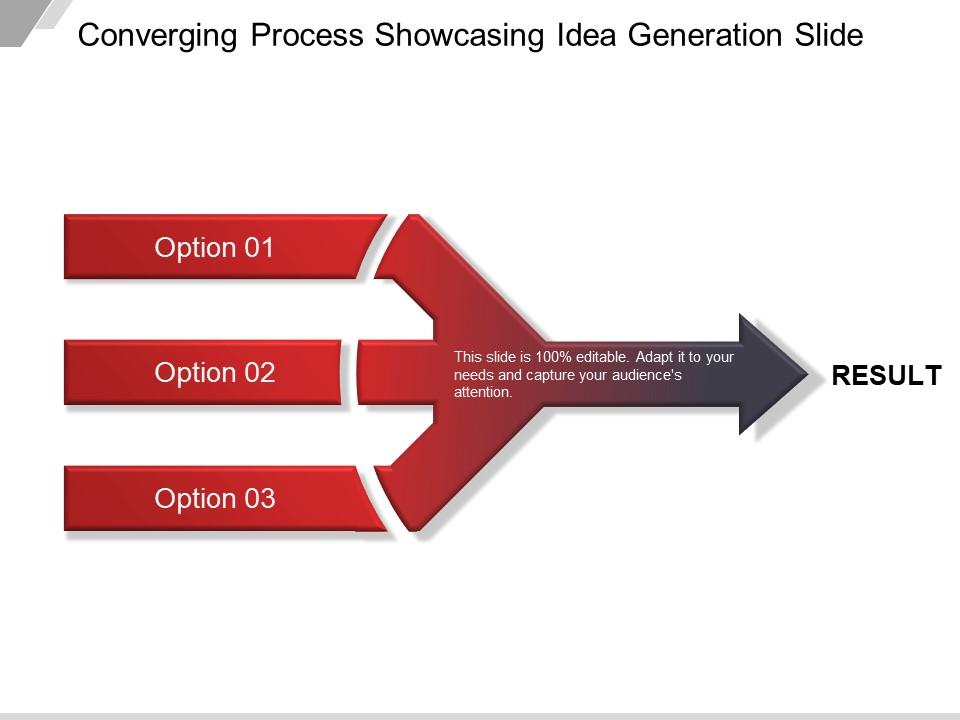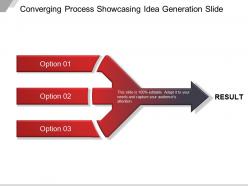
Exemplo de processo convergente apresentando geração de ideias Ppt

Rating:
90%
Converging process showcasing idea generation ppt example
Slide 1 of 5
Favourites Favourites

Try Before you Buy Download Free Sample Product

Audience Impress Your
Audience
Editable 100%
Editable
Time Save Hours
of Time
The Biggest Sale is ending soon in
0
0
:
0
0
:
0
0
Rating:
90%

Recursos destes slides de apresentação do PowerPoint:

Apresentando o processo convergente apresentando o slide PPT de geração de idéias. Este diagrama de apresentação foi projetado profissionalmente e é totalmente editável no PowerPoint. Você pode personalizar o tipo de fonte, tamanho da fonte, cores do diagrama e cor de fundo de acordo com sua necessidade. Fácil de incorporar o nome e o logotipo da sua empresa no slide. Substitua o conteúdo fictício nos espaços reservados de texto pelo conteúdo da sua apresentação. O slide é totalmente compatível com slides do Google e pode ser salvo no formato JPG ou PDF sem complicações. Gráficos e ícones de alta qualidade garantem que não haja deterioração na qualidade ao aumentar seu tamanho.

FAQs for Converging process showcasing idea

The key stages of idea generation include problem definition, research and exploration, brainstorming and divergent thinking, idea development, and evaluation and selection. These stages enable organizations to systematically approach innovation by gathering diverse perspectives, encouraging creative exploration, and refining concepts into viable solutions, with many companies finding that structured idea generation processes significantly enhance product development timelines and competitive advantage.

Visual aids enhance idea generation by stimulating creative thinking, facilitating clearer communication of complex concepts, and enabling participants to build upon each other's ideas more effectively. Through mind maps, sketches, and digital collaboration tools, teams can visualize connections between concepts, organize thoughts systematically, and maintain engagement throughout sessions, ultimately delivering more innovative solutions and comprehensive idea development.

Collaboration enhances idea generation by combining diverse perspectives, expertise, and experiences, enabling teams to build upon each other's concepts through brainstorming, cross-functional input, and collective problem-solving. Through structured collaborative processes, organizations in sectors like technology and healthcare accelerate innovation cycles, minimize blind spots, and ultimately deliver breakthrough solutions that individual contributors might not achieve alone.

Individuals can overcome mental blocks by changing environments, practicing brainstorming techniques, setting aside perfectionism, engaging in cross-functional collaboration, and establishing regular creative routines. These approaches enable professionals to break conventional thinking patterns, generate diverse perspectives, and unlock innovative solutions, with many organizations finding that structured creativity sessions and collaborative workshops ultimately deliver breakthrough ideas and enhanced problem-solving capabilities.

Techniques include cross-functional brainstorming sessions, perspective rotation exercises, constraint-based ideation, reverse brainstorming, and structured idea frameworks like SCAMPER or Six Thinking Hats. These approaches streamline creative processes by incorporating diverse viewpoints, challenging assumptions, and systematically exploring alternatives, with many organizations finding that structured diversity ultimately delivers more innovative solutions and competitive advantages.

Mood and environment significantly influence idea generation effectiveness by affecting cognitive flexibility, creative confidence, and collaborative dynamics. Positive environments with natural light, comfortable spaces, and minimal distractions enhance brainstorming sessions, while upbeat moods encourage risk-taking and innovative thinking, ultimately delivering more diverse solutions and breakthrough concepts for teams.

Businesses can utilize customer feedback to drive idea generation by analyzing reviews, conducting surveys, monitoring social media interactions, hosting focus groups, and tracking support tickets for recurring themes. Through these insights, companies identify unmet needs, product gaps, and service improvements, while many organizations finding that customer-driven innovation leads to higher adoption rates and stronger market positioning.

Effective idea generation tools include mind mapping software like MindMeister, collaborative platforms such as Miro and MURAL, brainstorming applications like Ideaflip, and structured innovation platforms including IdeaScale and Brightidea. These digital solutions streamline creative workflows by enabling real-time collaboration, visual concept mapping, and systematic idea capture, with many organizations finding that integrated platforms significantly accelerate innovation cycles while improving team engagement.

Mind mapping enhances idea generation by creating visual connections between concepts, enabling non-linear thinking, and revealing unexpected relationships between disparate elements. Through branching structures and visual associations, teams can explore multiple pathways simultaneously, capture spontaneous insights more effectively, and build upon initial concepts organically, ultimately delivering more comprehensive solutions and fostering collaborative creativity across diverse projects.

Convergent and divergent thinking create a balanced approach to innovation, with divergent thinking generating multiple creative possibilities while convergent thinking evaluates and refines these concepts into viable solutions. This strategic combination enables organizations to explore broad opportunities initially, then systematically narrow focus to the most promising ideas, ultimately delivering both creative breakthrough potential and practical implementation pathways.

Design thinking methodologies significantly enhance organizational idea generation by emphasizing human-centered approaches, iterative prototyping, and cross-functional collaboration throughout the innovation process. These structured frameworks enable teams to identify unmet customer needs, rapidly test concepts, and refine solutions based on real feedback, with many companies finding that this approach delivers more viable innovations and reduces time-to-market for new products and services.

Organizations can evaluate idea generation success through metrics like quantity of ideas generated, participation rates across teams, implementation conversion rates, time from concept to execution, and revenue generated from implemented ideas. These metrics enable companies to track innovation pipeline health, employee engagement levels, and ultimately measure competitive advantage gained through systematic creativity, with many finding that balanced scorecards combining volume and value metrics deliver optimal insights.

Cultivating an innovation culture requires encouraging experimentation, rewarding creative risk-taking, providing dedicated brainstorming time, fostering cross-departmental collaboration, and establishing clear idea evaluation processes. Organizations increasingly find that combining psychological safety with structured innovation frameworks enables teams to generate breakthrough concepts while maintaining business focus, ultimately delivering sustained competitive advantage and enhanced problem-solving capabilities across all departments.

Research serves as the foundation for effective idea generation by identifying market gaps, understanding customer needs, analyzing competitor strategies, and uncovering emerging trends and technologies. Through comprehensive market analysis, user interviews, and trend monitoring, organizations can ground their creative processes in real-world insights, ultimately generating more viable, targeted ideas that address actual problems and opportunities in their respective markets.

Storytelling enhances idea presentation by creating emotional connections, providing relatable contexts, and making complex concepts more memorable and persuasive. Through narrative frameworks, organizations can demonstrate real-world applications, showcase potential outcomes, and address stakeholder concerns more effectively, with many companies finding that story-driven presentations increase idea acceptance rates and secure faster implementation approvals.

Ratings and Reviews

90% of 100
Review Form
Write a review
Most Relevant Reviews
  1. 80%

    by Donte Duncan

    Understandable and informative presentation.
  2. 100%

    by Dong Santos

    Best Representation of topics, really appreciable.

2 Item(s)

per page: