Corporate Rebranding Launch Communication Plan
Try Before you Buy Download Free Sample Product
Audience
Editable
of Time
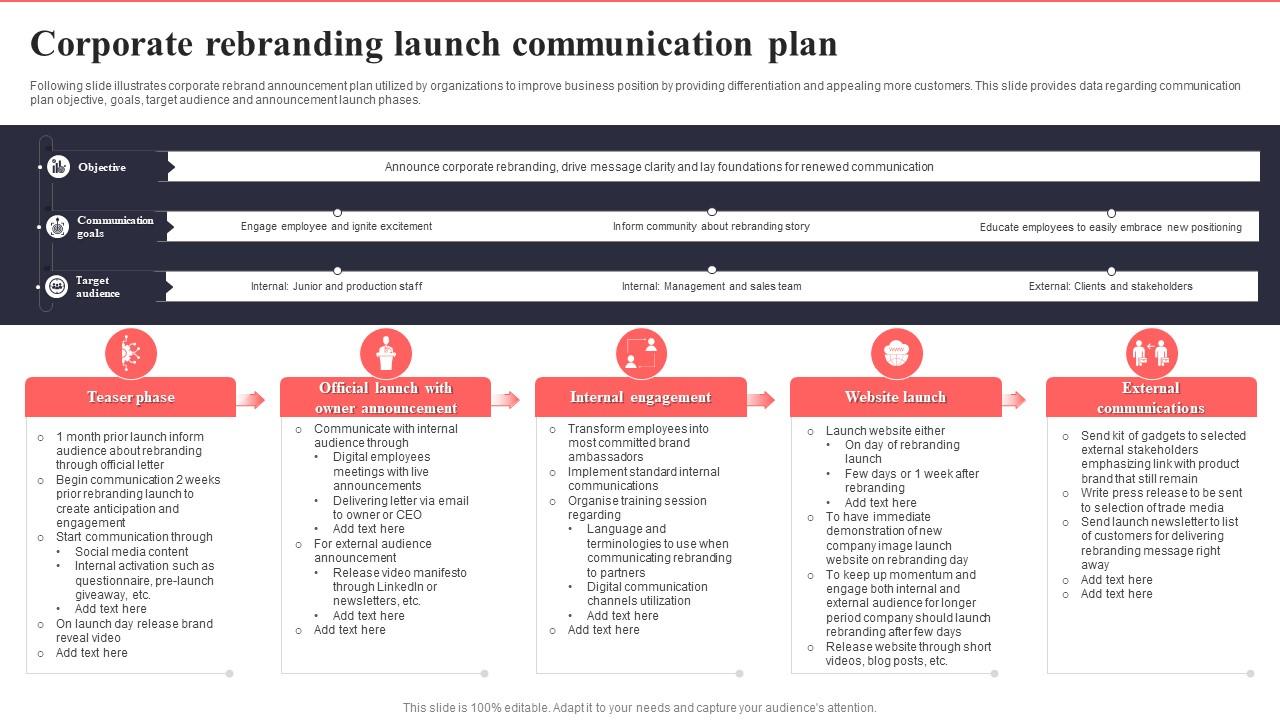
Following slide illustrates corporate rebrand announcement plan utilized by organizations to improve business position by providing differentiation and appealing more customers. This slide provides data regarding communication plan objective, goals, target audience and announcement launch phases.
People who downloaded this PowerPoint presentation also viewed the following :
Corporate Rebranding Launch Communication Plan with all 6 slides:
Use our Corporate Rebranding Launch Communication Plan to effectively help you save your valuable time. They are readymade to fit into any presentation structure.
FAQs for Corporate Rebranding
Corporate rebranding drivers include market repositioning, mergers and acquisitions, outdated brand perception, competitive differentiation, and strategic business pivots. These initiatives enable companies to capture new audiences, reflect evolved values, and align with changing market demands, with many organizations finding that strategic rebranding ultimately delivers enhanced market presence and competitive advantage.
Organizations can determine their needs by evaluating brand perception gaps, market positioning challenges, outdated visual identity elements, and declining customer engagement metrics. A brand refresh suffices when core values remain relevant but aesthetics need updating, while rebranding becomes necessary when fundamental messaging, target audiences, or strategic direction require complete transformation, with many companies finding that thorough market research and stakeholder feedback ultimately guide this critical decision.
Market research serves as the foundation for corporate rebranding strategy by identifying target audience preferences, competitive positioning opportunities, brand perception gaps, and market trends that influence consumer behavior. Through comprehensive surveys, focus groups, and competitive analysis, organizations can validate rebranding decisions, minimize risks, and ensure their new brand identity resonates with customers, ultimately delivering stronger market positioning and enhanced customer engagement.
Businesses can effectively communicate their new brand identity through comprehensive internal training, updated marketing materials, stakeholder meetings, and consistent messaging across all touchpoints. This strategic approach ensures employees become brand ambassadors while customers experience seamless transitions, with many organizations finding that coordinated communication campaigns ultimately enhance brand recognition and maintain customer loyalty during rebranding efforts.
Common rebranding pitfalls include insufficient market research, inconsistent messaging across channels, neglecting stakeholder communication, rushing implementation timelines, and losing brand equity through drastic changes. These challenges can be avoided by conducting comprehensive audience analysis, maintaining clear communication strategies, and implementing phased rollouts, with many organizations finding that strategic planning and stakeholder engagement ultimately deliver smoother transitions and stronger market positioning.
Customer feedback integration shapes successful rebranding by informing brand positioning, validating messaging strategies, identifying market perceptions, and uncovering unmet expectations throughout the initiative. Through systematic surveys, focus groups, and digital analytics, companies like Target and McDonald's have streamlined their rebranding efforts, ultimately delivering enhanced customer alignment and stronger market resonance.
Corporate rebranding success metrics include brand awareness levels, customer perception scores, employee engagement rates, market share changes, and revenue growth indicators. These measurements enable organizations to track both immediate market response and long-term strategic impact, with many companies finding that combining quantitative financial data with qualitative stakeholder feedback delivers the most comprehensive assessment of rebranding effectiveness.
Visual identity serves as the cornerstone of corporate rebranding, encompassing logo design, color palettes, typography, imagery style, and brand guidelines that create immediate market recognition. These elements work synergistically to communicate brand values and positioning, with companies like Mastercard and Airbnb demonstrating how strategic visual updates can enhance customer perception, streamline brand recognition, and ultimately deliver stronger market differentiation.
Corporate rebranding transitions require comprehensive stakeholder communication, phased implementation timelines, employee training programs, and consistent brand messaging across all touchpoints. Through strategic coordination, organizations streamline customer confusion while maintaining operational continuity, with many companies finding that early stakeholder engagement and detailed transition roadmaps ultimately deliver stronger brand adoption and competitive positioning.
Social media influences corporate rebranding by amplifying brand messaging, enabling real-time customer feedback, and facilitating direct audience engagement throughout the transformation process. Through strategic social campaigns, companies can control narrative timing, address stakeholder concerns immediately, and build anticipation for new brand elements, with many organizations finding that consistent social presence ultimately accelerates acceptance and enhances overall rebranding success.
Best practices for creating a cohesive brand narrative following a rebrand include developing a clear brand story, establishing consistent messaging across all touchpoints, training employees on new brand values, updating all marketing materials simultaneously, and engaging stakeholders early in the process. These strategies streamline brand adoption by ensuring unified communication, reinforcing new identity consistently, and building authentic connections, with many organizations finding that comprehensive narrative alignment ultimately delivers stronger customer loyalty and competitive differentiation.
Businesses can leverage their history by incorporating foundational values, heritage storytelling, and established brand equity into contemporary visual identity, messaging, and customer experiences. This strategic combination enables companies to maintain customer loyalty and brand recognition while attracting new demographics, with many organizations finding that honoring legacy elements during modernization ultimately delivers competitive differentiation and enhanced market positioning.
Employee buy-in serves as the foundation for successful corporate rebranding, directly influencing customer perceptions, brand authenticity, and implementation consistency across all touchpoints. When employees embrace the rebrand, they become powerful brand ambassadors who deliver cohesive messaging and experiences, while resistance can undermine credibility and create confusion, ultimately determining whether rebranding efforts achieve their strategic objectives.
Companies maintain brand consistency by developing comprehensive brand guidelines, training all stakeholders on new standards, and implementing centralized approval processes across digital, print, and physical touchpoints. Through strategic phased rollouts, organizations like banks and retail chains ensure uniform messaging, visual identity, and customer experience while monitoring compliance, ultimately delivering cohesive brand recognition and stronger market positioning.
Corporate rebranding risks include customer confusion, loss of brand recognition, alienated loyal customers, diluted market positioning, and decreased sales during transition periods. These challenges particularly affect established companies in competitive sectors like retail and financial services, where brand loyalty drives revenue, though strategic communication and phased implementation can minimize disruption while preserving valuable brand equity.
-
The content is very helpful from business point of view.
-
Satisfied with the way SlideTeam resolved my query regarding the right business PPTs that I was having difficulty finding. I found the perfect match with their assistance.