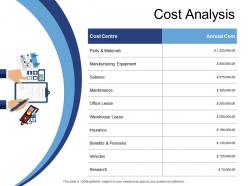
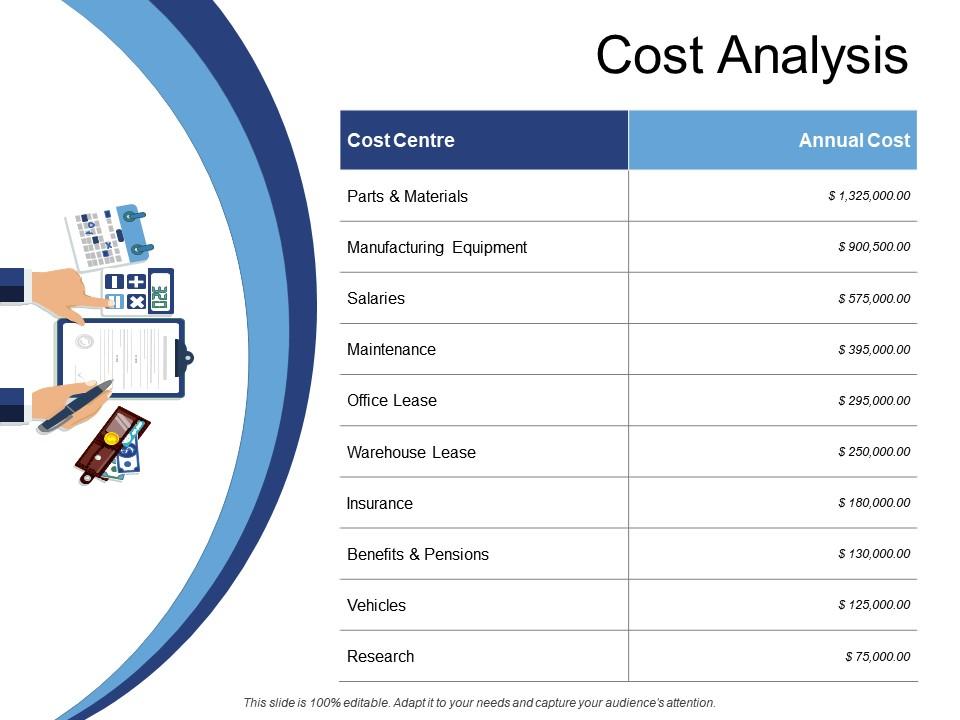
Cost analysis manufacturing equipment ppt powerpoint presentation slide
Try Before you Buy Download Free Sample Product
Audience
Editable
of Time
Hold their interest with our Cost Analysis Manufacturing Equipment Ppt Powerpoint Presentation Slide. Engage folks with an intelligent display.
People who downloaded this PowerPoint presentation also viewed the following :
Cost analysis manufacturing equipment ppt powerpoint presentation slide with all 5 slides:
Engage folks with an intelligent display due to our Cost Analysis Manufacturing Equipment Ppt Powerpoint Presentation Slide. It will hold their interest.
FAQs for Cost analysis manufacturing equipment ppt
Key factors include initial purchase price, installation costs, operating expenses, maintenance requirements, energy consumption, and expected lifespan. These elements enable manufacturers to calculate total cost of ownership, assess return on investment, and compare equipment options, with many organizations finding that comprehensive analysis reveals hidden costs like training, downtime, and disposal, ultimately delivering more informed purchasing decisions.
Total cost of ownership evaluates manufacturing equipment expenses by calculating purchase price, operational costs, maintenance expenses, energy consumption, and depreciation over the equipment's entire lifecycle. This comprehensive approach enables manufacturers to compare true long-term value rather than just upfront costs, with many finding that higher-quality equipment delivers lower TCO through reduced downtime, energy efficiency, and extended lifespan, ultimately optimizing capital allocation decisions.
Maintenance and operational costs significantly impact manufacturing machinery's total cost of ownership, often representing 60-70% of equipment expenses over its lifecycle through energy consumption, routine servicing, repairs, and downtime losses. These ongoing costs, including labor, spare parts, and productivity interruptions, ultimately determine equipment profitability, with many manufacturers finding that strategic maintenance planning delivers substantial competitive advantages.
Depreciation can be accurately accounted for through straight-line, declining balance, or units-of-production methods, each aligning with specific operational patterns and asset utilization rates. Manufacturing companies increasingly use units-of-production depreciation for equipment-intensive operations, as it ties costs directly to actual usage, ultimately delivering more precise cost allocation and enhanced financial transparency for strategic decision-making.
Key metrics include Overall Equipment Effectiveness (OEE), return on investment (ROI), throughput rates, downtime frequency, maintenance costs, and energy consumption per unit produced. These measurements enable manufacturers to evaluate operational efficiency, identify bottlenecks, and optimize resource allocation, with many industrial facilities finding that comprehensive tracking delivers improved productivity and significantly reduced operational costs.
Initial purchase prices often represent just 20-30% of manufacturing equipment's total lifecycle costs, with maintenance, energy consumption, training, and operational inefficiencies comprising the majority. While premium equipment requires higher upfront investment, it typically delivers lower operating costs, reduced downtime, and enhanced productivity over 10-15 years, ultimately providing superior ROI.
Energy consumption and sustainability initiatives significantly impact manufacturing equipment cost analysis through operational expenses, regulatory compliance costs, carbon pricing, and lifecycle assessments. These factors increasingly drive equipment selection decisions, with many manufacturers finding that energy-efficient technologies reduce long-term operating costs, enhance brand reputation, and deliver competitive advantages in environmentally conscious markets.
Leasing versus purchasing manufacturing equipment significantly impacts cost analysis through cash flow timing, tax implications, maintenance responsibilities, and asset ownership benefits. While leasing offers lower upfront costs and predictable monthly expenses, purchasing provides long-term ownership value and potential depreciation advantages, with many manufacturers finding that strategic combinations of both approaches optimize capital allocation and operational flexibility.
Hidden manufacturing equipment costs include maintenance complexity, operator training requirements, energy inefficiency penalties, compliance upgrades, and unexpected downtime expenses. These overlooked factors can significantly impact total cost of ownership, with many manufacturers finding that strategic upfront analysis of these variables enables better budget allocation, reduces operational surprises, and ultimately delivers more predictable equipment ROI.
Technology advancements significantly influence cost analysis by enhancing predictive maintenance capabilities, energy efficiency monitoring, and automated performance tracking for both older and newer manufacturing equipment. Through IoT sensors and AI analytics, manufacturers can accurately compare operational costs, maintenance frequencies, and productivity outputs, with many finding that strategic upgrades deliver substantial long-term savings despite higher initial investments.
Demand forecasting enhances cost analysis accuracy by predicting equipment utilization rates, optimizing capacity planning, identifying seasonal demand patterns, and enabling better resource allocation decisions. Through advanced analytics and historical data modeling, manufacturers can determine optimal equipment investments, reduce overproduction costs, and minimize idle capacity expenses, ultimately delivering more precise cost projections and improved operational efficiency.
Strategies include preventive maintenance scheduling, energy-efficient upgrades, operator training programs, predictive analytics implementation, and strategic replacement timing. These approaches streamline operational costs by minimizing unexpected breakdowns, reducing energy consumption, and extending equipment lifespan, with manufacturing facilities finding that comprehensive lifecycle planning delivers up to 30% cost savings while enhancing productivity.
Labor costs significantly impact manufacturing equipment analysis through operational complexity, required skill levels, training investments, and staffing requirements for different technologies. While automated equipment typically reduces direct labor expenses, it often demands higher-skilled technicians and specialized maintenance staff, with many manufacturers finding that strategic equipment selection balances labor optimization with long-term operational efficiency.
Financing options significantly impact manufacturing machinery cost analysis through interest rates, tax implications, cash flow management, and depreciation schedules. While leasing preserves capital and provides flexibility, purchasing offers long-term ownership benefits, with many manufacturers finding that strategic financing combinations optimize both immediate operational efficiency and ultimate total cost of ownership.
Benchmarking against industry standards assists comprehensive cost analysis by providing comparative performance metrics, operational efficiency baselines, and maintenance cost averages for similar equipment across sectors. Through industry benchmarks, manufacturers can identify cost optimization opportunities, validate equipment ROI projections, and make strategic purchasing decisions, ultimately enhancing competitive positioning while minimizing operational expenses.
No Reviews