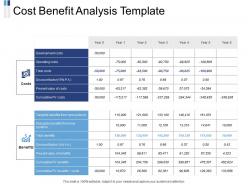
Cost benefit analysis template ppt powerpoint presentation professional

Cost benefit analysis template ppt powerpoint presentation professional
Slide 1 of 5
Favourites Favourites

Try Before you Buy Download Free Sample Product

Audience Impress Your
Audience
Editable 100%
Editable
Time Save Hours
of Time
The Biggest Sale is ending soon in
0
0
:
0
0
:
0
0
Presenting this set of slides with name Cost Benefit Analysis Template Ppt Powerpoint Presentation Professional. The topics discussed in these slides are Analysis, Development, Cumulative, Benefits, Management. This is a completely editable PowerPoint presentation and is available for immediate download. Download now and impress your audience.

People who downloaded this PowerPoint presentation also viewed the following :

FAQs for Cost benefit analysis template ppt

A comprehensive cost benefit analysis template should include initial investment costs, ongoing operational expenses, projected revenue streams, timeline for implementation, risk assessment factors, and quantifiable benefits measurement. These components enable organizations to systematically evaluate project viability across sectors like healthcare, manufacturing, and financial services, ultimately delivering strategic decision-making frameworks that enhance resource allocation and competitive advantage.

Visual elements enhance cost benefit analysis clarity by transforming complex financial data into digestible charts, graphs, comparison tables, and infographic summaries that stakeholders can quickly interpret. These presentation components streamline decision-making processes by highlighting key metrics, ROI projections, and risk assessments through color-coded frameworks, ultimately enabling executives to grasp financial implications faster and make more informed strategic choices.

Common pitfalls include underestimating hidden costs, overestimating benefits, ignoring time value of money, excluding stakeholder input, and using unrealistic assumptions. These oversights can mislead organizations across sectors like healthcare and manufacturing, where inaccurate analyses result in poor resource allocation, project failures, and missed strategic opportunities, ultimately undermining competitive advantage and operational efficiency.

A cost benefit analysis template can be effectively customized by modifying cost categories, benefit metrics, timeframes, and risk factors specific to each industry's operational realities. For example, healthcare organizations prioritize patient outcome improvements and compliance costs, while manufacturing focuses on production efficiency and equipment ROI, ultimately enabling more accurate financial projections and strategic decision-making across diverse business environments.

Essential metrics include direct costs (labor, materials, technology investments), indirect costs (training, maintenance, operational changes), quantifiable benefits (revenue increases, cost savings, efficiency gains), and intangible benefits (brand value, customer satisfaction, risk mitigation). These comprehensive metrics enable organizations to capture both immediate financial impacts and long-term strategic value, with many finding that including timeframe analysis and ROI calculations ultimately delivers more accurate investment decisions and stakeholder buy-in.

Technology streamlines cost benefit analysis template creation through automated data integration, real-time calculations, and collaborative editing platforms. Cloud-based tools enable financial teams to pull data directly from enterprise systems, apply dynamic formulas, and generate instant scenario comparisons, while project managers across industries find that digital templates reduce analysis time by 60% and improve accuracy.

Stakeholder analysis identifies key decision-makers, affected parties, and their priorities, ensuring the cost benefit analysis template captures relevant metrics, concerns, and success criteria for each group. By understanding stakeholder perspectives, organizations can weight costs and benefits appropriately, address potential objections proactively, and ultimately deliver more compelling business cases that secure buy-in and funding approval.

Ensuring realistic assumptions requires thorough market research, historical data analysis, expert consultation, and stakeholder input validation. These methodologies enhance accuracy by incorporating industry benchmarks, past performance metrics, and cross-functional perspectives, with many organizations finding that regular assumption testing and sensitivity analysis ultimately delivers more reliable cost-benefit projections and strategic decision-making confidence.

**INPUT**: What examples of successful cost benefit analyses can be used as benchmarks for template development? **OUTPUT**: Successful cost benefit analysis benchmarks include IT system upgrades, manufacturing automation projects, employee training programs, supply chain optimizations, and facility relocations across various industries. These templates demonstrate quantifiable ROI calculations, risk assessments, and timeline projections, with organizations like retail chains, healthcare systems, and financial institutions finding that standardized frameworks streamline decision-making while enhancing strategic resource allocation. [Word count: 60 words]

Cost-benefit analysis outcomes should be presented through clear executive summaries, visual dashboards with ROI metrics, comparative scenarios, and risk assessments that highlight financial projections and strategic implications. Successful presentations combine quantitative data with qualitative insights, enabling stakeholders to quickly grasp investment returns, operational efficiencies, and competitive advantages while facilitating informed decision-making processes.

Best practices for conducting sensitivity analysis include identifying key variables, testing multiple scenarios, using percentage-based ranges, documenting assumptions clearly, and incorporating Monte Carlo simulations. These approaches enhance decision-making by revealing cost drivers, quantifying risk exposure, and stress-testing financial projections, with many organizations finding that systematic sensitivity testing ultimately delivers more robust investment decisions and strategic planning confidence.

A cost benefit analysis template facilitates project management decisions by standardizing evaluation criteria, quantifying financial impacts, comparing multiple options systematically, and providing clear ROI calculations. This structured approach enables project managers to present compelling business cases to stakeholders, minimize financial risks, and prioritize resource allocation effectively, ultimately delivering faster approvals and more strategic project outcomes.

Effective cost benefit analysis templates should include comprehensive financial metrics, clear timeframe parameters, risk assessment frameworks, and stakeholder impact measurements. These criteria enable organizations to evaluate accuracy, usability, and decision-making value, with many financial institutions and consulting firms finding that templates incorporating sensitivity analysis, ROI calculations, and implementation feasibility ultimately deliver more reliable investment decisions and strategic outcomes.

User feedback enhances cost benefit analysis templates by identifying missing cost categories, clarifying confusing sections, and highlighting real-world application challenges that weren't initially considered. Through iterative improvements based on actual usage, organizations can streamline data input processes, enhance calculation accuracy, and ultimately deliver more comprehensive templates that better serve diverse industries and project types.

Legal considerations include compliance with industry-specific regulations, data privacy laws, financial reporting standards, environmental impact requirements, and audit trail documentation. Organizations must ensure their templates align with sector-specific mandates, whether healthcare compliance, financial services regulations, or environmental assessments, ultimately delivering transparency and regulatory confidence while streamlining decision-making processes.

Ratings and Reviews

0% of 100
Write a review
Most Relevant Reviews

No Reviews