Cost Containment Strategies To Reduce Healthcare Expenses
Try Before you Buy Download Free Sample Product
Audience
Editable
of Time
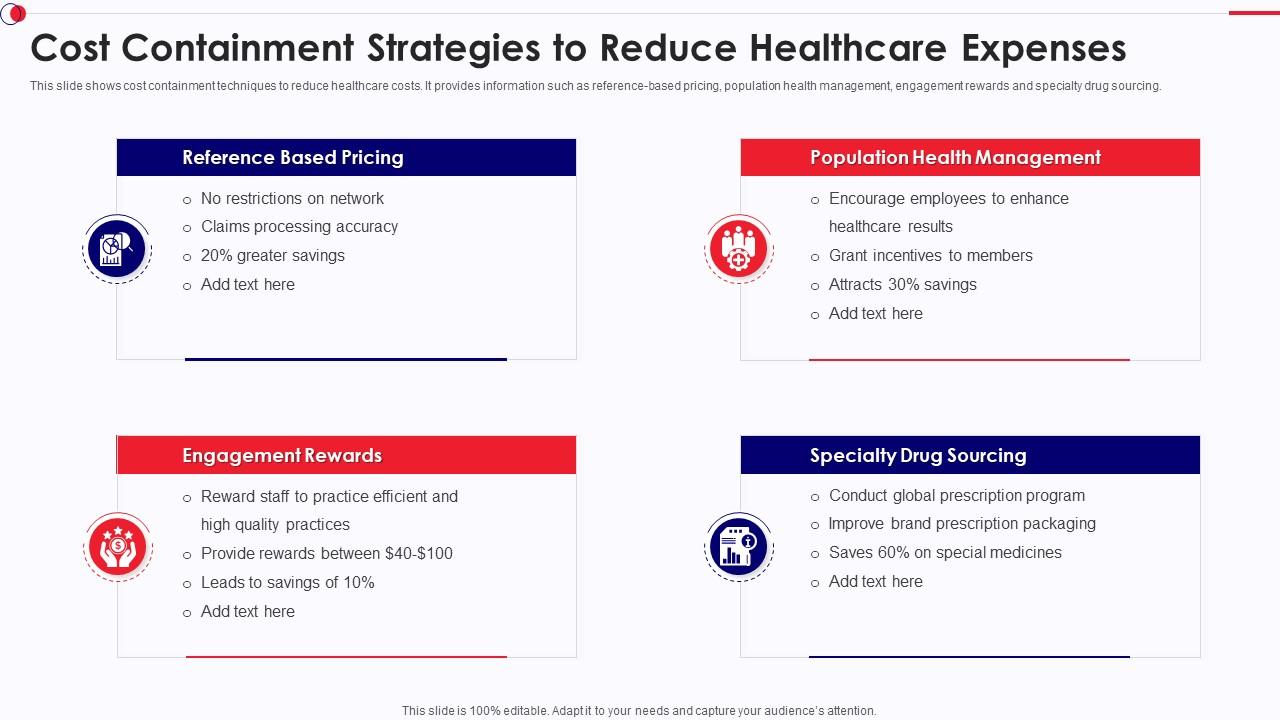
This slide shows cost containment techniques to reduce healthcare costs. It provides information such as reference-based pricing, population health management, engagement rewards and specialty drug sourcing.
People who downloaded this PowerPoint presentation also viewed the following :
Cost Containment Strategies To Reduce Healthcare Expenses with all 6 slides:
Use our Cost Containment Strategies To Reduce Healthcare Expenses to effectively help you save your valuable time. They are readymade to fit into any presentation structure.
FAQs for Cost Containment Strategies To
Key cost containment strategies include implementing value-based care models, optimizing supply chain management, leveraging healthcare analytics for predictive insights, automating administrative processes, and enhancing preventive care programs. These approaches streamline operations by reducing unnecessary procedures, negotiating better supplier contracts, and minimizing readmissions, with many hospitals finding that strategic technology investments ultimately deliver significant operational savings while improving patient outcomes.
Businesses measure cost containment success through key performance indicators like cost per unit, operational efficiency ratios, budget variance analysis, and return on investment metrics. These measurements enable organizations to track savings across departments, compare performance against industry benchmarks, and identify areas for further optimization, ultimately delivering improved profit margins and enhanced competitive positioning.
Technology enhances cost containment through automation, data analytics, cloud computing, AI-driven optimization, and digital workflow management. These solutions streamline operations by reducing manual processes, identifying spending inefficiencies, and enabling real-time budget monitoring, with many organizations finding that strategic technology investments ultimately deliver significant operational savings and competitive advantage.
Companies ensure cost containment doesn't compromise quality by implementing strategic cost management, process optimization, supplier partnerships, and technology automation rather than simply cutting expenses. Through value engineering and lean methodologies, organizations streamline operations while maintaining standards, with many manufacturing and service companies finding that systematic efficiency improvements actually enhance both profitability and customer satisfaction.
Common pitfalls in implementing cost containment include cutting essential resources, overlooking employee morale impacts, implementing changes too rapidly, neglecting quality standards, and focusing solely on short-term savings without strategic planning. These missteps often result in reduced productivity, higher turnover, and customer dissatisfaction, with many organizations finding that balanced, phased approaches ultimately deliver sustainable cost reduction while maintaining operational excellence.
Small businesses can implement cost containment through strategic budgeting, automation of routine processes, renegotiating supplier contracts, outsourcing non-core functions, and leveraging technology for operational efficiency. This balanced approach enables companies to reduce overhead while maintaining quality service delivery, with many small retailers and service providers finding that streamlined operations actually accelerate growth by freeing resources for strategic investments.
Employee training significantly impacts cost containment by reducing errors, improving productivity, enhancing employee retention, and minimizing compliance violations. Through strategic training programs, organizations streamline operations, decrease rework costs, and accelerate task completion, while skilled employees deliver better customer experiences and require less supervision, ultimately reducing operational expenses and turnover-related hiring costs.
Supply chain management contributes to cost containment through strategic sourcing, inventory optimization, supplier consolidation, transportation efficiency, and demand forecasting. These approaches streamline operations by reducing procurement costs, minimizing carrying expenses, and eliminating redundancies, with many organizations finding that integrated supply chain strategies ultimately deliver 15-25% cost reductions while enhancing operational agility.
Data analytics enhances cost containment by identifying spending patterns, predicting budget overruns, and optimizing resource allocation across departments and projects. Through advanced analytics tools, organizations streamline procurement processes, reduce operational waste, and improve financial forecasting accuracy, with many companies finding that predictive models deliver significant cost savings and strategic competitive advantage.
Leading companies adopt innovative cost containment solutions including predictive analytics for demand forecasting, automated procurement systems, energy management platforms, shared services models, and AI-driven resource optimization. These technologies streamline operations by reducing waste, minimizing manual processes, and enhancing decision-making accuracy, with many organizations finding that strategic automation delivers significant cost reductions while maintaining service quality.
Adjusting pricing strategies influences cost containment by optimizing revenue streams, improving profit margins, and reducing operational inefficiencies through data-driven decision making. Strategic pricing enables organizations to cover costs more effectively while remaining competitive, with many retailers and service providers finding that dynamic pricing models ultimately deliver better resource allocation and enhanced financial sustainability.
Organizations should track metrics including cost per unit, budget variance analysis, operational efficiency ratios, return on investment for cost initiatives, and expense-to-revenue ratios across departments. These measurements enable businesses to identify successful strategies, pinpoint areas requiring adjustment, and demonstrate tangible savings, with many finding that regular monitoring ultimately delivers sustained cost reduction and improved competitive positioning.
Stakeholder collaboration improves cost containment by aligning diverse perspectives, pooling resources, and identifying shared cost-saving opportunities across departments or organizations. Through strategic partnerships, companies streamline procurement processes, negotiate better vendor terms, and eliminate duplicate efforts, with many healthcare systems and manufacturing firms finding that collaborative approaches reduce operational costs by 15-25% annually.
**INPUT**: What best practices can be adopted for continuous cost containment in a dynamic market? **OUTPUT**: Cost containment best practices include regular expense audits, strategic vendor negotiations, process automation, resource optimization, and performance-based budgeting across departments. These approaches streamline operations by eliminating redundancies, leveraging technology for efficiency, and maintaining flexible cost structures, with many organizations finding that proactive monitoring ultimately delivers sustainable savings and competitive advantage in volatile markets. **Word count: 56 words**
Regulatory compliance affects cost containment by requiring investments in monitoring systems, reporting frameworks, and specialized personnel, while creating opportunities for operational efficiency and risk reduction. Industries like healthcare, financial services, and manufacturing find that strategic compliance approaches streamline processes, minimize penalties, and enhance competitive positioning, ultimately delivering long-term cost savings through improved transparency and standardized operations.
-
The design is clean-cut, modern, and sleek, keeping the users' needs in mind. The multiple uses make this product worth every penny!
-
SlideTeam’s pool of 2Million+ PPTs has really benefited my team, everyone from the IT department to HR. We are lucky to have crossed ways with them.