

Criteria For Selecting Distribution Channel For Effective Sales Management Powerpoint Presentation Slides





Try Before you Buy Download Free Sample Product
 Impress Your
 Audience
 100%
100% Editable
 Save Hours
 of Time


Check out our expertly designed Criteria for selecting distribution channel for effective sales management template to attract an extensive clientele. It helps the organization maintain the right mix of its distribution channels and then present them with the right solutions effectively. Our effective supply chain management deck exhibits various distribution strategies your company can use to create a broader customer base. It offers several distribution strategies based on the product type and analyses consumer demand using a variety of distribution intermediaries. The intense distribution channels well discuss in this module sell common or low value goods like bread and cakes in nearby convenience stores. Additionally, it demonstrates the careful selection of the businesss wholesalers for medium priced goods like vehicles and perfumes. Lastly, the corporation employs exclusive distribution channels to sell high end, technical products and to build a premium brand image in the minds of its clients. Access this effective template right away
People who downloaded this PowerPoint presentation also viewed the following :
Content of this Powerpoint Presentation
Slide 1: This slide introduces Criteria for Selecting Distribution Channel for Effective Sales Management. Commence by stating Your Company Name.
Slide 2: This slide depicts the Agenda of the presentation.
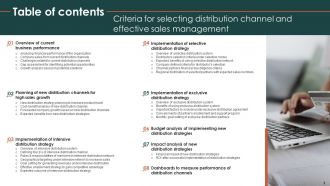
Slide 3: This slide incorporates the Table of contents.
Slide 4: This slide highlights the Title for the Topics to be covered further.
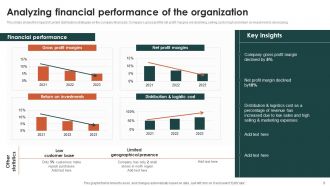
Slide 5: This slides shows the impact of current distribution strategies on the company financials.
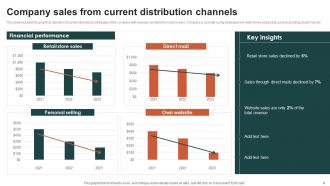
Slide 6: This slide includes the graphical depiction of current distribution strategies of the company with revenue numbers from last 3 years.
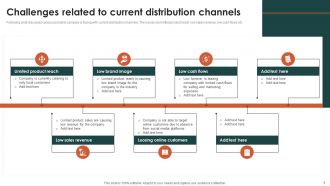
Slide 7: The Following slide discusses various problems company is facing with current distribution channels.
Slide 8: The following slide provides the gap analysis to identify opportunity areas.
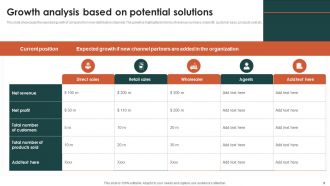
Slide 9: This slide showcases the expected growth of company from new distribution channels.
Slide 10: This slide elucidates the Heading for the Components to be covered further.
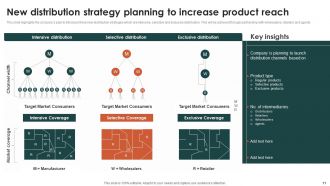
Slide 11: This slide highlights the company’s plan to introduce three new distribution strategies which are intensive, selective and exclusive distribution.
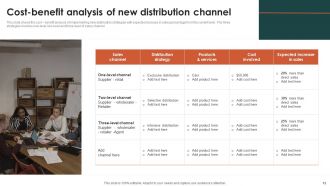
Slide 12: This slide shows the cost – benefit analysis of implementing new distribution strategies with expected increase in sales percentage from the current level.
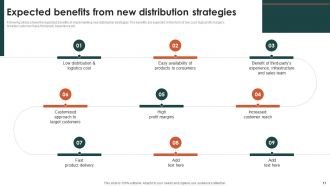
Slide 13: The Following slide reveals the expected benefits of implementing new distribution strategies.
Slide 14: This slide elucidates the Title for the Ideas to be discussed further.
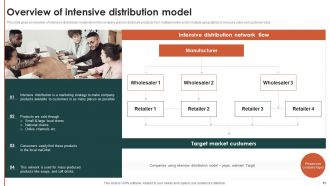
Slide 15: This slide gives an overview of intensive distribution model.
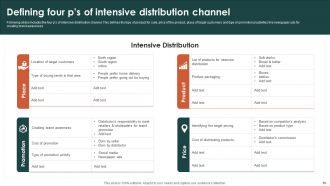
Slide 16: This slide includes the four p’s of intensive distribution channel.
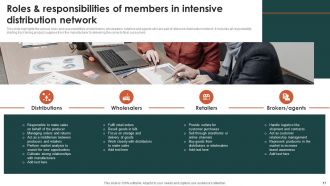
Slide 17: This slide highlights the various roles and responsibilities of distributors, wholesalers, retailers and agents who are part of intensive distribution network.
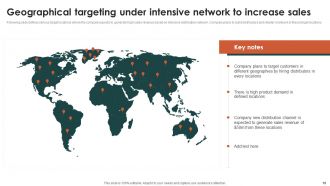
Slide 18: The following slide illustrates the Geographical targeting under intensive network to increase sales.
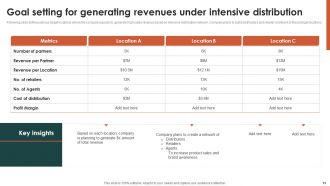
Slide 19: This slide defines various target locations where the company expects to generate high sales revenue based on intensive distribution network.
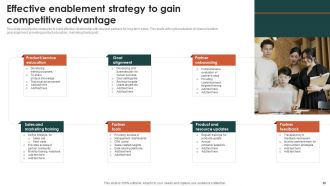
Slide 20: This slide includes the strategies to build effective relationship with channel partners for long term sales.
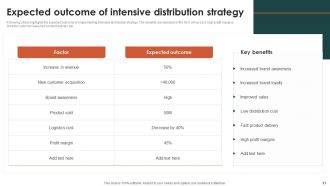
Slide 21: The Following slides indicates the expected outcome of implementing intensive distribution strategy.
Slide 22: This slide depicts the Heading for thev
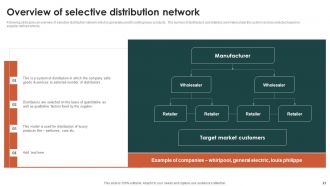
Slide 23: The Following slide provides an overview of selective distribution network which is generally used for selling luxury products.
Slide 24: This slide presents the Quantitative and qualitative eligibility criteria for distributors under selective model.
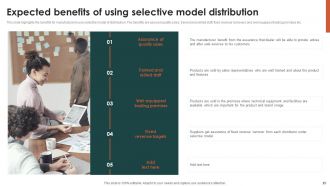
Slide 25: This slide highlights the benefits for manufacturer to use selective model of distribution.
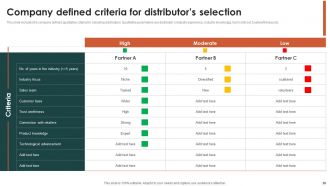
Slide 26: This slide represents the Company defined qualitative criteria for selecting distributors.
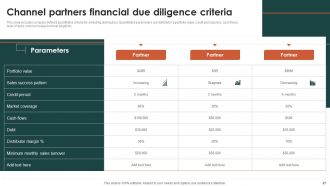
Slide 27: This slide incorporates the Channel partners financial due diligence criteria.
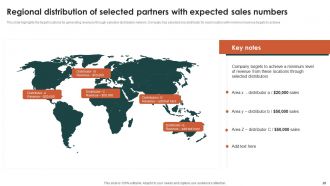
Slide 28: This slide showcases the target locations for generating revenues through selective distribution network.
Slide 29: This slide mentions the Heading for the Ideas to be discussed further.
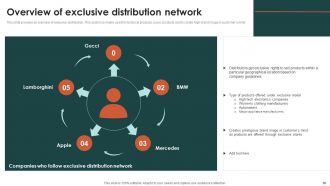
Slide 30: This slide provides an overview of exclusive distribution.
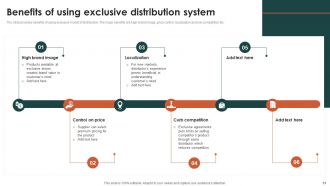
Slide 31: This slide showcases the benefits of using exclusive model of distribution.
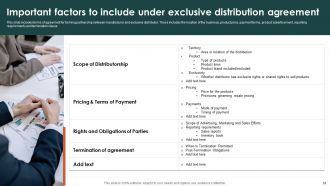
Slide 32: This slide includes terms of agreement for forming partnership between manufacturer and exclusive distributor.
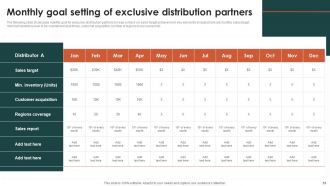
Slide 33: The following slide elucidates the monthly goal for exclusive distribution partners to keep a check on sales target achievement.
Slide 34: This slide exhibits the Title for the Components to be covered in the following template.
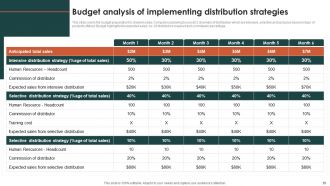
Slide 35: This slide covers the budget preparation for channel sales.
Slide 36: This slide shows the Heading for the Topics to be discussed next.
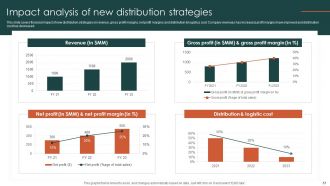
Slide 37: This slide reveals the financial impact of new distribution strategies on revenue, gross profit margins, net profit margins and distribution & logistics cost.
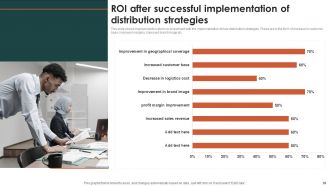
Slide 38: This slide shows improvement in return on investment with the implementation of new distribution strategies.
Slide 39: This slide mentions the Title for the Topics to be covered in the forth-coming template.
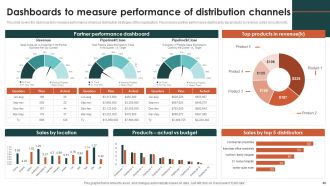
Slide 40: This slide represents the dashboards to measure performance of various distribution strategies of the organization.
Slide 41: This is the Icons slide containing all the Icons used in the plan.
Slide 42: This slide showcases the Additional information.
Slide 43: This is the About us slide for stating the Company related information.
Slide 44: This is Our team slide. State your Organization related information here.
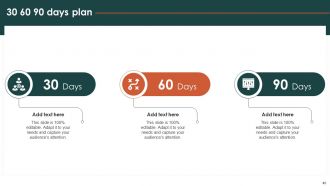
Slide 45: This slide incorporates the 30 60 90 days plan for efficient planning.
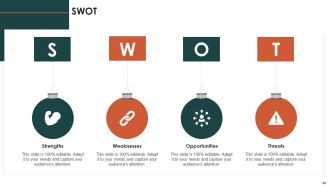
Slide 46: This slide gives information about the SWOT analysis of the Company.
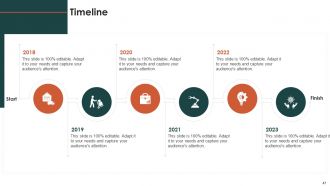
Slide 47: This slide presents the Organization's Timeline.
Slide 48: This is the Magnifying glass for minute details.
Slide 49: This slide incorporates the Post it notes for reminders and deadlines.
Slide 50: This is the Venn diagram slide for showcasing some relevant organization information.
Slide 51: This is the Thank You slide for acknowldegement.
Criteria For Selecting Distribution Channel For Effective Sales Management Powerpoint Presentation Slides with all 56 slides:
Use our Criteria For Selecting Distribution Channel For Effective Sales Management Powerpoint Presentation Slides to effectively help you save your valuable time. They are readymade to fit into any presentation structure.






















FAQs for Criteria For Selecting Distribution Channel For Effective Sales Management
Key factors include target customer preferences, product characteristics, cost structure, market reach requirements, and competitive landscape dynamics. These considerations enable businesses to optimize resource allocation, enhance customer accessibility, and maximize market penetration, with many organizations finding that strategic channel alignment ultimately delivers improved profit margins and sustainable competitive advantage.
Target market characteristics directly influence distribution channel selection through demographics, purchasing behaviors, geographic location, income levels, and technology preferences. Companies serving tech-savvy millennials increasingly favor e-commerce and mobile platforms, while businesses targeting older demographics often maintain physical retail presence, with many organizations finding that multi-channel approaches deliver broader market reach and enhanced customer satisfaction.
Product nature significantly influences distribution channels, with durable goods often utilizing longer channels through wholesalers and retailers, while perishable items require direct or short channels for rapid delivery. Companies manufacturing electronics or furniture can afford extended distribution networks, whereas fresh produce suppliers and pharmaceutical companies need streamlined channels to maintain quality and minimize spoilage, ultimately delivering faster market access.
Companies assess distribution channel cost-effectiveness by analyzing direct costs, operational expenses, customer acquisition costs, profit margins, and return on investment for each channel. Through comprehensive financial modeling, businesses evaluate shipping expenses, warehousing requirements, and channel partner commissions, while measuring reach efficiency and customer lifetime value, ultimately determining which channels deliver optimal profitability and strategic advantage.
Technology revolutionizes modern distribution channel strategies by enabling omnichannel integration, real-time inventory management, predictive analytics, and automated logistics optimization. Through AI-powered platforms and IoT tracking, retailers streamline operations, enhance customer experiences across multiple touchpoints, and reduce distribution costs, while e-commerce capabilities increasingly allow businesses to reach global markets more efficiently.
Competitors' distribution strategies significantly influence channel selection by creating market pressure to match customer accessibility, forcing differentiation through alternative channels, and establishing industry standards for service delivery. Companies often respond by adopting multi-channel approaches, targeting underserved segments, or leveraging digital platforms to bypass traditional competitors, ultimately delivering enhanced customer reach and competitive positioning.
Direct distribution channels enable complete control over customer relationships, pricing strategies, and brand messaging, while maximizing profit margins through eliminated intermediary costs. Indirect channels provide broader market reach and reduced operational complexity, with many retailers and manufacturers finding that strategic combinations of both approaches deliver optimal market penetration and resource efficiency across diverse customer segments.
Alignment between distribution channels and brand positioning is crucial for maintaining consistent customer experiences, protecting brand equity, and maximizing market impact. Luxury brands carefully select premium retail partners while mass-market companies leverage broad distribution networks, with many organizations finding that channel-brand misalignment can dilute messaging and ultimately undermine competitive positioning across target segments.
Businesses should evaluate distribution channels using revenue per channel, cost-to-serve ratios, customer acquisition costs, market reach effectiveness, and inventory turnover rates. These metrics enable organizations to identify high-performing partnerships, optimize resource allocation, and streamline operations, with many companies finding that regular channel performance analysis ultimately delivers improved profitability and enhanced competitive positioning.
Multi-channel distribution strategies enhance customer experience by providing seamless shopping options, consistent service across touchpoints, and flexible fulfillment methods like buy-online-pickup-in-store. Through strategic channel integration, retailers deliver personalized interactions, faster resolution times, and convenient access points, while banks and healthcare providers increasingly find that unified channel approaches ultimately improve satisfaction and loyalty.
Environmental factors include economic conditions, technological infrastructure, regulatory requirements, cultural preferences, and competitive landscape dynamics. These considerations enable businesses to optimize market entry strategies, ensure regulatory compliance, and adapt to local consumer behaviors, with many retail and manufacturing companies finding that environmental analysis ultimately delivers improved market penetration and sustainable competitive advantage.
Regulatory issues significantly influence channel selection by determining licensing requirements, compliance standards, operational restrictions, and market entry barriers across different jurisdictions. Companies must navigate varying regulations in sectors like pharmaceuticals, financial services, and telecommunications, often requiring specialized intermediaries or direct operations to ensure compliance, ultimately shaping distribution strategies that balance regulatory adherence with market penetration efficiency.
Partnerships with logistics providers enhance distribution efficiency by leveraging specialized expertise, advanced transportation networks, and established warehousing infrastructure. These strategic collaborations enable businesses to reduce operational costs, accelerate delivery times, and expand geographical reach, while many companies finding that outsourcing logistics allows them to focus on core competencies and achieve greater scalability.
Geographic region affects channel selection through local infrastructure capabilities, cultural preferences, regulatory requirements, and economic conditions. Companies operating across diverse markets find that rural areas may require direct sales or partnerships with local distributors, while urban regions support multiple channels, ultimately enabling businesses to optimize market penetration and customer accessibility.
Digital transformation, omnichannel integration, sustainability requirements, data-driven personalization, and direct-to-consumer expansion are reshaping distribution strategies across industries. These trends enable organizations to streamline operations, enhance customer experiences, and reduce costs, with many retail and manufacturing companies finding that strategic channel diversification ultimately delivers competitive advantage in an increasingly dynamic marketplace.
-
You know what? I'm so glad I opted for this PPT design. It has been a total game-changer for me and my presentations. Thank you!
-
Wide collection of templates available. SlideTeam has made it easier to create presentations in just a few minutes.