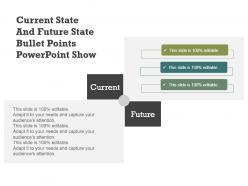
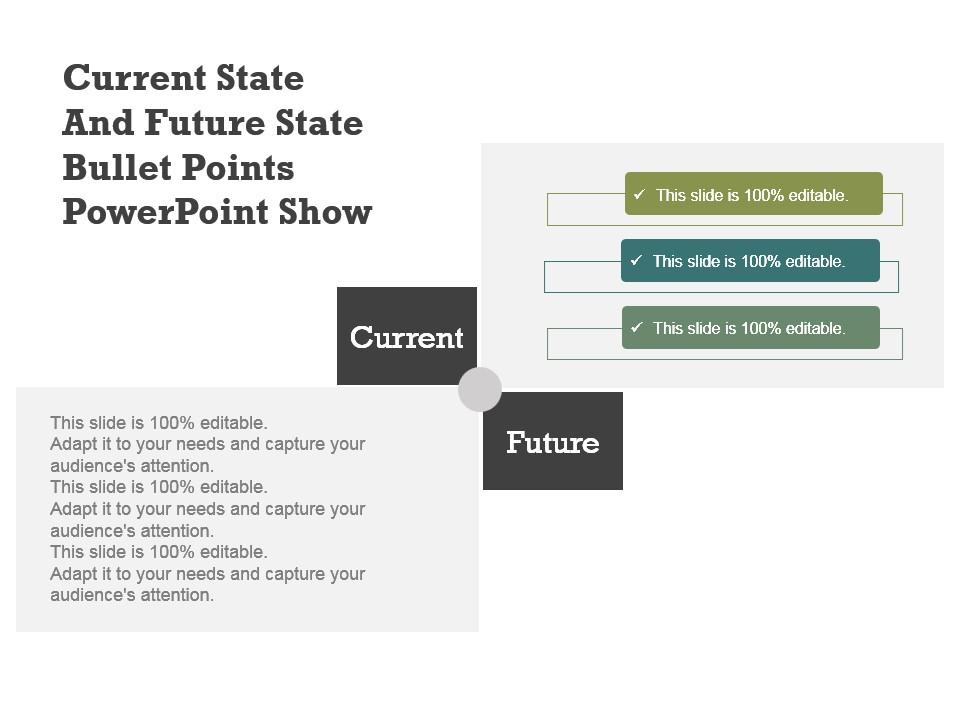
Current state and future state bullet points powerpoint show
Try Before you Buy Download Free Sample Product
Audience
Editable
of Time
Our Current State And Future State Bullet Points Powerpoint Show facilitate accurate interpretations. Be exact in your assessment of indications.
People who downloaded this PowerPoint presentation also viewed the following :
Current state and future state bullet points powerpoint show with all 6 slides:
Arouse innate desires with our Current State And Future State Bullet Points Powerpoint Show. Enable folks to indulge their childhood dreams.
FAQs for Current state and future state bullet
Successful leadership transitions depend on clear communication with stakeholders, thorough understanding of organizational culture, strategic relationship building, and early wins that demonstrate competence. These factors work together by establishing credibility, building trust, and creating momentum, with many organizations finding that leaders who focus on listening, learning, and adapting during their first 90 days ultimately deliver stronger long-term performance.
Organizations effectively manage employee expectations during transitions through transparent communication, regular updates about timelines and changes, and clear documentation of new processes and roles. By establishing feedback channels, providing comprehensive training programs, and setting realistic milestones, companies help employees navigate uncertainty while maintaining productivity, with many finding that proactive expectation management significantly reduces resistance and accelerates successful organizational transformation.
Common corporate transition pitfalls include inadequate communication planning, insufficient stakeholder engagement, rushed implementation timelines, poor change management processes, and neglecting employee training needs. These challenges often derail organizational transformations by creating resistance, confusion, and operational disruptions, with many companies finding that strategic communication and phased implementation approaches ultimately deliver smoother transitions and higher success rates.
Presentation templates support teams during transitions by providing consistent communication frameworks, standardizing change management processes, and ensuring unified messaging across all stakeholders. Through ready-made transition roadmaps, status update formats, and stakeholder alignment decks, organizations streamline change communications, reduce preparation time, and maintain professional consistency, ultimately enabling smoother transitions and better team coordination.
Visual storytelling enhances transition messaging by making complex changes more relatable, memorable, and emotionally engaging through infographics, timelines, process flows, and before-and-after comparisons. These visual elements help organizations communicate transformation journeys more effectively, with companies finding that visual narratives reduce resistance, increase stakeholder buy-in, and ultimately accelerate successful change adoption across teams.
Employee feedback serves as a critical mechanism for identifying transition challenges, gauging readiness levels, addressing concerns proactively, and refining implementation strategies in real-time. Through structured surveys, focus groups, and regular check-ins, organizations can minimize resistance, enhance buy-in, and accelerate adoption rates, with many companies finding that continuous feedback loops ultimately deliver smoother transitions and higher success rates.
Transition plans can be effectively communicated through multi-channel approaches including stakeholder meetings, detailed documentation, visual timelines, regular updates, and dedicated communication portals. These methods enhance transparency and alignment by providing clear expectations, addressing concerns proactively, and maintaining consistent messaging across departments, with many organizations finding that structured communication significantly reduces resistance and accelerates successful implementation.
Transition success metrics include timeline adherence, budget compliance, stakeholder satisfaction scores, operational efficiency improvements, and risk mitigation effectiveness. These measurements enable organizations to track progress across financial services, healthcare systems, and manufacturing operations, while identifying bottlenecks early, ensuring resource optimization, and ultimately delivering smoother transitions with measurable competitive advantages.
Technology streamlines workplace transitions by automating documentation, enabling remote collaboration tools, and providing real-time progress tracking across departments. Through cloud-based platforms and AI-powered workflows, organizations accelerate onboarding processes, minimize administrative overhead, and enhance communication transparency, with many companies finding that digital integration reduces transition timelines while improving employee experiences.
Maintaining morale during transitions requires transparent communication, employee involvement in planning processes, recognition of concerns, and celebrating small wins throughout the change journey. Organizations find success through regular feedback sessions, skills development programs, and flexible implementation timelines, while leadership visibility and honest acknowledgment of challenges, coupled with clear future vision sharing, ultimately delivers sustained engagement and smoother organizational transformation.
Transition concepts vary significantly across industries, with healthcare focusing on patient care continuity, manufacturing emphasizing production line changeovers, and financial services prioritizing system migrations and regulatory compliance shifts. These industry-specific transitions require tailored strategies, specialized technologies, and sector-appropriate change management approaches, with organizations increasingly finding that customized transition frameworks deliver smoother implementations, reduced disruption, and enhanced operational efficiency.
Best practices for transitioning project management methodologies include conducting thorough current-state assessments, securing executive sponsorship, implementing phased rollouts, providing comprehensive team training, and establishing clear success metrics. These approaches streamline adoption by minimizing resistance, ensuring stakeholder buy-in, and maintaining project continuity, with many organizations finding that pilot programs in specific departments deliver measurable improvements before company-wide implementation.
Cultural considerations significantly impact multinational transitions by influencing communication styles, decision-making processes, change acceptance rates, and employee engagement levels across different regions. Companies like Unilever and Siemens address these challenges through localized change management strategies, cultural liaison teams, and region-specific training programs, ultimately enabling smoother transitions and higher adoption rates globally.
**INPUT**: What tools can be utilized to create compelling presentations about transitions? **OUTPUT**: Transition presentation tools include PowerPoint with advanced animation features, Prezi for dynamic storytelling, Canva for visual design, Keynote for seamless transitions, and specialized platforms like Haiku Deck. These technologies streamline communication by combining data visualization, timeline creation, and interactive elements, with many organizations finding that strategic presentation design accelerates stakeholder buy-in and minimizes resistance during critical business changes.
Businesses can leverage transitions as opportunities by embracing strategic planning, investing in new technologies, diversifying operations, and fostering adaptive organizational cultures. Through restructuring initiatives, companies streamline processes, enhance operational efficiency, and identify emerging market segments, with many organizations finding that transitions ultimately deliver competitive advantages, accelerated innovation cycles, and stronger market positioning.
-
Innovative and Colorful designs.
-
Wonderful templates design to use in business meetings.