Customer Account Escalation Workflow Process

Rating:
80%
Customer Account Escalation Workflow Process Customer Account Escalation Workflow Process
Slide 1 of 6

or

Favourites Favourites

Try Before you Buy Download Free Sample Product

Audience Impress Your
Audience
Editable 100%
Editable
Time Save Hours
of Time
The Biggest Sale is ending soon in
0
0
:
0
0
:
0
0
Rating:
80%
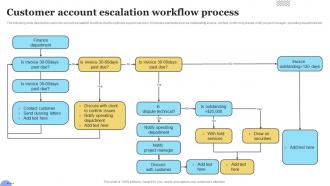
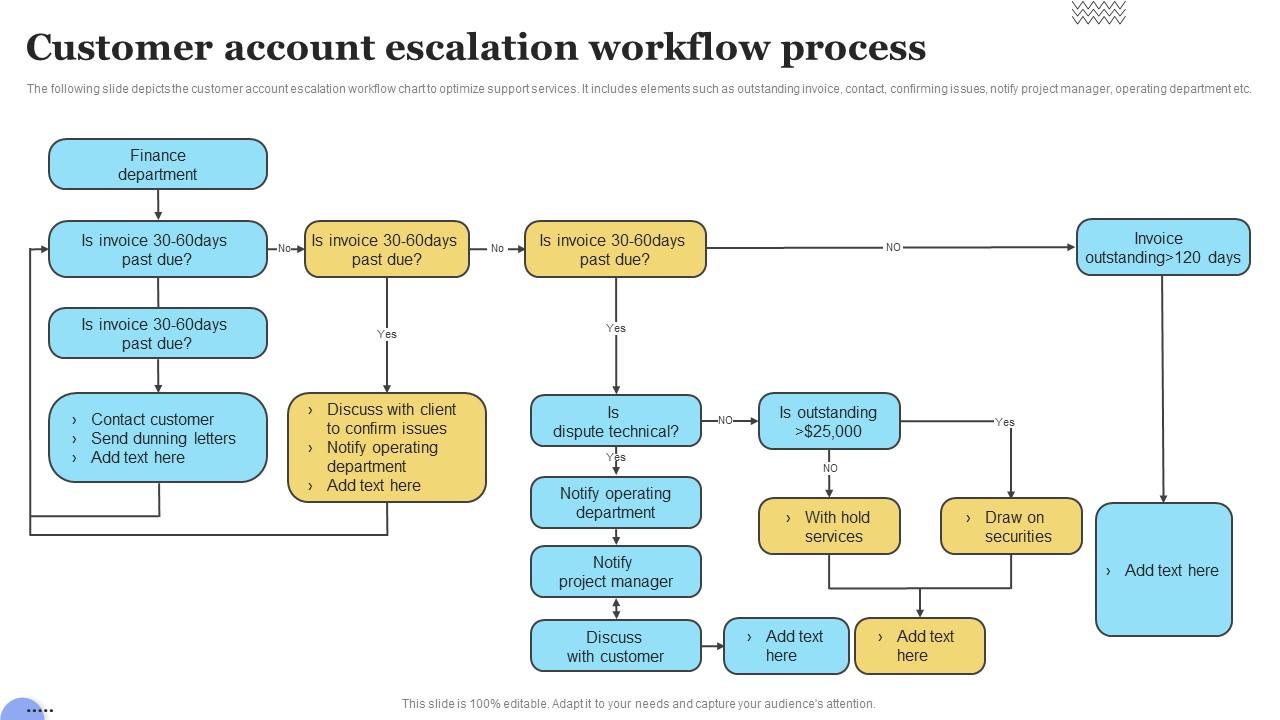
The following slide depicts the customer account escalation workflow chart to optimize support services. It includes elements such as outstanding invoice, contact, confirming issues, notify project manager, operating department etc. Presenting our well structured Customer Account Escalation Workflow Process. The topics discussed in this slide are Finance Department, Operating Department, Project Manager. This is an instantly available PowerPoint presentation that can be edited conveniently. Download it right away and captivate your audience.
FAQs for Customer Account

Key indicators include repeated service failures, escalating complaint severity, threats to terminate contracts, requests for senior management involvement, and significant financial impact disputes. These warning signs enable customer success teams to intervene proactively, preventing account churn and relationship deterioration, with many organizations finding that early escalation protocols ultimately deliver higher retention rates and stronger client partnerships.

Customer issue escalation levels are determined by assessing severity impact, urgency timeframes, customer tier status, potential revenue implications, and resource requirements needed for resolution. Financial services and healthcare organizations typically use matrix-based frameworks that evaluate factors like service disruption scope, regulatory compliance risks, and customer relationship value, ultimately enabling faster resolution pathways while preserving strategic accounts.

Effective communication during customer account escalation requires immediate acknowledgment of the issue, clear timeline establishment, regular progress updates, and designated point-of-contact assignment. These protocols streamline resolution by maintaining transparency, setting realistic expectations, and ensuring accountability throughout the process, with many organizations finding that structured communication frameworks significantly reduce resolution time while enhancing customer trust and satisfaction.

Technology streamlines customer account escalation through automated routing systems, AI-powered issue classification, real-time tracking dashboards, and predictive analytics that identify potential problems before they escalate. These solutions enable faster resolution times, improved customer satisfaction, and reduced operational costs, with many financial institutions and service providers finding that automated escalation workflows deliver significantly enhanced customer experiences while minimizing manual intervention requirements.

Customer service representatives should receive training in de-escalation techniques, active listening skills, emotional intelligence, conflict resolution strategies, and product knowledge mastery. Through role-playing scenarios and communication workshops, representatives develop empathy-driven approaches, solution-focused thinking, and decision-making authority, with many organizations finding that comprehensive escalation training reduces resolution times while significantly improving customer satisfaction and retention rates.

Businesses can measure escalation success through resolution time metrics, customer satisfaction scores, escalation volume trends, first-call resolution rates, and cost-per-case analysis. These measurements enable organizations to identify bottlenecks, optimize resource allocation, and enhance service quality, with many companies finding that systematic tracking ultimately delivers faster resolutions and improved customer retention.

Customer account escalations commonly stem from unresolved billing disputes, service outages, delayed response times, product defects, and miscommunication between support teams. These issues can be prevented by implementing proactive monitoring systems, establishing clear communication protocols, training support staff comprehensively, and creating escalation pathways that address concerns quickly, ultimately delivering improved customer satisfaction and reduced operational costs.

Feedback from escalated accounts reveals critical service gaps, identifies recurring pain points, and highlights process inefficiencies that impact customer satisfaction. This strategic intelligence enables organizations to enhance training programs, streamline resolution procedures, and proactively address systemic issues, with many companies finding that incorporating escalation insights ultimately reduces future complaints while delivering improved customer experiences and operational efficiency.

Empathy plays a crucial role in resolving escalated customer accounts by building trust, demonstrating understanding, and de-escalating emotional tensions through active listening and acknowledgment of concerns. This approach enables customer service teams to uncover root issues, foster collaborative problem-solving, and transform frustrated customers into loyal advocates, ultimately reducing churn rates and enhancing long-term business relationships.

Businesses ensure prompt escalation handling through clear escalation protocols, dedicated response teams, automated routing systems, defined SLAs, and real-time tracking dashboards. These frameworks streamline case prioritization by urgency level, customer tier, and issue complexity, while enabling specialized teams in sectors like banking and telecommunications to resolve critical issues faster, ultimately delivering improved customer retention and operational efficiency.

Customer escalation documentation best practices include detailed incident recording, clear timeline tracking, root cause analysis, resolution steps documentation, and stakeholder communication logs. These comprehensive records enhance organizational learning by identifying recurring issues, streamline future escalation handling, and ultimately deliver improved customer experiences and operational efficiency, with many service teams finding that structured documentation reduces resolution times significantly.

Cross-departmental collaboration improves escalated account outcomes by pooling specialized expertise, accelerating problem resolution, and ensuring comprehensive customer solutions across technical, billing, and service domains. When sales, support, technical, and management teams coordinate seamlessly, organizations deliver faster resolution times, reduce customer churn, and transform potentially damaging situations into relationship-strengthening opportunities, ultimately enhancing retention rates.

Key metrics include Net Promoter Score, Customer Satisfaction scores, resolution time, first-call resolution rates, and customer retention percentages. These measurements enable organizations to assess service recovery effectiveness, identify process improvements, and enhance future customer experiences, with many companies finding that systematic post-escalation tracking ultimately delivers stronger customer loyalty and operational efficiency.

Customer account escalation policies align with company ethos by embedding core values into resolution frameworks, ensuring consistent brand representation, and training teams to reflect organizational principles during challenging interactions. Through values-based decision matrices and empowerment guidelines, companies like retail chains and financial services create seamless customer experiences that reinforce their mission, ultimately building stronger relationships and competitive differentiation.

Frequent escalations reveal critical gaps in product design, service delivery, training protocols, and communication channels, providing valuable data for systematic improvements. Companies increasingly find that analyzing escalation patterns enables them to identify root causes, enhance quality control processes, streamline customer touchpoints, and proactively address issues before they impact broader customer satisfaction and retention.

Ratings and Reviews

80% of 100
Review Form
Write a review
Most Relevant Reviews
  1. 80%

    by Diego Gardner

    Exclusive and extensive collection of templates. Really helped me create a professional presentation in just no time.
  2. 80%

    by Curtis Herrera

    Great product with effective design. Helped a lot in our corporate presentations. Easy to edit and stunning visuals.

2 Item(s)

per page: