Customer Support Services Portfolio For Solving Issues

Rating:
90%
Customer Support Services Portfolio For Solving Issues
Slide 1 of 6
Favourites Favourites

Try Before you Buy Download Free Sample Product

Audience Impress Your
Audience
Editable 100%
Editable
Time Save Hours
of Time
The Biggest Sale is ending soon in
0
0
:
0
0
:
0
0
AI-Ready
Upload this template to AI and ask it to make any changes to content or color
100% editable Powerpoint Template for AI-assisted presentations. Finish your work in less time. ​
Works with
Microsoft PowerPoint
Microsoft 365
Claude for PowerPoint
ChatGPT
Google Slides
Microsoft Copilot
Rating:
90%
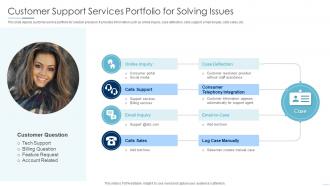
This slide depicts customer service portfolio for solution provision. It provides information such as online inquiry,case deflection,calls support,email enquiry,calls sales,etc. Introducing our Customer Support Services Portfolio For Solving Issues set of slides. The topics discussed in these slides are Consumer Telephony Integration, Email Inquiry, Online Inquiry, Consumer Portal, Social Media. This is an immediately available PowerPoint presentation that can be conveniently customized. Download it and convince your audience.

FAQs for Customer Support Services Portfolio

Honestly, customer support is where your brand's true colors show. People forget ads, but they'll never forget how you made them feel when they had a problem. Bad support? They're done with you forever - we've all been there. But here's the thing: when you actually solve someone's issue without making them jump through hoops, they become your biggest fans. They'll literally defend you on social media and tell everyone they know. Don't just train your team to read scripts though. Give them real power to fix things. That's what separates good companies from the ones people actually love.

Set up a proper feedback system - surveys, support tickets, actual conversations with customers. Then here's the thing most people mess up: actually look for patterns instead of just collecting dust. I was shocked when I finally categorized our complaints and found 60% were literally the same three problems we kept ignoring. Group the recurring stuff by how often it happens and how much it hurts people. Fix those first. Oh, and don't forget to tell customers "hey, you complained about X so we changed Y" - they love knowing you listened. Make it regular, not some once-a-year thing.

Focus on response time, resolution time, CSAT scores, and first-contact resolution - those are your bread and butter. Response time is just how fast you reply to tickets. Resolution time tracks how long the actual fix takes. CSAT surveys show if customers are happy, but honestly don't spam them with surveys every five seconds. First-contact resolution is clutch because nobody wants to repeat their story three times to different agents. Oh, and track ticket volume trends too - helps you see what's coming. These four will get you started without drowning in data.

Look, start small with one automation tool instead of going crazy with everything at once. Chatbots and knowledge bases handle the basic stuff so your team isn't answering "how do I reset my password" for the millionth time. Routing tickets automatically saves tons of time too - no more manually sorting through everything. The AI response suggestions are actually getting scary good these days. Real-time dashboards help you catch problems early, which is clutch. Honestly though, the repetitive task automation is probably where you'll notice the biggest difference right away.

Honestly, start with product knowledge - your team can't help anyone if they don't know what they're selling. Communication skills are massive too, especially learning how to read different personality types. Throw in some conflict resolution training because, let's be real, angry customers are inevitable. Don't skip the technical stuff either - there's nothing more frustrating than watching someone fumble around their own system. Active listening and empathy training make a huge difference since people mostly just want to feel heard. Oh, and basic sales skills help too since support calls are perfect for upselling opportunities.

Honestly, automation works best for the boring stuff - FAQs, tracking orders, basic troubleshooting. That way your actual team can handle the messy situations that need real problem-solving. But here's where companies screw up: they automate everything and make it impossible to reach a human. Super frustrating. Your chatbot should kick people to a real person the second things get weird or complicated. Oh, and don't bury your contact info either. The goal is quick answers for simple questions, but actual help when someone's dealing with something unique.

Honestly, the worst part is when ticket volumes just explode and your team can't keep up. Customers hate waiting forever, and your agents are scrambling to fix complicated stuff fast. What really gets people mad though? When they get totally different answers depending on who they talk to. Your knowledge base is probably outdated too - mine always was. Plus those clunky systems that make everything take twice as long. There's always this pressure to be quick but thorough, which is basically impossible. Don't try fixing everything at once though. Check your response times first, figure out what's really broken, then tackle those issues. Way less overwhelming that way.

Check your analytics first to see what languages pop up most. Then get native speakers or solid translation services for those - don't just rely on Google Translate, it's still pretty clunky with cultural stuff. Set up separate channels so people can actually reach someone who speaks their language properly. Cultural training matters too since some cultures are super direct while others are way more roundabout. Honestly, I'd start with maybe 2-3 languages and see how it goes before expanding. Way easier than trying to do everything at once.

Quick responses totally make or break customer satisfaction - like, you can literally double your scores just by getting back to people within an hour instead of waiting till the next day. Speed equals caring in customers' minds, which is kinda unfair but whatever. Even if you can't fix their issue right away, just hitting them back with "hey, saw this, digging into it now" works wonders. Makes them feel heard, you know? I'd aim for 2-4 hours max on most stuff. But honestly? The faster the better - I've watched so many "perfect" responses fall flat because they came too late.

So basically, pick whatever platform your customers actually use most - Twitter's usually good for this. Set up alerts for your brand name so you're not missing complaints. The thing is, people expect way faster responses on social than email, which honestly makes sense. Train your team to handle public complaints well since everyone's watching. I'd start with just one platform first rather than spreading yourself thin everywhere. Oh and definitely make dedicated support accounts instead of using your main marketing ones - keeps things cleaner. Quick responses really do make a huge difference here.

Dude, start with a chatbot - total game changer for handling basic stuff 24/7. Your team gets to focus on the tricky problems instead. Live chat with co-browsing is wild, you can literally see their screen while helping them. Video support works amazing for technical stuff too. Way easier to show someone than explain it, you know? Self-serve knowledge bases are clutch now with better search. Though honestly, half the time people still don't use them lol. But seriously, get chatbot + live chat going first. Those two will completely change how your support feels to customers.

Oh man, this stuff is so key for customer service! Younger people want chat and self-help options - they'll bounce if you make them call. Older customers? They actually prefer talking to someone and need more detailed explanations. Income matters too since budget shoppers need totally different solutions than your premium customers. Tech-savvy people get super annoyed if you walk them through basic stuff, but you've got to slow way down for less technical folks. Cultural backgrounds change everything about communication style and how fast people expect responses. Honestly, it's like being a chameleon - you need different approaches for different types of people.

Honestly, just shut up and listen first - let them vent completely without jumping in. Once they're done, acknowledge how frustrated they must be. Don't get defensive even if it wasn't your screw-up (I've watched so many people tank it right here). Own the problem and focus on fixing it, not making excuses. Give them a realistic timeline for when you'll sort it out. The follow-up call is huge - most reps skip this but it's what turns angry customers into loyal ones. Weird how complaints can actually make relationships stronger if you handle them right.

So instead of just fixing problems one-by-one, try getting your customers talking to each other. Forums work great for this - people love helping others with similar issues. I've noticed the best support teams actually turn tickets into group conversations sometimes. Highlight when customers come up with clever solutions and put those in your help docs. Success stories are gold too. The whole thing shifts from you solving everything to users teaching each other. Honestly, once people start connecting over shared problems, half your work does itself. Start with your most common questions and build spaces around those.

Dude, AI automation is everywhere now - customers basically expect flawless support across every platform they touch. Chatbots handle the boring stuff while actual humans deal with complicated problems. Personalization matters big time too since people want reps who already know their story. Oh and video support is blowing up way faster than I expected. Real-time messaging obviously. Here's what I'd do: mess around with AI tools now but don't go overboard. The human element still separates amazing support from just... robotic nonsense that pisses everyone off.

Ratings and Reviews

90% of 100
Review Form
Write a review
Most Relevant Reviews
  1. 80%

    by Damien Murray

    You know what? I'm so glad I opted for this PPT design. It has been a total game-changer for me and my presentations. Thank you! 
  2. 100%

    by Doyle Andrews

    “I always have a wonderful experience with SlideTeam. It's my ""go to"" when I need a template.”

2 Item(s)

per page: