Customer value proposition model ppt diagram
Try Before you Buy Download Free Sample Product
Audience
Editable
of Time
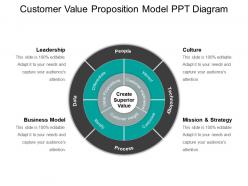
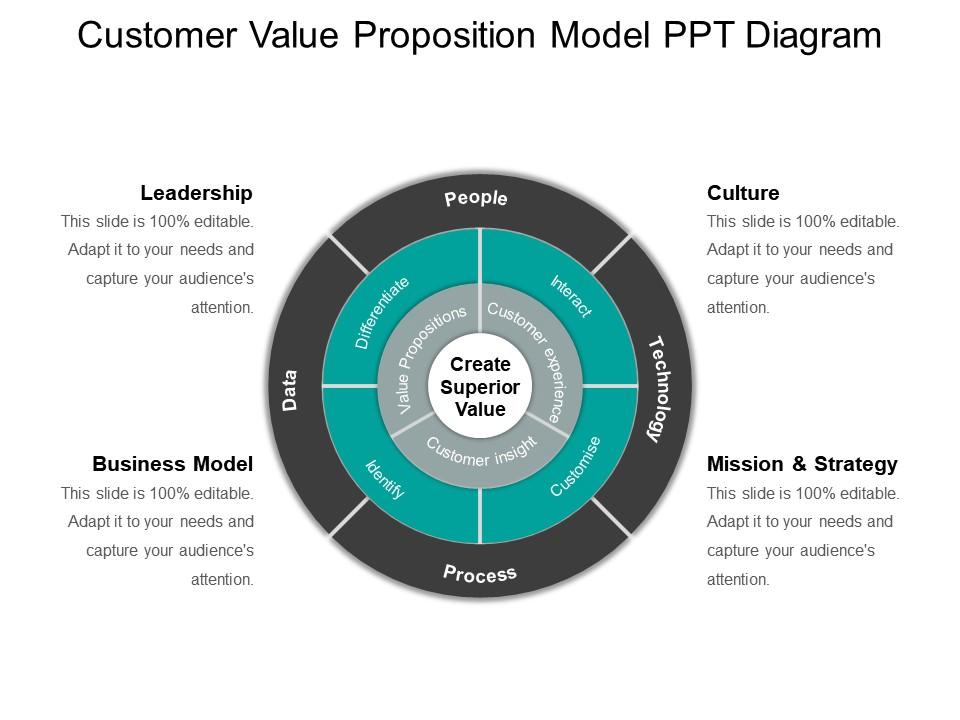
Embrace your thoughts with our customer value proposition model PPT diagram. Include all the benefits, services you have included in the return to customer's associated payment through the help of this PPT slide. Circular patterns are shown here in the design to convey your client value proposition and benefits through a four-stage process. Four key factors included here are, culture, leadership, business model, mission & strategy. Determine your business operations and internal/external queries using our customer value proposition layout. Present your business and marketing related exhibitions a bold edge, click download now and get started with our customer value proposition model PPT diagram. You use visual aid to stimulate the interest of your audience, help them understand complex data and keep their attention. However, it has to be done right and we do it right with our Customer Value Proposition Model Ppt Diagram
People who downloaded this PowerPoint presentation also viewed the following :
Customer value proposition model ppt diagram with all 5 slides:
Guide the frontrunners with our Customer Value Proposition Model Ppt Diagram. Enable them to indulge in free and fair competition.
FAQs for Customer value proposition
Customer Value Proposition is a strategic statement that clearly articulates the unique benefits, solutions, and outcomes a company delivers to specific customer segments, differentiating it from competitors. It's critical because it drives customer acquisition, retention, and pricing power by communicating tangible value, with successful companies like Apple and Amazon leveraging compelling CVPs to command premium positioning, streamline marketing efforts, and ultimately achieve sustainable competitive advantage in increasingly crowded markets.
Businesses can effectively identify their target audience through market research, customer surveys, demographic analysis, behavioral data examination, and competitor assessment. These methods enable organizations to understand customer pain points, preferences, and purchasing patterns across different segments like retail, healthcare, or financial services, ultimately delivering more personalized value propositions and competitive advantage.
A compelling Customer Value Proposition includes clear target customer identification, specific pain points addressed, unique benefits delivered, quantifiable value metrics, and competitive differentiation elements. These components work together by establishing customer relevance, demonstrating measurable outcomes, and communicating distinct advantages, with many organizations finding that well-crafted propositions significantly enhance conversion rates and customer acquisition.
Businesses can differentiate their CVP in saturated markets by focusing on unique customer pain points, leveraging personalization through data analytics, emphasizing sustainability or social responsibility, and creating exclusive service experiences. Through strategic positioning and innovative delivery methods, companies like Netflix with personalization algorithms or Patagonia with environmental commitment achieve competitive advantage, ultimately building stronger customer loyalty and market positioning.
Customer feedback plays a crucial role in validating, refining, and evolving your CVP by revealing gaps between perceived and actual value delivery, uncovering unmet needs, and identifying messaging that resonates most effectively. Through surveys, interviews, and behavioral analytics, companies can iterate their value propositions based on real customer experiences, with many organizations finding that feedback-driven CVP refinements significantly improve conversion rates and customer satisfaction.
Visual presentation templates enhance CVP communication by providing structured frameworks, consistent messaging formats, clear value hierarchies, compelling data visualization, and professional design elements. These templates streamline complex value propositions into digestible formats, enabling sales teams and executives to deliver more persuasive presentations while ensuring brand consistency, ultimately improving stakeholder understanding and accelerating decision-making processes across client interactions.
Companies should track metrics including customer acquisition cost, conversion rates, customer lifetime value, Net Promoter Score, and retention rates to measure CVP effectiveness. These metrics enable organizations to assess market resonance, competitive positioning, and revenue impact, with many finding that tracking customer satisfaction alongside acquisition data ultimately delivers comprehensive insights into value proposition performance and strategic market advantage.
A strong CVP influences customer loyalty by clearly communicating unique value, addressing specific pain points, and differentiating from competitors through compelling benefits and outcomes. When customers understand exactly how a product solves their problems and delivers superior value, they develop stronger emotional connections and repeat purchase behaviors, with many businesses finding that well-articulated CVPs reduce churn rates significantly while increasing lifetime customer value.
A CVP aligns with brand strategy by ensuring consistent messaging, reinforcing core brand values, and differentiating market positioning across all customer touchpoints. This strategic alignment enables companies to build stronger brand recognition, enhance customer loyalty, and create cohesive experiences, with many organizations finding that integrated CVP-brand strategies ultimately deliver competitive advantage and sustained market presence.
Companies commonly make mistakes like creating generic, feature-focused propositions instead of benefit-driven messages, failing to differentiate from competitors, and not aligning their CVP with actual customer needs or pain points. These missteps often result from insufficient market research, internal assumptions rather than customer insights, and lack of testing across different segments, ultimately delivering weak positioning that fails to resonate with target audiences.
Businesses can iterate their CVP through continuous market research, customer feedback analysis, competitive monitoring, and performance metrics evaluation. These adaptive strategies enable companies to refine messaging, adjust value offerings, and realign positioning, with many organizations finding that regular CVP updates deliver enhanced market relevance and sustained competitive advantage.
Successful Customer Value Propositions include Amazon's "Earth's Most Customer-Centric Company" emphasizing convenience and selection, Apple's seamless ecosystem integration, Netflix's personalized entertainment on-demand, and Tesla's sustainable luxury performance. These propositions deliver competitive advantage by clearly differentiating offerings, addressing specific customer pain points, and consistently communicating unique value, with many organizations finding that focused messaging drives customer loyalty and market positioning.
Storytelling techniques enhance CVP presentation by creating emotional connections through customer journey narratives, problem-solution arcs, and relatable character scenarios that demonstrate value propositions. These approaches transform abstract benefits into compelling stories, with companies like Airbnb and Slack finding that narrative-driven presentations increase audience engagement, improve message retention, and ultimately deliver stronger stakeholder buy-in across organizations.
Technology plays a crucial role in modernizing CVPs through data analytics, AI-driven personalization, automation platforms, and real-time customer insights systems. These technologies enable organizations to deliver highly targeted value propositions by streamlining customer interactions, enhancing service delivery, and automating personalized experiences, ultimately creating competitive advantage and stronger customer relationships.
Small businesses can create impactful CVPs by focusing on their unique strengths, deeply understanding target customer pain points, and crafting clear, specific value statements that highlight their competitive advantages. By leveraging personal customer relationships, niche expertise, and agile service delivery, small businesses often deliver more personalized experiences than larger competitors, ultimately creating stronger customer loyalty and market differentiation.
-
Great designs, Easily Editable.
-
Appreciate the research and its presentable format.
-
Topic best represented with attractive design.
-
Use of icon with content is very relateable, informative and appealing.