

Cyber Incident Report Template Flowchart For Quality Assurance




Try Before you Buy Download Free Sample Product
 Impress Your
 Audience
 100%
100% Editable
 Save Hours
 of Time


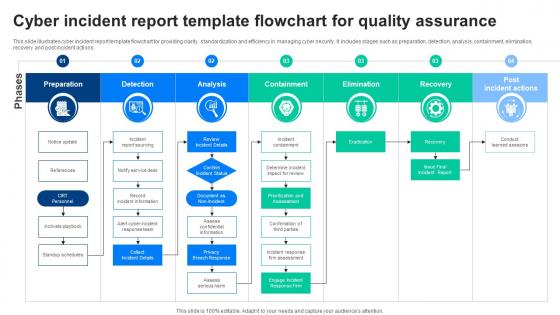
This slide illustrates cyber incident report template flowchart for providing clarity, standardization and efficiency in managing cyber security. It includes stages such as preparation, detection, analysis, containment, elimination, recovery and post incident actions.
People who downloaded this PowerPoint presentation also viewed the following :
Cyber Incident Report Template Flowchart For Quality Assurance with all 9 slides:
Use our Cyber Incident Report Template Flowchart For Quality Assurance to effectively help you save your valuable time. They are readymade to fit into any presentation structure.








FAQs for Cyber Incident Report Template Flowchart
A comprehensive cyber incident report template should include incident classification and severity level, detailed timeline of events, affected systems and data types, initial response actions taken, and stakeholder notification records. These components enable organizations to streamline incident documentation, enhance regulatory compliance, and improve future response protocols, with many financial institutions and healthcare providers finding that standardized templates significantly reduce response times while ensuring thorough forensic analysis.
Organizations ensure regulatory compliance by aligning their cyber incident report templates with specific frameworks like NIST, ISO 27001, GDPR, and industry regulations such as HIPAA or PCI DSS. These templates must include mandatory fields for incident classification, timeline documentation, impact assessment, and remediation steps, with many financial services and healthcare organizations finding that standardized reporting frameworks streamline audits while ensuring comprehensive regulatory coverage.
A timeline provides chronological documentation of attack progression, response actions, containment measures, and recovery steps, enabling precise incident reconstruction and forensic analysis. This detailed sequence helps organizations identify response gaps, improve future protocols, and demonstrate regulatory compliance, while providing stakeholders with clear visibility into incident impact, resolution timeframes, and the effectiveness of security measures deployed.
A cyber incident report template standardizes documentation by capturing attack vectors, response timelines, system vulnerabilities, and recovery procedures, enabling thorough post-incident analysis. This structured approach helps organizations identify patterns across incidents, strengthen security protocols, and develop targeted prevention strategies, with many financial institutions and healthcare providers finding that consistent reporting ultimately reduces response times and prevents similar breaches.
The incident description should include the attack vector used, systems or data compromised, timeline of events from detection to containment, scope of impact across affected departments, and initial assessment of damage or unauthorized access. This comprehensive documentation enables security teams to understand the full breach methodology, assess organizational vulnerabilities, and develop targeted remediation strategies, while providing stakeholders with clear incident impact visibility.
Organizations can customize cyber incident report templates by incorporating industry-specific compliance requirements, threat landscapes, regulatory reporting standards, asset classifications, and stakeholder communication protocols. Financial institutions emphasize data breach notifications and regulatory timelines, while healthcare organizations focus on HIPAA compliance and patient data protection, with many finding that tailored templates streamline incident response and enhance regulatory adherence.
Stakeholder communication ensures cyber incident report templates capture comprehensive information requirements from IT teams, legal departments, executives, and regulatory bodies, while maintaining clarity for diverse audiences. Effective templates balance technical detail with executive summaries, enabling seamless information flow during crisis situations, with many organizations finding that pre-defined communication protocols significantly reduce response times and enhance regulatory compliance.
Visual elements enhance cyber incident reports by incorporating timeline graphics, network diagrams, attack flow charts, impact assessment matrices, and data visualization dashboards. These components streamline complex technical information into digestible formats, enabling faster executive decision-making and clearer stakeholder communication, with many organizations finding that visual reports accelerate incident response times and improve strategic cybersecurity planning.
Common mistakes include using overly technical jargon that hinders stakeholder understanding, omitting crucial timeline documentation fields, failing to establish clear escalation pathways, and neglecting to include business impact assessments alongside technical details. Organizations should ensure their templates balance comprehensive data collection with usability, while incorporating standardized severity classifications and communication protocols, ultimately enabling faster incident resolution and more effective post-incident analysis across security teams.
Measuring cyber incident report effectiveness involves analyzing response time metrics, stakeholder feedback quality, process improvement outcomes, and compliance adherence rates. Organizations typically track how quickly teams can execute response procedures, assess communication clarity among departments, and evaluate whether reports enable faster threat containment, ultimately delivering reduced recovery costs and enhanced security posture across future incidents.
Organizations can ensure timely incident reports by establishing clear reporting timelines, pre-defined escalation procedures, automated notification systems, designated response teams, and standardized templates that streamline documentation processes. These practices enable faster incident containment and regulatory compliance, with many financial services and healthcare institutions finding that automated workflows reduce reporting time by 60-70%, ultimately delivering improved security posture and stakeholder confidence.
Cyber incident report templates should be reviewed and updated quarterly or bi-annually, with immediate updates following significant security incidents, regulatory changes, or organizational restructuring. This regular maintenance ensures templates capture evolving threat landscapes, comply with current regulations, and reflect updated response procedures, with many security teams finding that frequent reviews significantly improve incident documentation accuracy and regulatory compliance.
Tools for creating cyber incident report templates include Microsoft Word, Google Docs, ServiceNow, JIRA Service Management, and specialized platforms like IBM Resilient or Splunk Phantom. These solutions streamline incident documentation by automating data collection, enabling real-time collaboration, and integrating with security systems, with many organizations finding that template-driven approaches significantly reduce response times while ensuring comprehensive reporting consistency.
Addressing sensitive information requires strategic redaction techniques, role-based access controls, executive summaries with varying detail levels, and clear classification protocols that separate technical findings from confidential data. Organizations typically create tiered reporting structures where stakeholders receive information appropriate to their clearance level, while incident response teams maintain comprehensive internal documentation, ultimately delivering transparency without compromising security protocols or regulatory compliance requirements.
Staff responsible for incident reporting require training in threat identification, evidence documentation procedures, timeline reconstruction methods, and regulatory compliance requirements. Through comprehensive cybersecurity awareness programs, personnel learn to accurately assess incident severity, preserve digital forensics, and communicate technical details clearly, ultimately enabling faster response times and more effective security measures across the organization.
-
Easily Understandable slides.
-
Extensive range of templates! Highly impressed with the quality of the designs.