Cyber Security Incident Response Framework For Performance Enhancement
Try Before you Buy Download Free Sample Product
Audience
Editable
of Time
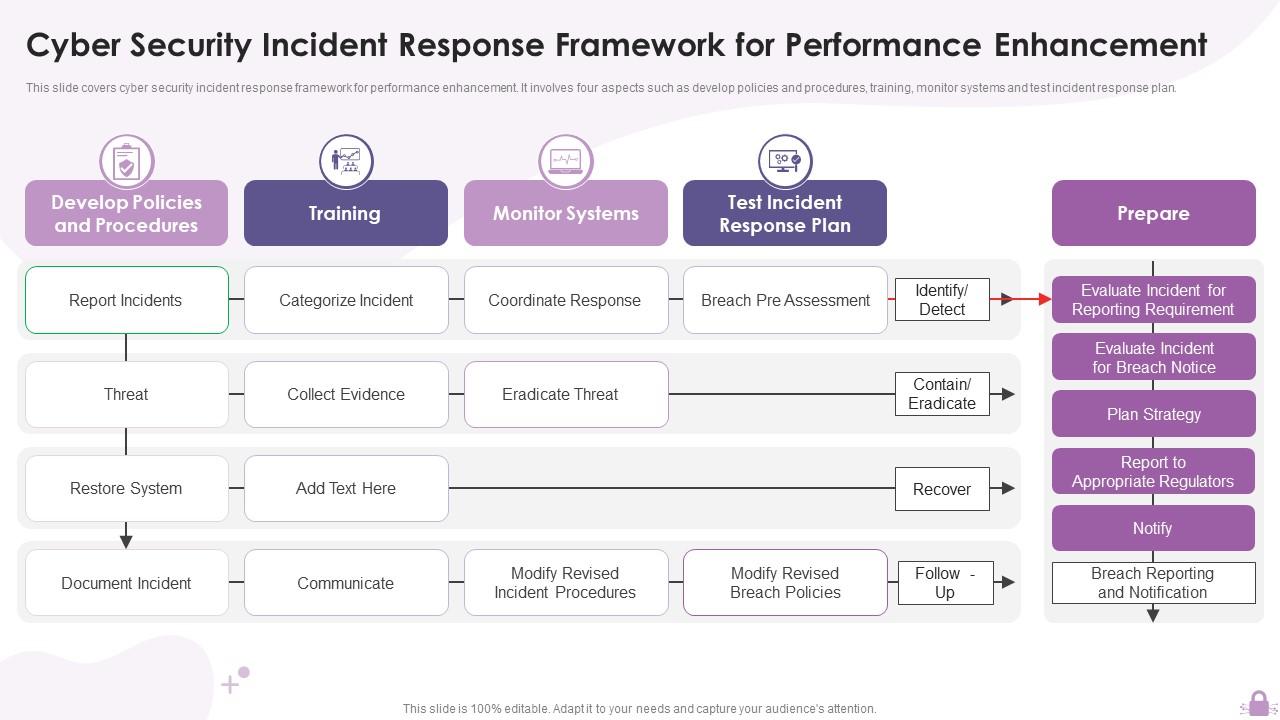
This slide covers cyber security incident response framework for performance enhancement. It involves four aspects such as develop policies and procedures, training, monitor systems and test incident response plan.
People who downloaded this PowerPoint presentation also viewed the following :
Cyber Security Incident Response Framework For Performance Enhancement with all 6 slides:
Use our Cyber Security Incident Response Framework For Performance Enhancement to effectively help you save your valuable time. They are readymade to fit into any presentation structure.
FAQs for Cyber Security Incident Response Framework
**INPUT**: What are the key components of an effective Cyber Security Incident Response Framework? **OUTPUT**: An effective Cyber Security Incident Response Framework includes preparation protocols, detection mechanisms, containment strategies, eradication procedures, and recovery processes. These components streamline organizational responses by establishing clear communication channels, defining roles and responsibilities, and enabling rapid threat mitigation, with many enterprises finding that structured frameworks significantly reduce breach impact and recovery time. **Word count: 55 words**
Incident response frameworks adapt through specialized containment strategies, communication protocols, and recovery procedures tailored to each threat type's unique characteristics and business impact. While malware incidents focus on system isolation and forensic analysis, ransomware responses prioritize backup restoration and negotiation considerations, and data breaches emphasize regulatory compliance and customer notification, with many organizations finding that flexible frameworks enable faster threat neutralization and minimize operational disruption.
Communication protocols serve as the backbone of incident response by establishing clear escalation paths, stakeholder notification procedures, internal team coordination methods, and external reporting requirements. These structured frameworks enable organizations to maintain operational continuity during breaches, ensure regulatory compliance, and preserve stakeholder confidence, with many finding that well-defined protocols significantly reduce response times and minimize business disruption.
Organizations ensure current incident response plans through regular threat intelligence integration, quarterly plan reviews, continuous staff training, and post-incident analysis updates. By incorporating emerging attack vectors from sectors like healthcare and financial services, conducting tabletop exercises, and collaborating with industry peers, companies maintain effective defenses while adapting to evolving threats, ultimately delivering stronger security postures.
**INPUT**: What are best practices for establishing a Security Operations Center (SOC) to handle incident response effectively? **OUTPUT**: Best practices for establishing an effective SOC include implementing 24/7 monitoring capabilities, deploying automated threat detection tools, establishing clear escalation procedures, maintaining updated incident playbooks, and ensuring skilled analyst staffing. These foundational elements streamline threat identification and response coordination, with many financial institutions and healthcare organizations finding that centralized SOC operations reduce incident response times by 40-60%, ultimately delivering enhanced security posture and regulatory compliance. [Word count: 58 words]
Employee training and awareness are fundamental to incident response effectiveness, as human error causes approximately 95% of cybersecurity breaches, making staff the first line of defense. Through regular simulations, phishing awareness programs, and response protocols, organizations significantly reduce incident frequency and response times, with many financial institutions and healthcare providers finding that well-trained employees detect threats 200% faster than untrained staff.
Organizations should monitor metrics including mean time to detection, mean time to containment, incident recurrence rates, recovery time objectives, and cost per incident. These measurements enable security teams to identify process gaps, optimize resource allocation, and demonstrate ROI to stakeholders, with many enterprises finding that comprehensive metrics tracking reduces future incident impact by 40-60%.
Businesses integrate threat intelligence into incident response frameworks by establishing automated feeds, creating threat-specific playbooks, and implementing real-time correlation systems that match incoming threats against known indicators. This strategic combination enables security teams to prioritize incidents more effectively, reduce response times, and proactively defend against emerging attack patterns, ultimately delivering faster containment and enhanced organizational resilience.
Common challenges include delayed detection, inadequate communication protocols, insufficient skilled personnel, poor documentation practices, and lack of predefined response procedures. These obstacles can be mitigated by implementing automated monitoring systems, establishing clear communication channels, conducting regular training programs, and developing comprehensive incident playbooks, ultimately enabling faster containment and reduced business impact.
Organizations should document incident response activities through detailed logs, timeline records, communication tracking, evidence preservation, and decision rationale for each phase. These comprehensive documentation practices enable regulatory compliance, support forensic analysis, and facilitate post-incident reviews, with many security teams finding that structured documentation ultimately streamlines future response efforts and demonstrates due diligence to auditors.
Essential tools include SIEM platforms, endpoint detection and response systems, network monitoring solutions, forensic analysis software, and automated orchestration platforms. These technologies streamline incident detection, containment, and recovery by providing real-time threat visibility, automated response workflows, and comprehensive forensic capabilities, with many organizations finding that integrated toolsets significantly reduce response times and enhance overall security posture.
The incident response lifecycle integrates with cybersecurity governance through risk assessment alignment, policy enforcement, compliance monitoring, and strategic decision-making frameworks. This integration enables organizations to transform security incidents into governance insights, strengthen risk management protocols, and enhance board-level visibility into cyber resilience, with many enterprises finding that coordinated incident response ultimately delivers improved regulatory compliance and competitive security positioning.
Legal considerations during incident response include breach notification requirements, data protection compliance, evidence preservation, regulatory reporting, and cross-border data transfer restrictions. Organizations must balance swift containment with legal obligations, especially in regulated sectors like healthcare and finance, while maintaining forensic integrity and coordinating with law enforcement, ultimately ensuring compliance protects both customers and competitive positioning.
Organizations incorporate lessons learned by conducting thorough post-incident reviews, updating response procedures based on identified gaps, and integrating new threat intelligence into their frameworks. These improvements enhance detection capabilities, streamline communication protocols, and strengthen recovery processes, with many financial institutions and healthcare organizations finding that systematic lesson integration reduces response times and minimizes future impact.
External stakeholders, including law enforcement agencies, regulatory bodies, legal counsel, and cybersecurity vendors, provide critical expertise, regulatory compliance guidance, and investigative support during incident response. These partnerships enable organizations to navigate complex legal requirements, coordinate with federal investigations, and access specialized forensic capabilities, while ensuring proper breach notifications and regulatory reporting, ultimately strengthening overall incident containment and recovery efforts.
-
Loved the fact that SlideTeam provides clean, high-definition, and professional PowerPoint products.Â
-
Wow! The design and quality of templates on SlideTeam are simply the best.Â