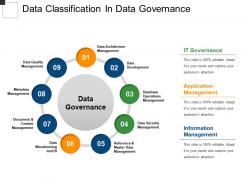
Data classification in data governance powerpoint themes
Try Before you Buy Download Free Sample Product
Audience
Editable
of Time
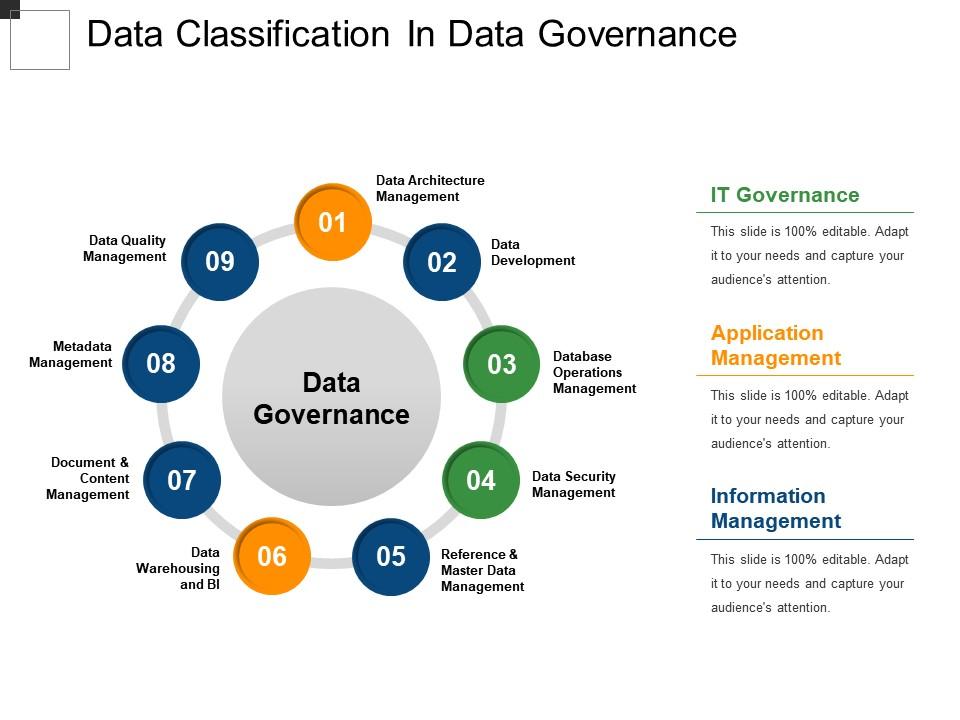
Use this Data Classification In Data Governance PowerPoint Themes template to explain why data classification is essential and what are its benefits. The data classification presentation template is perfect to describe the types of data. A user can use the data classification PPT slide to highlight the roles and responsibilities of individuals associated with the data classification effort. The data classification procedure presentation template is perfect for a user who wants to explain step by step data classification procedure to viewers. Apart from that, user can also give the detail that who is going to perform each step, how data get assessed for sensitivity, what should be done when data does not fit an established category and many more. The data classification PPT template is ready to use and is professionally designed by our designers. Use it to create an effective yet easy to understand high-quality PowerPoint presentation in less time.
People who downloaded this PowerPoint presentation also viewed the following :
Data classification in data governance powerpoint themes with all 5 slides:
Gain good ground with your effort due to our Data Classification In Data Governance Powerpoint Themes. It helps you get ahead in the battle.
FAQs for Data classification in data
**INPUT**: What are the main types of data classification, and how do they differ in their applications? **OUTPUT**: Data classification types include supervised learning, unsupervised learning, semi-supervised learning, and reinforcement learning, each serving distinct analytical purposes. Supervised methods excel in fraud detection for banks and medical diagnosis in hospitals, while unsupervised approaches streamline customer segmentation in retail and pattern recognition in manufacturing, ultimately delivering targeted insights and competitive advantage. [Word count: 54 words]
Businesses can implement data classification frameworks by establishing clear data categories, defining sensitivity levels, creating automated tagging systems, training employees on protocols, and integrating classification rules into existing security infrastructure. This strategic approach enables organizations to prioritize protection resources, streamline compliance efforts, and reduce breach risks, with many financial services and healthcare institutions finding that structured classification ultimately delivers faster incident response and significantly lower regulatory penalties.
Machine learning automates data classification by analyzing patterns, learning from historical datasets, and continuously improving accuracy through algorithms that adapt to new information types. These AI-driven systems streamline classification workflows by reducing manual intervention, accelerating processing speeds, and enhancing consistency, with many organizations finding that automated classification delivers significant operational efficiency and enables better resource allocation.
Organizations determine data sensitivity levels by conducting comprehensive data discovery audits, implementing automated classification tools, and establishing clear categorization frameworks based on regulatory requirements, business impact, and access controls. Through systematic assessment processes, companies evaluate confidentiality needs, compliance obligations, and potential risks, ultimately creating tiered sensitivity models that enable strategic data governance and enhanced security protocols across their operations.
**INPUT**: What best practices should be followed for data labeling during classification? **OUTPUT**: Data labeling best practices include establishing clear labeling guidelines, ensuring annotator training and consistency, implementing quality control measures, maintaining balanced datasets, and creating comprehensive documentation. These approaches streamline classification accuracy by reducing human error, standardizing processes, and enabling scalable model training, with many organizations finding that consistent labeling protocols ultimately deliver more reliable AI outcomes and improved operational efficiency.
GDPR and CCPA significantly reshape data classification strategies by requiring organizations to identify, categorize, and protect personal data with enhanced precision, automated tracking, and clear consent mechanisms. These regulations drive companies toward more granular classification systems that distinguish between sensitive personal information, processing purposes, and retention periods, ultimately delivering improved data governance, reduced compliance risks, and stronger customer trust through transparent data handling practices.
Common data classification challenges include inconsistent data quality, scalability limitations, regulatory compliance complexities, manual labeling inefficiencies, and integration difficulties across systems. Organizations overcome these through automated classification tools, standardized governance frameworks, machine learning algorithms for pattern recognition, and comprehensive staff training programs, ultimately delivering improved data security, streamlined compliance processes, and enhanced operational efficiency across their information management infrastructure.
Data classification significantly influences data governance policies by establishing clear handling protocols, access controls, and compliance requirements for different data types. Organizations use these classifications to develop targeted policies for sensitive financial records, personal customer information, and proprietary business data, ultimately enabling streamlined regulatory compliance, enhanced security measures, and strategic resource allocation across their data management infrastructure.
**INPUT**: What tools and software are available for effective data classification? **OUTPUT**: Data classification tools include Microsoft Purview, AWS Macie, Varonis Data Security Platform, Symantec Data Loss Prevention, and IBM Security Guardium. These technologies streamline governance by automating discovery, applying consistent labeling policies, and enabling real-time monitoring, with many organizations finding that strategic classification ultimately delivers enhanced compliance, reduced security risks, and improved operational efficiency. [Word count: 55 words]
Data classification enhances analytics by organizing information into structured categories, improving data quality, enabling faster query processing, and ensuring relevant datasets are easily accessible. Through systematic categorization, organizations can streamline analysis workflows, reduce processing time, and generate more accurate insights, with many financial services and retail companies finding that classified data delivers significantly improved predictive modeling and strategic decision-making capabilities.
Misclassifying sensitive data can result in regulatory violations, security breaches, inadequate protection controls, and significant financial penalties. Organizations face compliance risks with GDPR, HIPAA, or PCI-DSS requirements, while operational challenges include data exposure, inefficient resource allocation, and compromised customer trust, ultimately undermining competitive advantage and business continuity.
Industries prioritize data classification based on their unique regulatory environments, risk profiles, and operational requirements, with healthcare focusing on patient privacy, financial services emphasizing fraud prevention, and retail prioritizing customer data protection. Manufacturing companies increasingly classify operational data for supply chain optimization, while government agencies concentrate on national security classifications, ultimately enabling each sector to streamline compliance and enhance their competitive positioning.
Cloud computing transforms data classification strategies by enabling automated categorization at scale, real-time policy enforcement, and centralized governance across distributed environments. Through cloud-native classification tools, organizations streamline compliance workflows, enhance data discovery capabilities, and implement consistent security controls, while reducing infrastructure costs and accelerating classification processes, ultimately delivering improved data governance and regulatory compliance.
Effective data classification training programs should include role-based workshops, hands-on classification exercises, regular security awareness sessions, incident response simulations, and ongoing compliance updates. These comprehensive programs enhance staff understanding by demonstrating real-world scenarios across departments like finance, HR, and customer service, while establishing clear protocols for handling sensitive information, ultimately reducing data breaches and ensuring regulatory compliance organization-wide.
Data classification improves incident response by enabling rapid threat prioritization, automated security protocols, and targeted resource allocation based on data sensitivity levels. Through classification frameworks, cybersecurity teams can immediately identify which breaches require urgent attention, streamline containment procedures, and minimize response time, with many organizations finding that classified data systems reduce incident resolution time by 40-60%.
-
Designs have enough space to add content.
-
Excellent work done on template design and graphics.