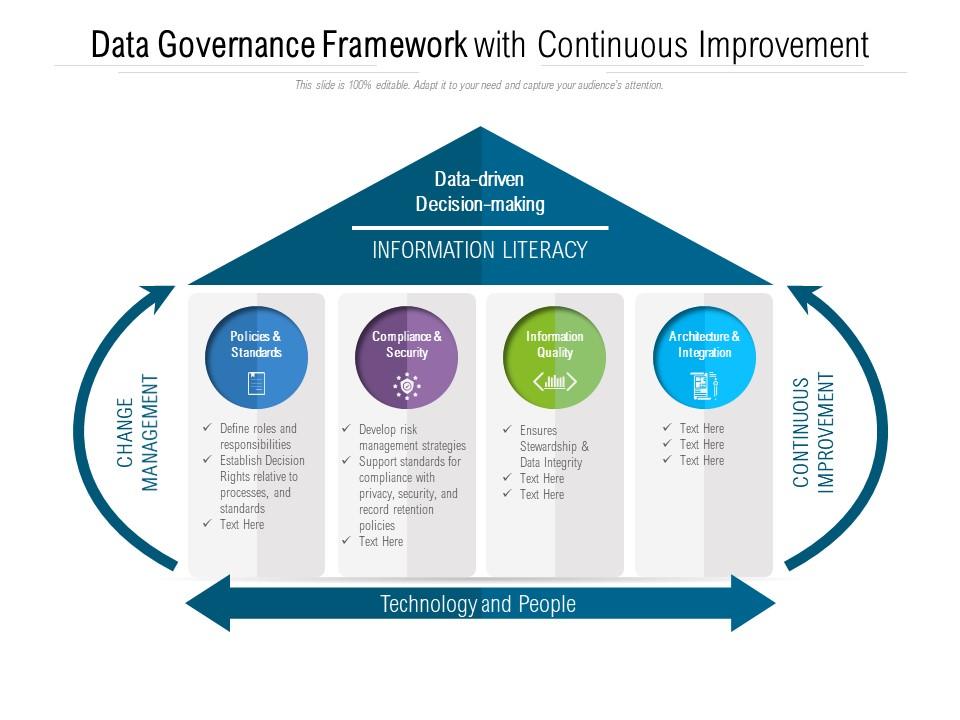
Cadre de gouvernance des données avec amélioration continue

Slide 1 of 2
Favourites Favourites

Try Before you Buy Download Free Sample Product

Audience Impress Your
Audience
Editable 100%
Editable
Time Save Hours
of Time
The Biggest Sale is ending soon in
0
0
:
0
0
:
0
0

Caractéristiques de ces diapositives de présentation PowerPoint :

Présentation de cet ensemble de diapositives avec le nom Cadre de gouvernance des données avec amélioration continue. Il s'agit d'un processus en quatre étapes. Les étapes de ce processus sont les politiques et les normes, la qualité de l'information, l'architecture et l'intégration. Il s'agit d'une présentation PowerPoint entièrement modifiable et disponible en téléchargement immédiat. Téléchargez maintenant et impressionnez votre public.

FAQs for Data governance framework

OK so basically it comes down to four things: accountability, quality, security, and making sure people can actually find the data they need. First thing - figure out who owns what data. Not just "oh the data team handles it" but actual specific people responsible for specific stuff. Then set up some basic quality checks so you're not basing decisions on complete trash data. Security's obviously huge now with all these privacy laws everywhere. But honestly? None of this matters if your data's buried somewhere nobody can access it. I'd start with mapping ownership and basic quality stuff - that'll probably fix most of your problems right there.

Check five main areas: your policies, data quality processes, who's responsible for what, tech setup, and how you monitor compliance. Most companies totally overestimate where they stand - it's wild how disconnected leadership can be from reality. Do you actually have documented data ownership? Regular quality checks that people follow? Survey folks across departments to get the real story, not just what management thinks. DAMA-DMBOK is solid if you want a formal framework, but honestly a simple self-assessment works too. Be ruthless about identifying gaps instead of just going through the motions. Then tackle your biggest headaches first.

Data stewards are your governance framework's boots-on-the-ground people. They handle the day-to-day stuff - monitoring data quality, managing access controls, dealing with compliance headaches. Basically they're the bridge between your fancy high-level policies and reality. Because honestly? Policies mean nothing if nobody's actually following them. These folks resolve data quality problems, process access requests, keep you compliant with regulations. I've seen too many companies skip this step and wonder why their governance "strategy" isn't working. You need stewards across your key data domains, and you've got to actually give them some authority to do their jobs properly.

So data governance is basically your safety net for compliance stuff. You set up clear rules for collecting, storing, and using data. Track where everything comes from. Keep quality high and control who can access what. Honestly, auditors eat this stuff up - they love seeing organized processes. GDPR fines are brutal (like, company-killing brutal), so catching problems early saves your butt. The whole point is having everything documented with clear ownership. That way when compliance questions pop up, you're not panicking trying to figure out where your data lives or who's supposed to handle it.

Focus on data cataloging first - Collibra or Alation are solid for discovery and lineage tracking. Get automated classification tools so you're not manually hunting through everything (trust me, that gets old fast). Workflow platforms handle approval processes pretty well. Honestly, data quality monitoring saves you from most governance headaches down the road. Don't get distracted by flashy features though - integration with your current stack matters way more. Oh, and classification tools that actually work are worth their weight in gold. Start with cataloging since everything else builds off that foundation anyway.

Honestly, most companies track data governance through stuff like data quality scores and compliance rates - basically how clean your data is and whether you're following the rules. Speed matters too - how fast can people actually get to reliable data when they need it? I'd start with baseline measurements before rolling anything out, then check progress every quarter or so. Don't go crazy with metrics though. Pick maybe 3-5 that actually matter to your business instead of trying to measure every little thing. User satisfaction is huge too - if people hate your data systems, you're probably doing something wrong. Focus on what actually impacts decisions, not just pretty dashboard numbers.

Honestly, the politics are the worst part - way more draining than any tech issues. People get so territorial about their data, and every department thinks they're special. You'll sit through endless meetings arguing over access and ownership. Executive buy-in is tough too since ROI feels pretty abstract at first. The technical stuff with legacy systems? Yeah, it's annoying but manageable. My take - pick one quick win that'll actually move the needle, nail that first, then build from there. Way better than trying to boil the ocean from day one.

So data governance is basically setting up rules and processes to keep your data from turning into a hot mess. You assign actual owners to your datasets (not just whoever's stuck with it). Clean validation rules catch problems before they spiral. Different teams stop using random definitions for the same stuff. Honestly, half the battle is just having someone who gives a damn about data quality - we've all worked with people who treat spreadsheets like dumping grounds. Regular check-ups help you spot issues early. Start small though - pick your most important data first and get owners assigned. That'll make a huge difference right away.

Data governance is like your privacy safety net - sets up who can touch what data and for how long. Without it, you're basically guessing on GDPR and CCPA stuff. Good governance means you've got clear owners for different data sets, proper deletion controls, and audit trails for when regulators show up (and trust me, they will). The trick is mapping out how your data actually flows first. I know it sounds boring, but that's honestly where real privacy protection starts. You'll want those policies locked down before you need them.

First things first - get the executives on board or you're dead in the water. Figure out who owns what data and set quality standards that actually work for YOUR company, not some textbook example. Don't write policies that sound impressive but nobody follows. I'd map your most critical data flows and focus there instead of trying to boil the ocean. Honestly, pilot programs are your friend here - pick one area, nail it, then expand. You can always add more governance later, but if you try to do everything at once you'll just overwhelm everyone and nothing will stick.

Honestly, your data governance probably needs a complete overhaul for AI stuff. Those quarterly check-ins? Useless when your models are learning 24/7. I've seen companies still treating ML like it's Excel spreadsheets from 2005 - total nightmare. You need real-time monitoring and automated bias checks running constantly. The "set and forget" approach will bite you hard. Start automating whatever you can, but keep humans in the loop for the tricky decisions. Build something that actually grows with your models instead of against them.

Dude, bad data governance is like navigating with a busted GPS - you're constantly getting lost. Different departments give you conflicting numbers, so nobody knows what's actually true. Your team wastes hours arguing over which report is right instead of fixing real problems. Meanwhile, competitors are making smarter moves faster because their data actually works. Honestly, it's such a pain. Start small though - pick your most important data sources and figure out who owns them. Set some basic quality rules for those first, then expand from there.

You need different departments talking to each other - that's where the magic happens with data governance. Marketing sees customer stuff, IT knows the tech side, finance handles compliance. Without everyone together, you're basically flying blind. I've seen teams think their data is perfect while another department is pulling their hair out trying to use it. Get regular check-ins going between teams. They'll catch quality issues way faster and actually create policies that don't suck in real life. It sounds obvious but most places totally skip this step.

Dude, culture is literally everything when it comes to data governance. Without buy-in from people, your fancy policies are just expensive paperwork. I've watched so many programs crash because leadership preached about data quality but then ignored their own rules. Pretty frustrating honestly. You need folks to actually care about following data standards, not just going through the motions. Get your leadership team to visibly champion good practices first. Celebrate the wins when teams clean up their data. Otherwise people will treat it like annoying busywork instead of something that matters.

Oh totally - market changes mess with your data governance constantly. New regulations like GDPR hit and suddenly you're scrambling to update policies. AI adoption changes everything too, plus cloud migrations mean rethinking how you classify and protect stuff. The tricky part? Your governance can't be so rigid that it kills innovation. I learned this the hard way at my last job - we were so focused on compliance we basically strangled any cool projects. Build in flexibility from the start so when trends shift (and they always do), you can actually adapt quickly.

Ratings and Reviews

0% of 100
Review Form
Write a review
Most Relevant Reviews

No Reviews